


He might have become an Internet meme linked to the alt-right in the West, but Pepe the Frog’s image has been adopted in Hong Kong, where democracy protesters have embraced it as an irreverent symbol of their resistance.
Throughout the more than 100 days of protests in the international finance hub, banners featuring the cartoon frog and stuffed toys of the amphibian have become ubiquitous, providing moments of levity as the violence escalates.
Pepe fervor reached new heights on Monday, when hundreds of demonstrators — many festooned with stickers or holding cuddly toys — formed a human chain along the territory’s harborfront, chanting slogans and singing protest songs.
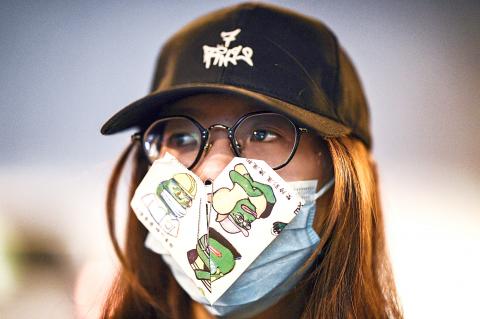
Photo: AFP
Some of the Pepe toys brought by the largely young participants were decked in the yellow hard hats and gas masks worn by protesters in their clashes with police.
“In the United States it’s a hate symbol, but now it is reborn in Hong Kong as a symbol of love and freedom,” a 21-year-old animation student, who gave her name as Phoenix, told reporters. “Even in a really tough situation, we still want to feel hope and be happy. If we can maintain our minds in a positive way, then maybe we can keep protesting and find a way to win.”
Pepe’s embrace by Hong Kongers is the latest bizarre twist in the fate of a cartoon character who went from relative Internet obscurity to international notoriety.
It also shows how digital trends can mean different things depending on where you live in the world.
Created in 2005 by US artist Matt Furie as a “chill frog-dude,” Pepe became an Internet meme within online forums.
He was embraced by alt-right and white nationalist corners of the Internet, leading Furie to pronounce his original creation dead in 2017.
However, in Hong Kong and China, Pepe never had those connotations and was instead known as the “sad frog.”
The character became especially popular earlier this year when he appeared within downloadable WhatsApp sticker packs that people add to messages.
When the pro-democracy rallies began in June, young Hong Kongers were already pinging Pepe stickers to each other.
However, new protest-themed variations of Pepe emerged, transforming him into a pro-democracy everyman.
Soon Pepe was being graffitied onto pavements, plastered across protest “Lennon Walls” and even painted on fingernails.
“The creator of Pepe said he was dead, but now he’s alive again here,” said a 26-year-old graphic designer surnamed Leung, who attended Monday’s protest with friends.

‘CROSSING THE LINE’: China’s embassy in Seoul criticized US Forces Korea Commander General Xavier Brunson, asking if his ‘hostile’ remarks were authorized by Washington South Korea and the US are in talks over recent public remarks by the commander of US Forces Korea, Seoul’s presidential office said yesterday, after the comments drew sharp criticism from China. In a recent podcast interview, US Forces Korea Commander General Xavier Brunson described South Korea as “the dagger in the heart of Asia” from China’s east coast, prompting the Chinese embassy in Seoul to say that he had “truly crossed the line.” The interview came amid growing speculation that Washington might seek to expand the role of US Forces Korea in countering the growing regional influence of China, a key
SEEKING ORDER: Rodrigo Paz said that ‘anyone who wants to destroy the nation will have to deal with this president and the full force of the constitution’ Bolivian President Rodrigo Paz on Wednesday said that the nation was at a “breaking point” after nearly a month of protests that have caused shortages of food, fuel and medicine. Paz, who took office six months ago amid the worst economic crisis there in four decades, is battling a groundswell of fury over his policies. The political capital, La Paz, has been besieged by low-income workers and members of the indigenous majority calling for his resignation. “The country needs order and is reaching breaking point,” the 58-year-old said at a public event in La Paz, renewing his appeal for dialogue. On Tuesday, the Bolivian

Australian researchers have trained lab-grown brain cells on a silicon computer chip to play the 1990s shooter game Doom and said they are just scratching the surface of what the neurons could be capable of doing. It is the science-fiction work of biotech boffins at Cortical Labs, who researched and developed the technology that harnesses the workings of the brain’s networking system. Each so-called “biological computer” contains about 200,000 living human brain cells, grown from stem cells that were harvested from blood donations. Having mastered the simple computer game Pong, where a paddle is moved up and down to send a ball

Through the noise of rushing papers and whirring belts at a print factory in Kyoto, two creators watch their photo essay come to life in broadsheet form — part of an effort to win new audiences in the age of artificial intelligence (AI). Despite the decline of the publishing industry, self-publication and handmade “zine” magazines are growing in popularity in Japan, reflecting the nation’s enduring love of paper in the digital era. While speaking to Agence France-Presse at the plant, his hands black with ink, one of the creators, Kazuma Obara, said: “I think [paper] is a medium that engages all five


 RSS
RSS