


As evening fell over their Amazon home, the hunter-gatherers of the Uru-eu-wau-wau people extracted bamboo arrows from the flank of a wild pig and began roasting it.
A few kilometers — and a world — away on the opposite side of the rainforest’s delicate existential divide, cowboys on horseback rounded up cattle at the outer reaches of a vast ranch.
“We have no problem with them,” said Awapy Uru-eu-wau-wau, the young chief of the 19-people forest community in central Rondonia State.
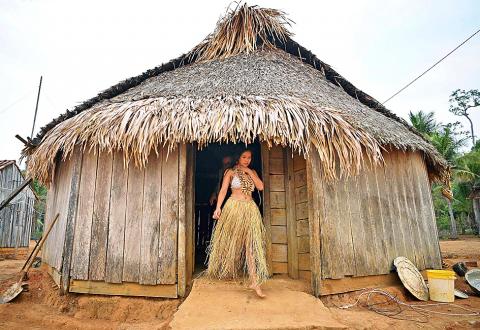
Photo: AFP
It is an uncommon expression of goodwill in an area where the worlds of rich landowners and indigenous tribes collide and jostle over the future of the planet’s largest rainforest.
The tribe’s resource-rich 1.8 million hectare native reserve — an area nearly twice the size of Lebanon — is under constant siege from landlords, timber traders, landowners and miners who rely on deforestation to exploit its bounty.
“I’ve been facing this invasion since I was 19 or 20, and these guys are threatening us, because we’re standing up to them,” said Awapy, 38. “I’m not afraid of risking my life. It’s the only way.”
The few hundred inhabitants of the reserve, divided into seven hamlets, have a long history of resistance.
To help surveil the forest and protect themselves, the self-styled guardians of nature mostly live along the boundaries of their territory, demarcated in the early 1990s.
Awapy’s village comprises half a dozen small dwellings, some of wood with a straw roof, others of cement with roofs of tile.
The five families there live almost entirely off the jungle, where they venture daily to hunt and when necessary, to see off invaders — often organized groups — in confrontations that often turn violent, he said.
In this area south of the town of Porto Velho, fresh clearings and grasslands are evident from the air, signs of ever-advancing deforestation often heralded by the wildfires which have reverberated on a global scale in the past few weeks.
The state’s absence from the ground has made areas like this a breeding ground for gangs and encourages occupation of land, which often ends up being integrated into cattle farms, non-governmental organizations have said.
Prosecutors have filed complaints against rural producers for having occupied, parcelled and sold land on the reserve and in other places.
The Uru-eu-wau-wau have argued that the invaders feel protected since the arrival in power in January of Brazilian President Jair Bolsonaro, who has supported the opening up of protected lands to agriculture and mining activities.
He said at his inauguration that indigenous people needed to be integrated into society and not live in reserves “as if they were animals in a zoo.”
“It wasn’t like that in the past, but today, they are deforesting everything,” said Awapy, in his oca, or room used for family gatherings, surrounded by villagers lying in hammocks.
An hour-and-a-half away along a forest road, in the small town of Monte Negro, the agribusiness sector showed its muscle at a rodeo, where about 20 cowboys displayed their talent by riding bulls for as many seconds as they can.
Dressed in Stetson hats, blue jeans and cowboy boots, they work at some of the area’s vast cattle ranches that have cut into the forest over decades.
The spectators enjoyed the show and laughed loudly at an interlude sketch in which a clown chased a deer — a veado in Portuguese, which is also a disparaging term for homosexuals.
This is rural, conservative Brazil, a fiefdom of Bolsonarism, whose inhabitants belong to the “BBB” demographic. The “Beef, Bible and Bullet” set is the triumverate of powerful interests that helped sweep Boslonaro to power — the agribusiness sector, Evangelical churches and the pro-gun lobby in Brazilian Congress.
The landowners, arrogant and circumspect to outsiders, are accused by environmental advocates of being partly responsible for spreading ruin in the Amazon, profiteering to the detriment of public lands and indigenous reserves.
They have maintained that they respect the boundaries of their lands, claim their right to develop it and recall the importance of agricultural expansion for the Brazilian economy.
“People have to respect the fact that what is reserve is reserve, what is indigenous is indigenous,” said Marconi Silvestre, owner of a farm in Monte Negro and organizer of the rodeo.
Another owner who came to the show to sell breeding bulls said privately that the indigenous people themselves deforest and sell wood and land.
“They are doing the same thing that Pedro Alvares Cabral did when he arrived,” he said, referring to the Portuguese explorer who in 1500 landed on the coast of what would later become Brazil. “They are exchanging wealth for mirrors.”
Several landowners claimed the media exaggerated the reach of the wildfires and mocked French President Emmanuel Macron, who last month called for “internationalizing” protection of the Amazon rainforest.
“The Amazon is ours. Tell that to Macron,” one of the landowners said.
ROCKY RELATIONS: The figures on residents come as Chinese tourist numbers drop following Beijing’s warnings to avoid traveling to Japan The number of Chinese residents in Japan has continued to rise, even as ties between the two countries have become increasingly fractious, data released on Friday showed. As of the end of December last year, the number of Chinese residents had increased by 6.5 percent from the previous year to 930,428. Chinese people accounted for 22.6 percent of all foreign residents in Japan, making them by far the largest group, Japanese Ministry of Justice data showed. Beijing has criticized Tokyo in increasingly strident terms since Japanese Prime Minister Sanae Takaichi last year suggested that a military conflict around Taiwan could

A pro-Iran hacking group claimed to breach FBI Director Kash Patel’s personal e-mail inbox and posted some of the contents online. The e-mails provided by the hacking group include travel details, correspondence with leasing agents in Washington and global entry, and loyalty account numbers. The e-mail address the hackers claim to have compromised has been previously tied to Patel’s personal details, and the leaked e-mails contain photos of Patel and others, in addition to correspondence with family members and colleagues. “The FBI is aware of malicious actors targeting Director Patel’s personal email information,” the agency said in a statement on
RIVALRY: ‘We know that these are merely symbolic investigations initiated by China, which is in fact the world’s most profligate disrupter of supply chains,’ a US official said China has started a pair of investigations into US trade practices, retaliating against similar probes by US President Donald Trump’s administration as the superpowers stake out positions before an expected presidential summit in May. The move, announced by the Chinese Ministry of Commerce on Friday, is a direct mirror of steps Trump took to revive his tariff agenda after the US Supreme Court last month struck down some of his duties. “China expresses its strong dissatisfaction and firm opposition to these actions,” a ministry spokesperson said in a statement, referring to the so-called Section 301 investigations initiated on March 11.

When a hiker fell from a 55m waterfall in wild New Zealand bush, rescuers were forced to evacuate the badly hurt woman without her dog, which could not be found. After strangers raised thousands of dollars for a search, border collie Molly was flown to safety by a helicopter pilot who was determined to reunite the pet and the owner. A week earlier, an emergency rescue helicopter found the woman with bruises and lacerations after a fall at a rocky spot at the waterfall on the South Island’s West Coast. She was airlifted on March 24, but they were forced to


 RSS
RSS