


Women supporting the anti-government protests in Hong Kong say they are being harassed online, including with rape threats, body-shaming and doctored photograph, by suspected pro-Beijing commenters.
Hundreds of thousands of demonstrators have taken to the city’s streets week after week in the biggest challenge to China’s rule of the semi-autonomous territory for decades.
However, female protesters posting support for the pro-democracy movement said they have experienced a slew of sexist online attacks in response.
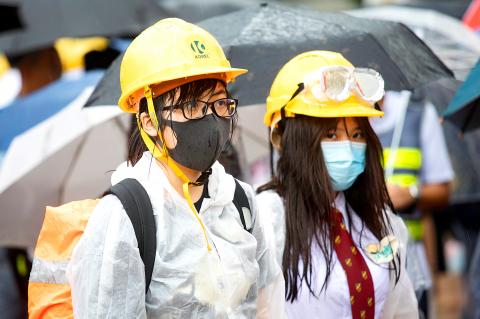
Photo: Bloomberg
“They are not attacking my views or anything, they just attack me because I am female,” Hong Kong student Mickey Leung Ho Wun said.
The 17-year-old discovered a doctored picture of her at a pro-democracy rally was being spread on Facebook via a page supporting the city’s police.
In the original, Wun is standing next to a banner reading: “I am a secondary school student,” but in the altered version, the sign reads: “I am not wearing any underwear.”
“These are Hong Kong people who are pro-Beijing,” Wun said of the people sharing the doctored image.
Celebrity Hong Kong singer turned activist Denise Ho (何韻詩) said on Facebook that the aim of online attacks against her was to “ignore her will, ignore her vision, focus on her exterior and dress, and then demonize.”
These women said they suspected pro-Beijing trolls were behind the abuse, as the majority of messages were in simplified Chinese, which is predominantly used in mainland China.
The abuse has intensified since Beijing ramped up its rhetoric over the protests, they said.
On Wednesday evening last week, thousands rallied against alleged police sexual violence, holding aloft purple lights in solidarity with abuse victims.
Attendees shared the #ProtestToo hashtag, a play on 2017’s global #MeToo movement that exposed sexual assault and harassment in high-profile industries.
However, women at the protest told reporters that they had stopped posting online as the rhetoric against the protesters increased.
Online harassment was “a weapon to harm women,” a spokesperson for Hong Kong’s Association Concerning Sexual Violence Against Women said, adding that it was linked to outdated social norms and cultural values.
Social media has been a key battleground for both sides during the protests.
Last month, tech giants Twitter and Facebook said that they had suspended nearly 1,000 active accounts emanating from China aimed at undercutting the legitimacy of the Hong Kong protest movement.
Twitter said it had shut down a further 200,000 accounts before they could inflict any damage.
Laurel Chor (左力豐), 29, said that as a female reporter covering the protests in Hong Kong, she had received a “constant barrage” of abuse in her comments and Instagram DMs.
“They were using words like whore or prostitute and bitch,” she said.
A Twitter post that called on people to shun a list of female Asian journalists — including Chor — was indicative of how “women do get disproportionately targeted and it is not only gendered, but also racial,” she said.
Similarly, journalist Vicky Xu (許秀中), who was born in mainland China, but is writing about the protests from Australia, said that her Twitter account was swamped by negative comments, including rape threats.
“The insults that were towards me they were a really weird combination of nasty nationalism, sexism and racism,” she said. “I felt physically sick.”
It is not only pro-democracy demonstrators who have been subjected to such treatment. Photographs of Hong Kong Chief Executive Carrie Lam (林鄭月娥) have been superimposed onto scantily-clad models’ bodies and pasted on walls in the city.
Meanwhile, the wives of some serving police officers were identified by Telegram users who created a poll on the encrypted messaging service to vote on which wife they would rather “sleep with,” a senior police source said.
A Twitter spokesperson told reporters that “abuse, harassment and hateful conduct have no place on our service.”
Neither Instagram nor Facebook immediately responded to requests to comment, but Instagram confirmed that it was investigating the issue.
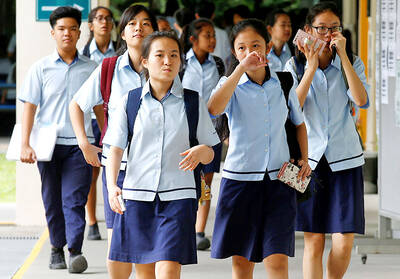
School bullies in Singapore are to face caning under new guidelines, but the education minister on Tuesday said it would be meted out only as a last resort with strict safeguards. Human rights groups regularly criticize Singapore for the use of corporal punishment, which remains part of the school and criminal justice systems, but authorities have defended it as a deterrent to crime and serious misconduct. Caning was discussed in the parliament after legislators asked how it would be used in relation to bullying in schools. The debate followed stricter guidelines on serious student misconduct, including bullying, unveiled by the Singaporean Ministry of
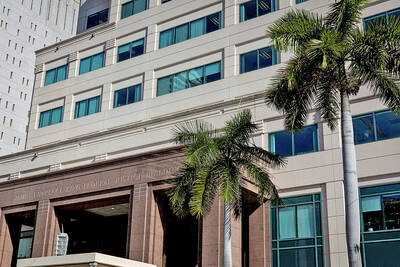
‘GROSS NEGLIGENCE?’ Despite a spleen typically being significantly smaller than a liver, the surgeon said he believed Bryan’s spleen was ‘double the size of what is normal’ A Florida surgeon who is facing criminal charges after allegedly removing a patient’s liver instead of his spleen has said he is “forever traumatized” by that person’s death. In a deposition from November last year that was recently obtained by NBC, 44-year-old Thomas Shaknovsky described the death of 70-year-old William Bryan as an “incredibly unfortunate event that I regret deeply.” Bryan died after the botched surgery; and last month, a grand jury in Tallahassee indicted Shaknovsky on a charge of manslaughter. “I’m forever traumatized by it and hurt by it,” Shaknovsky added, also saying that wrong-site surgeries can happen “during

A MESSAGE: Japan’s participation in the Balikatan drills is a clear deterrence signal to China not to attack Taiwan while the US is busy in the Middle East, an analyst said The Japan Self-Defense Forces yesterday fired a Type 88 anti-ship missile during a joint maritime exercise with US, Australian and Philippine forces, hitting a decommissioned Philippine Navy ship in waters facing the disputed South China Sea, in drills that underscore Tokyo’s rising willingness to project military power on China’s doorstep. The drill took place as Manila and Tokyo began talks on a potential defense equipment transfer, made possible by Japan’s decision to scrap restrictions on military exports. The discussions include the possible early transfer of Abukuma-class destroyers and TC-90 aircraft to the Philippines, Japanese Minister of Defense Shinjiro Koizumi said. Philippine Secretary of

A South Korean judge who last week more than doubled former South Korean first lady Kim Keon-hee’s prison sentence was found dead yesterday, police said. Shin Jong-o was found unconscious at about 1am at the Seoul High Court building, an investigator at the Seocho District Police Station in Seoul said. Shin was taken to a hospital and pronounced dead, he said. “There is no sign of foul play in the death,” the investigator added. Local media reported that Shin had left a suicide note, but the investigator said there was none. On Tuesday last week, Shin presided over 53-year-old Kim’s appeal trial, finding her guilty


 RSS
RSS