


Trees are one of the best things we have to clean the Earth’s air, but they have certain drawbacks: They need time and space to grow.
Enter the BioUrban, an artificial tree that sucks up as much air pollution as 368 real trees.
Designed by a Mexican start-up, the towering metal structure uses microalgae to clean carbon dioxide and other contaminants from the air, returning pure oxygen to the environment.
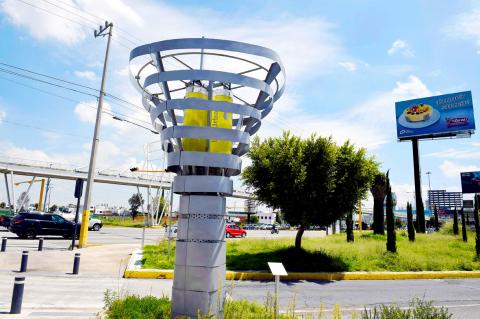
Photo: AFP
Measuring 4.2m tall and nearly 3m wide, the device looks like a cross between a tree and a postmodernist high-rise, with a steel trunk that radiates rising bands of concentric metal.
“What this system does, through technology, is inhale air pollution and use biology to carry out the natural process [of photosynthesis], just like a tree,” said Jaime Ferrer, a founding partner in BiomiTech, the company behind the invention.
Mexicans know a thing or two about air pollution.
Mexico City, a sprawling urban area of more than 20 million people, regularly grinds to a halt under air pollution alerts, triggered by emissions from the capital’s more than 5 million vehicles, its polluting industries and even the nearby Popocatepetl volcano.
Ferrer said that the company’s goal is to help such cities achieve cleaner air in targeted areas — those used by pedestrians, cyclists or older people, for example — when planting large numbers of trees is not an option.
Worldwide, about 7 million people die from exposure to air pollution each year, the WHO has said.
“We decided our job was to not just stand by and let people keep dying,” Ferrer said.
Launched in 2016, BiomiTech has so far “planted” three trees: one in the city of Puebla in central Mexico, where it is headquartered; one in Colombia; and one in Panama.
It has a contract for two more in Turkey and projects in the works to install them in Mexico City and Monterrey in northern Mexico.
A BioUrban typically costs about US$50,000, although the final price varies depending on the site.
Each tree weighs about 1 tonne and cleans as much air as 1 hectare of forest — the equivalent of what 2,890 people breathe in a day.
Ferrer said that the idea of the BioUrban is not to replace real trees, but complement them in areas where planting a forest would not be viable.
“They can be used in high-traffic areas, transportation terminals, where you can’t just plant a hectare of trees,” he said. “The system isn’t going to end air pollution in Mexico City, but it can alleviate the problem in high-traffic areas.”
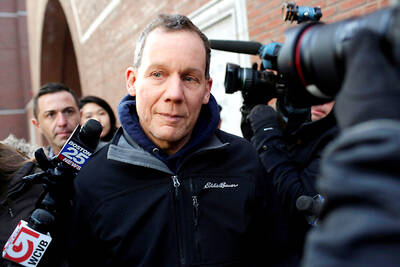
An American scientist convicted of lying to US authorities about payments from China while he was at Harvard University has rebuilt his research lab in Shenzhen, China, to pursue technology the Chinese government has identified as a national priority: embedding electronics into the human brain. Charles Lieber, 67, is among the world’s leading researchers in brain-computer interfaces. The technology has shown promise in treating conditions such as amyotrophic lateral sclerosis and restoring movement in paralyzed people. It also has potential military applications: Scientists at the Chinese People’s Liberation Army have investigated brain interfaces as a way to engineer super soldiers by boosting
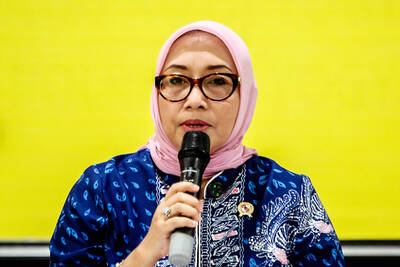
Indonesian police have arrested 13 people after shocking images of alleged abuse against small children at a daycare center went viral, sparking outrage across the nation, officials said on Monday. Police on Friday last week raided Little Aresha, a daycare center in Yogyakarta on Java island, following a report from a former employee. CCTV footage circulating on social media showed children, most younger than two, lying on the floor wearing only diapers, their hands and feet bound with rags. The police have confirmed that the footage is authentic. Police said they also found 20 children crammed into a room just 3m by 3m. “So
A grieving mother has ended her life at a clinic in Switzerland four years after the death of her only child. Wendy Duffy, 56, a physically healthy woman, died at the Pegasos clinic in Basel after struggling to cope with the death of her 23-year-old son, Marcus. The former care worker, from the West Midlands, England, had previously attempted to take her own life. The case comes as assisted dying would not become law in England and Wales after proposed legislation, branded “hopelessly flawed” by opponents, ran out of time. Ruedi Habegger, the founder of Pegasos, described Duffy’s death as
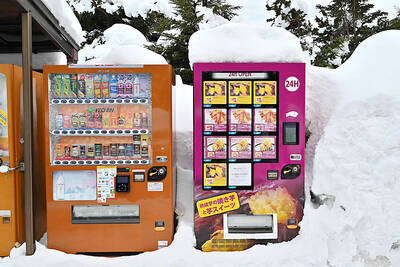
From post offices and parks to stations and even the summit of Mount Fuji, Japan’s vending machines are ubiquitous, but with the rapid pace of inflation cooling demand for their drinks, operators are being forced to rethink the business. Last month beverage giant DyDo Group Holdings announced it would remove about 20,000 vending machines — about 7 percent of their stock nationwide — by January next year, to “reconstruct a profitable network.” Pokka Sapporo Food & Beverage, based in Nagoya, also said last month it would sell its 40,000-machine operation to Osaka-based Lifedrink Co. “The strength of the vending machine


 RSS
RSS