


Thousands are flocking to see a Buddhist temple in central Thailand exposed after drought drove water levels to record lows in a dam reservoir where it had been submerged.
As the reservoir reaches less than 3 percent of capacity, the remains of Wat Nong Bua Yai, a modern temple submerged during construction of the dam 20 years ago, have become visible in the middle of dry ground.
Last week, some Buddhist monks were among the hundreds of people who walked through broken temple structures on cracked earth littered with dead fish to pay respects to a headless 4m-tall Buddha statue, adorning it with flowers.
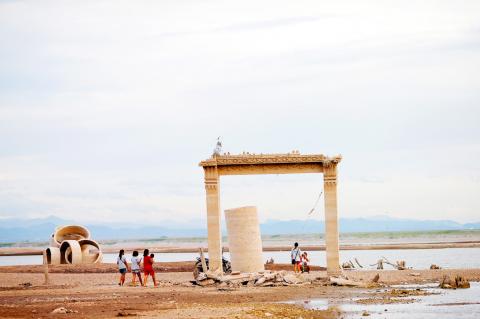
Photo: Reuters
“The temple is normally covered by water. In the rainy season you don’t see anything,” said one of the visitors, Somchai Ornchawiang, a 67-year-old retired teacher.
He regretted the temple flooding, but is now worried about the damage the drought is causing to farmland, he added.
The dam, with capacity of 960 million cubic meters, normally irrigates more than 526,000 hectares of farmland in four provinces, but drought has cut that to just 1,214 hectares in Lopburi only.
The meteorological department says Thailand is facing its worst drought in a decade, with water levels in dams nationwide having fallen far short of the monthly average.
Yotin Lopnikorn, 38, headman of the Nong Bua Village that used to be near the temple, recalls visiting it with friends as a child, before dam construction forced the villagers out.
“When I was young, I always came to meet friends at the elephant sculptures in front of the main building to play there,” Yotin said.
At the time, the temple was the center of the community, used to conduct rituals, festivities and educational activities, besides functioning as a playground and recreational area.
Next to the temple compound are the remains of 700 households of the village.
The ruins have reappeared before, after a drought in 2015.
“This is the second time I have seen this temple in this condition,” Yotin said. “Now I think we need to save this place.”

‘CROSSING THE LINE’: China’s embassy in Seoul criticized US Forces Korea Commander General Xavier Brunson, asking if his ‘hostile’ remarks were authorized by Washington South Korea and the US are in talks over recent public remarks by the commander of US Forces Korea, Seoul’s presidential office said yesterday, after the comments drew sharp criticism from China. In a recent podcast interview, US Forces Korea Commander General Xavier Brunson described South Korea as “the dagger in the heart of Asia” from China’s east coast, prompting the Chinese embassy in Seoul to say that he had “truly crossed the line.” The interview came amid growing speculation that Washington might seek to expand the role of US Forces Korea in countering the growing regional influence of China, a key

Through the noise of rushing papers and whirring belts at a print factory in Kyoto, two creators watch their photo essay come to life in broadsheet form — part of an effort to win new audiences in the age of artificial intelligence (AI). Despite the decline of the publishing industry, self-publication and handmade “zine” magazines are growing in popularity in Japan, reflecting the nation’s enduring love of paper in the digital era. While speaking to Agence France-Presse at the plant, his hands black with ink, one of the creators, Kazuma Obara, said: “I think [paper] is a medium that engages all five

Australian researchers have trained lab-grown brain cells on a silicon computer chip to play the 1990s shooter game Doom and said they are just scratching the surface of what the neurons could be capable of doing. It is the science-fiction work of biotech boffins at Cortical Labs, who researched and developed the technology that harnesses the workings of the brain’s networking system. Each so-called “biological computer” contains about 200,000 living human brain cells, grown from stem cells that were harvested from blood donations. Having mastered the simple computer game Pong, where a paddle is moved up and down to send a ball

A surprising gut feeling may help pigeons find their way home. Animals use various techniques to navigate, including following the stars and remembering key landmarks. Birds, fish and turtles orient themselves using Earth’s magnetic field as a compass, but it is not yet clear how exactly they do this. Pigeons are a well-known group of frequent flyers that can traverse hundreds of kilometers in a single day. For thousands of years, humans have used them to carry news, notes and military messages. Scientists have long tried to untangle how pigeons travel without getting lost. Some think the birds detect magnetic cues using light-sensitive


 RSS
RSS