


One of the few Malaysian female rappers, Bunga said that she at first did not consider a career in music.
“My initial dream was to be a politician or a lawyer,” the 19-year old rapper told reporters before her first performance in Singapore for last weekend’s Pesta Raya arts festival.
Her success has her changing her tune.
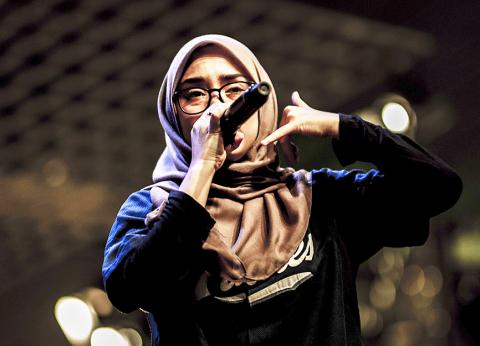
Photo: AP
Bunga, whose real name is Noor Ayu Fatini Mohd Bakhari, is one of the only known rappers who wears a hijab and baju kurung, a traditional Malay dress, at her performances.
Selfies on her Instagram account show her wearing various shades of hijab, but she did not start that way.
From Perak, the fourth-largest state in Malaysia, she became popular after a video of her performing in baju kurung in a local rap competition went viral in November.
“When I reached the venue, I was wearing regular clothes,” Bunga said.
However, even though she was the only female at the event, she did not stand out.
“At the very last minute, I bought myself a baju kurung at the venue itself,” she said.
Bunga raps about her own personal life, her experiences of being bullied, facing love and working at a gadget shop.
She also gives advice to girls through her rap. She steers clear of obscenity and racism.
“[Being a female rapper] doesn’t mean I have to act like boys or talk about gangsters,” Bunga said.
Rapping in traditional garments comes with its own challenges.
“We can’t jump around so much wearing baju kurung,” Bunga said.
Another challenge is facing criticism.
Bunga said she has been criticized for “bringing down the image of women” by rapping in a hijab.
Bunga said she is “living proof” that women can make it in a male-dominated rap.
“I’ve realized that there are more hijabis who want to rap,” Bunga said. “I think that’s a good thing because you shouldn’t worry about what others say.”

When a hiker fell from a 55m waterfall in wild New Zealand bush, rescuers were forced to evacuate the badly hurt woman without her dog, which could not be found. After strangers raised thousands of dollars for a search, border collie Molly was flown to safety by a helicopter pilot who was determined to reunite the pet and the owner. A week earlier, an emergency rescue helicopter found the woman with bruises and lacerations after a fall at a rocky spot at the waterfall on the South Island’s West Coast. She was airlifted on March 24, but they were forced to

CONFIDENCE BOOSTER: ’After parkour ... you dare to do a lot of things that you think only young people can do,’ a 67-year-old parkour enthusiast said In a corner of suburban Singapore, Betty Boon vaults a guardrail, crawls underneath a slide, executes forward shoulder rolls and scales a steep slope, finishing the course to applause. “Good job,” the 69-year-old’s coach cheers. This is “geriatric parkour,” where about 20 retirees learned to tackle a series of relatively demanding exercises, building their agility and enjoying a sense of camaraderie. Boon, an upbeat grandmother, said learning parkour has aided her confidence and independence as she ages. “When you’re weak, you will be dependent on someone,” she said after sweating it out with her parkour classmates in suburban Toa Payoh,

HIGH HOPES: The power source is expected to have a future, as it is not dependent on the weather or light, and could be useful for places with large desalination facilities A Japanese water plant is harnessing the natural process of osmosis to generate renewable energy that could one day become a common power source. The possibility of generating power from osmosis — when water molecules pass from a less salty solution to a more salty one — has long been known. However, actually generating energy from that has proved more complicated, in part due the difficulty of designing the membrane through which the molecules pass. Engineers in Fukuoka, Japan, and their private partners think they might have cracked it, and have opened what is only the world’s second osmotic power plant. It generates

Chinese dissident artist Gao Zhen (高兟), famous for making provocative satirical sculptures of former Chinese leader Mao Zedong (毛澤東), was tried on Monday over accusations of “defaming national heroes and martyrs,” his wife and a rights group said. Gao, 69, who was detained in 2024 during a visit from the US, faces a maximum three-year prison sentence, said his wife, Zhao Yaliang (趙雅良), and Shane Yi, a researcher at the Chinese Human Rights Defenders group which operates outside the nation. The closed-door, one-day trial took place at Sanhe City People’s Court in Hebei Province neighboring the capital, Beijing, and ended without a


 RSS
RSS