


Tory rivals battling to be the next UK prime minister traded insults over Brexit in the first TV debate of the Conservative Party leadership contest, as the front-runner, former British secretary of state for foreign and commonwealth affairs Boris Johnson, was mocked for refusing to take part.
During the 90-minute Channel 4 broadcast on Sunday, the candidates argued over the radical option of suspending parliament as a last resort to deliver a no-deal Brexit.
It is an idea that has split the contenders and risks sparking a wider revolt that could fatally undermine the next leader before he has even taken office.
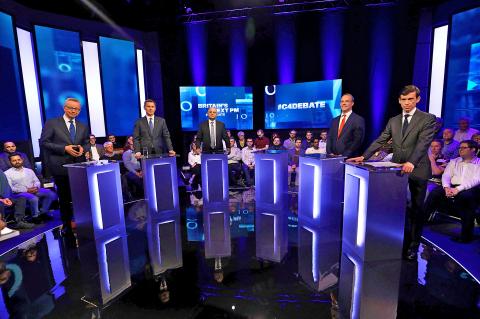
Photo: EPA-EFE
Johnson was unable to give his view, as he declined to join the debate. His absence was marked in the studio with an empty lectern on the stage.
Even so, he continued to pick up support with British Secretary of State for Health and Social Care Matt Hancock, a moderate who withdrew from the leadership contest on Friday, yesterday pitching in behind Johnson in an article in the Times newspaper.
Britain is due to exit the EU by the end of October and the leading candidates to replace British Prime Minister Theresa May are all pledging to renegotiate her Brexit deal.
Johnson and former British secretary of state for exiting the EU Dominic Raab have promised to take the UK out of the bloc on Oct. 31 even if no deal has been struck in time, potentially causing an economic crash that would hit the pound and snarl cross-border trade.
Other contenders argue that lawmakers would never allow a no-deal split — which prompted Raab to threaten to suspend parliament in order to stop the House of Commons delaying Brexit again.
Johnson has not yet ruled out the draconian measure.
During the debate, British Home Secretary Sajid Javid led the attacks on Raab over his suggestion.
“We are not selecting a dictator of our country, we are selecting a prime minister,” Javid said.
Raab and his one-time ally British Environment Secretary Michael Gove then traded blows over the same issue.
Raab insisted the option should not be ruled out, accusing Gove of allowing Brexit to be delayed already and telling him: “You would buckle.”
Gove countered: “You cannot take Britain out of the European Union against the will of parliament.”
It was a passionate exchange, with the two men talking across each other as they tried to get their messages out. The outsider in the race, British International Development Secretary Rory Stewart, accused his colleagues of engaging in a macho showdown.
The issue has also galvanized opposition from pro-Europeans in the Conservative Party. Rebels are threatening to overthrow the next prime minister if he closes parliament as a step to force through a no-deal Brexit.
British Work and Pensions Secretary Amber Rudd said enough of her party colleagues would bring down the government if the leader intended to push through an exit without a deal.
Tory lawmakers are holding a series of secret ballots to whittle down the field of candidates from 10 to two. The final pair will then be put to a postal vote of the party’s 160,000 members and the winner is to be announced late next month.
Johnson dominated the first round of voting on Friday, winning the backing of 114 of his colleagues. The second round of voting will be today.
Any candidate with 32 votes or fewer is eliminated. If all candidates have more than 32 votes, the one with the fewest is eliminated.
Additional reporting by Reuters
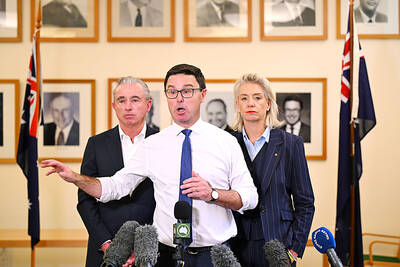
BACKLASH: The National Party quit its decades-long partnership with the Liberal Party after their election loss to center-left Labor, which won a historic third term Australia’s National Party has split from its conservative coalition partner of more than 60 years, the Liberal Party, citing policy differences over renewable energy and after a resounding loss at a national election this month. “Its time to have a break,” Nationals leader David Littleproud told reporters yesterday. The split shows the pressure on Australia’s conservative parties after Prime Minister Anthony Albanese’s center-left Labor party won a historic second term in the May 3 election, powered by a voter backlash against US President Donald Trump’s policies. Under the long-standing partnership in state and federal politics, the Liberal and National coalition had shared power
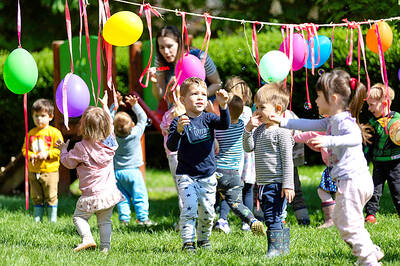
A Croatian town has come up with a novel solution to solve the issue of working parents when there are no public childcare spaces available: pay grandparents to do it. Samobor, near the capital, Zagreb, has become the first in the country to run a “Grandmother-Grandfather Service,” which pays 360 euros (US$400) a month per child. The scheme allows grandparents to top up their pension, but the authorities also hope it will boost family ties and tackle social isolation as the population ages. “The benefits are multiple,” Samobor Mayor Petra Skrobot told reporters. “Pensions are rather low and for parents it is sometimes

CONTROVERSY: During the performance of Israel’s entrant Yuval Raphael’s song ‘New Day Will Rise,’ loud whistles were heard and two people tried to get on stage Austria’s JJ yesterday won the Eurovision Song Contest, with his operatic song Wasted Love triumphing at the world’s biggest live music television event. After votes from national juries around Europe and viewers from across the continent and beyond, JJ gave Austria its first victory since bearded drag performer Conchita Wurst’s 2014 triumph. After the nail-biting drama as the votes were revealed running into yesterday morning, Austria finished with 436 points, ahead of Israel — whose participation drew protests — on 357 and Estonia on 356. “Thank you to you, Europe, for making my dreams come true,” 24-year-old countertenor JJ, whose
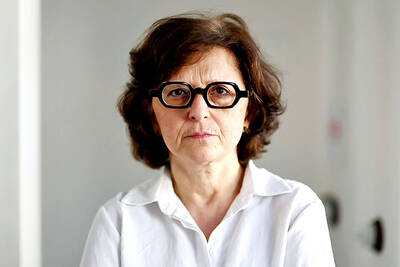
A documentary whose main subject, 25-year-old photojournalist Fatima Hassouna, was killed in an Israeli airstrike in Gaza weeks before it premiered at Cannes stunned viewers into silence at the festival on Thursday. As the cinema lights came back on, filmmaker Sepideh Farsi held up an image of the young Palestinian woman killed with younger siblings on April 16, and encouraged the audience to stand up and clap to pay tribute. “To kill a child, to kill a photographer is unacceptable,” Farsi said. “There are still children to save. It must be done fast,” the exiled Iranian filmmaker added. With Israel


 RSS
RSS