


Thousands of people sporting traditional ethnic costumes and Karen rebel fighters showing off their guns marched, sang and danced last week to celebrate 70 years since the start of the struggle for greater autonomy from Myanmar.
Boasting more than 5,000 soldiers, the Karen National Union (KNU) is one of the most powerful and best-established of the country’s myriad militia groups that have fought the government since shortly after Myanmar gained independence in 1948.
The KNU’s parade served as a reminder that the biggest priority of Aung San Suu Kyi’s administration — ending decades of ethnic wars — remains elusive.
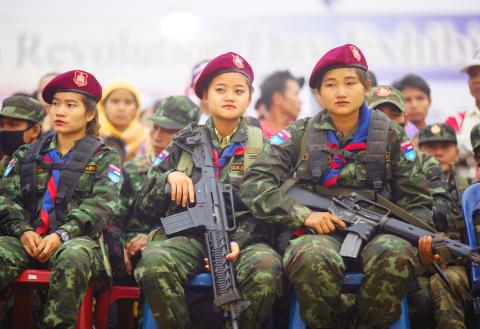
Photo: EPA-EFE
Aung San Suu Kyi has struggled to make progress with autonomy-seeking ethnic minority rebels, who have accused her government of a high-handed approach and ignoring their grievances and aspirations.
The celebrations took place at a remote base in the mountains straddling the Myanmar-Thai border.
“The history of the revolution for 70 years is a very rough one. As someone who has been involved in the revolution for 50 years, I can say it’s very tough and the sacrifices were very big,” Man Nyein Maung, one of the KNU’s executive members, told the Irrawaddy online news magazine.
The celebrations lasted several days and nights with a folk dance competition and theater performances before a military parade and speeches on a cloud-shrouded, dusty parade ground carved from the hills at the crack of dawn.
A banner hoisted above the grounds listed some of the group’s political demands, including calls to “retain our arms” and to “decide our own political destiny.”
One of the dance groups was made up of women wearing yellow scarves, with their hair tied in a bun and an exposed fringe. Their yellow shirts with green patterns contrasted with their white face powder and red lipstick.
The performers mingled with villagers and soldiers of the Karen National Liberation Army, the KNU’s armed wing. The men smoked cigarettes as they watched, some with heavy bullet belts draped around automatic rifles, and with insignia in red, white and blue displayed on their uniforms.
The KNU signed a ceasefire with the government in 2012 after more than six decades of conflict that had driven tens of thousands of refugees into Thailand.
Some have come back, although about 100,000 remain in the refugee camps on the other side of the border, according to the UN.
While major clashes have been avoided, the KNU’s relations with the Myanmar army remain tense.
Aung San Suu Kyi has struggled to secure peace elsewhere in the country and long-simmering conflicts in the north and the west have intensified in recent years.
In 2017, a military offensive drove out 730,000 Rohingya Muslims from the western state of Rakhine to Bangladesh, creating one of the world’s largest refugee crises.
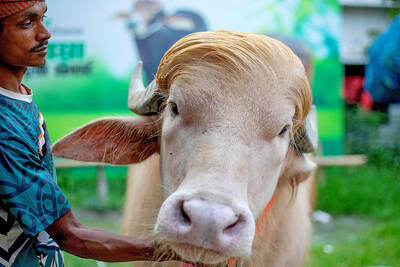
Crowds in Bangladesh are flocking to snap photographs with an unlikely social media star — an albino buffalo with flowing blond hair nicknamed “Donald Trump” that is due to be sacrificed within days. Owner Zia Uddin Mridha, 38, said his brother named the 700kg bull over its flowing helmet of hair resembling the signature look of the US president. “My younger brother picked this name because of the buffalo’s extraordinary hair,” he said at his farm in Narayanganj, just outside the capital, Dhaka. Mridha said that a constant stream of curious visitors — social media fans, onlookers and children — have come throughout

It began as a satirical online project. Now millions of young people in India are flocking to it as an outlet for their frustration. A parody political party called the Cockroach Janta Party, with the insect as its symbol, has exploded across India’s social media by turning absurdist humor into protest. Memes and short videos mocking corruption, joblessness and political dysfunction have flooded social media sites, where millions of users are embracing the cockroach — known for its ability to survive harsh conditions — as a tongue-in-cheek symbol of endurance. The online movement’s rise has been unusually rapid. The Cockroach Janta Party (CJP)
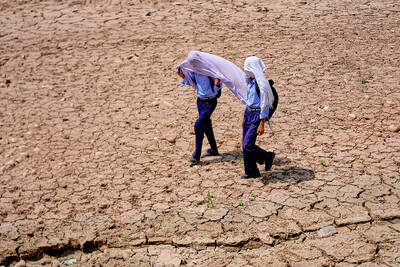
HOTTER: While Indians are accustomed to summer heat, climate change has caused northwestern India to warm faster than other parts of the country, an academic said Roads and markets have emptied during afternoons and some farmers have switched to nighttime work to avoid scorching temperatures as a heat wave grips large parts of India. The India Meteorological Department forecast maximum temperatures for yesterday of about 45°C in the capital, New Delhi, where authorities have opened temporary “cooling zones” to help people cope. The weather department warned that conditions would likely persist across several northern regions in the coming days, with temperatures staying well above seasonal averages. Authorities urged people to stay indoors during the hottest hours and take precautions against heat-related illnesses. India declares a heat wave whenever maximum temperatures

BIGGER ROLE: Beijing has said it maintains an impartial stance on the war in Ukraine, but by training Russian troops, China is far more involved than previously known China’s armed forces secretly trained about 200 Russian military personnel in China late last year, and some have since returned to fight in Ukraine, according to three European intelligence agencies and documents seen by Reuters. While China and Russia have held a number of joint military exercises since Moscow’s full-scale invasion of Ukraine in 2022, Beijing has repeatedly said that it is neutral in the conflict and presents itself as a peace mediator. The covert training sessions, which predominantly focused on the use of drones, were outlined in a dual-language Russian-Chinese agreement signed by senior Russian and Chinese officers in Beijing on


 RSS
RSS