


Veteran artist Ablade Glover measures spaces on a canvas with a palette knife, then dabs on vibrant blue paint while the morning light pours into his Accra studio.
The 84-year-old artist, educator and founder of the Artists Alliance Gallery in Ghana’s capital has won national and international recognition for his work.
He set up the gallery 25 years ago and moved it to its current location, a three-story building on the beachfront 11 years ago. The premises are open to the public, offering local people and tourists the chance to see contemporary art, mostly from Ghana itself.
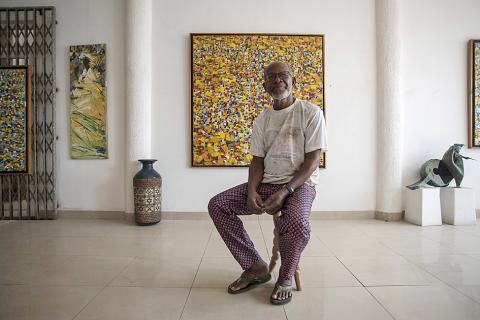
Photo: AFP
When Glover started out, there was little support for local artists and most needed to hold down day jobs to make a living, but in recent years there has been a huge swing. More artists are making a living from their work as a result of galleries like Glover’s, festivals, collectors and art professionals.
One of Glover’s works hangs in Seth Dei’s private gallery, on a quiet street in a leafy suburb of Accra.
The 73-year-old businessman has been an avid supporter of Ghanaian artists for several decades. He has seen them struggle and slowly build up their reputations.
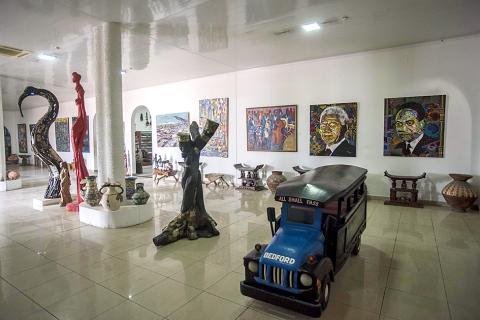
Photo: AFP
He said he would much rather have a painting by a Ghanaian in his living room than a Picasso.
“I like to be surrounded by paintings that I can understand, that reflect who I am,” he said, looking at Glover’s rendering of a forest in vivid orange and red.
The work is one of about 550 pieces of art spread between his home, gallery and in storage.
Dei, who cofounded Ghanaian fruit export company Blue Skies, started collecting local art in 1993 and says, at that time, artists were not well-supported.
“The artists in our society found themselves a bit ignored and lonely and in the society as a whole we didn’t have a lot of people buying art,” he said.
He did what he could to help, buying art and encouraging the artists to keep producing.
“It got to a point where artists would come and say, ‘I painted this and I think you should have it in your collection,’” he said. “Even if I didn’t have money I would pay it off, little by little.”
As a result, he saw the careers of Wiz Kudowor, Larry Otoo and Kofi Setordji build up to the point where they have international reputations.
“People are getting used to the idea of pricing works in USD [US dollars], which would have been impossible a few years ago, and art prices are rising,” Dei said.
The increasing popularity of Ghanaian art is a double-edged sword, for a lot of it has left the country, as expatriates or companies buy works.
Glover said he wants to see a public institution invest in keeping work in Ghana for Ghanaians to appreciate, hoping the government will step in and create a national art museum.
While he and Dei have their spaces to exhibit — and for Glover, to sell — they are keen for the government to take a similar interest. Both said creating a national art gallery would be a good place to start.
Dei said he would be happy to see his collection form part of it, so everyone can enjoy the nation’s talents.
Nana Oforiatta Ayim has been promoting Ghanaian artists through curating exhibitions, a mobile museum and working to develop artists since 2002. The writer, art historian and filmmaker has held exhibitions in Ghana and Britain.
“I had seen the older artists do their work here, but [they] didn’t have such successful international careers,” she said. “So, my whole point was I want them to have the same start as an artist in London would.”
She and Ghanaian-British architect David Adjaye earlier this month said that Ghana would have a pavilion at the Venice Biennale in May.

‘CROSSING THE LINE’: China’s embassy in Seoul criticized US Forces Korea Commander General Xavier Brunson, asking if his ‘hostile’ remarks were authorized by Washington South Korea and the US are in talks over recent public remarks by the commander of US Forces Korea, Seoul’s presidential office said yesterday, after the comments drew sharp criticism from China. In a recent podcast interview, US Forces Korea Commander General Xavier Brunson described South Korea as “the dagger in the heart of Asia” from China’s east coast, prompting the Chinese embassy in Seoul to say that he had “truly crossed the line.” The interview came amid growing speculation that Washington might seek to expand the role of US Forces Korea in countering the growing regional influence of China, a key

Through the noise of rushing papers and whirring belts at a print factory in Kyoto, two creators watch their photo essay come to life in broadsheet form — part of an effort to win new audiences in the age of artificial intelligence (AI). Despite the decline of the publishing industry, self-publication and handmade “zine” magazines are growing in popularity in Japan, reflecting the nation’s enduring love of paper in the digital era. While speaking to Agence France-Presse at the plant, his hands black with ink, one of the creators, Kazuma Obara, said: “I think [paper] is a medium that engages all five

Australian researchers have trained lab-grown brain cells on a silicon computer chip to play the 1990s shooter game Doom and said they are just scratching the surface of what the neurons could be capable of doing. It is the science-fiction work of biotech boffins at Cortical Labs, who researched and developed the technology that harnesses the workings of the brain’s networking system. Each so-called “biological computer” contains about 200,000 living human brain cells, grown from stem cells that were harvested from blood donations. Having mastered the simple computer game Pong, where a paddle is moved up and down to send a ball

A surprising gut feeling may help pigeons find their way home. Animals use various techniques to navigate, including following the stars and remembering key landmarks. Birds, fish and turtles orient themselves using Earth’s magnetic field as a compass, but it is not yet clear how exactly they do this. Pigeons are a well-known group of frequent flyers that can traverse hundreds of kilometers in a single day. For thousands of years, humans have used them to carry news, notes and military messages. Scientists have long tried to untangle how pigeons travel without getting lost. Some think the birds detect magnetic cues using light-sensitive


 RSS
RSS