


Makeup artist Solongo Batsukh braves Mongolia’s below-freezing temperatures in a skimpy black dress and light pastel pink coat — the nation’s trailblazing transgender beauty queen wants to look good in any weather.
“I don’t like to look puffy,” the 25-year-old said as she drove to a beauty salon that hired her to promote its products and services via Facebook Live.
It is with this typical bluntness, confidence and attitude that taboo-breaking Batsukh strutted into the nation’s first-ever Miss Universe Mongolia competition in October.

Photo: AFP
Although she fell short of representing her country at the Miss Universe contest in Thailand on Monday last week, her participation shed another light on a group living on the edges of a deeply patriarchal country with conservative views about sexual identity.
Had she won, she would have joined Miss Spain’s Angela Ponce as the first transgender contestants in Miss Universe’s 66-year history.
“I wanted to inspire as many women as possible, but I’m still proud that I got the chance to compete in this contest, and the ‘Solongo’ I created was a true winner in my heart,” Batsukh said.
Her participation did not please everyone, dredging up negative reactions on social media.
“The world would have a negative image of our country if a man represents us while there are thousands of beautiful and real women in our country,” one person wrote on the Facebook page of Miss Universe Mongolia.
However, Batsukh is not deterred by such abuse.
Born Bilguun Batsukh, she grew up as a boy in the semi-arid central province of Dundgovi.
She could not pinpoint her gender identity until she learned about different orientations as a university student in her early 20s.
It was when she started working as a program officer at Youth for Health, a non-governmental organization that provides safe-sex education for LGBT people, that she realized she was a woman born in a man’s body.
She started wearing wigs, putting on dresses and taking hormone therapy.
Batsukh is among the few LGBT people who have come out in Mongolia, where about 80 percent of the community remain in the closet, a UN survey showed.
“It is extremely difficult for transgender people to be employed,” LGBT Center legal program manager Baldangombo Altangerel said.
A video of a young transgender woman who had repeatedly been beaten in the streets went viral in Mongolia last year, highlighting the prejudices LGBT people face.
Batsukh wants to dispel the image that transgender women can only be sex workers or strippers living on the fringes of society.
She flaunts her wealth, regularly travels abroad and is a celebrity in her country of 3 million people.
Batsukh found fame in 2014, when she represented Mongolia in Miss International Queen, finishing in the top 10 of the international transgender beauty pageant in Thailand.
She pursued a modeling career and became a makeup artist.
“I had to reveal myself [as transgender] so I could correct the misunderstandings in society. If we keep hidden, society will keep on hating us. They don’t know us,” she said.

Through the noise of rushing papers and whirring belts at a print factory in Kyoto, two creators watch their photo essay come to life in broadsheet form — part of an effort to win new audiences in the age of artificial intelligence (AI). Despite the decline of the publishing industry, self-publication and handmade “zine” magazines are growing in popularity in Japan, reflecting the nation’s enduring love of paper in the digital era. While speaking to Agence France-Presse at the plant, his hands black with ink, one of the creators, Kazuma Obara, said: “I think [paper] is a medium that engages all five
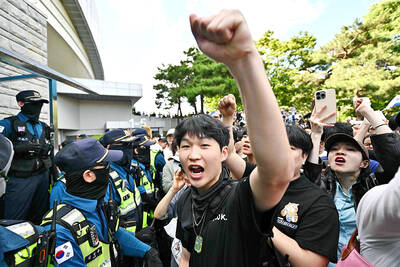
‘ABSURD MISTAKE’: The election commission said that there had been a failure to anticipate turnout after 14 polling stations ran short of ballot papers South Korean riot police yesterday cleared protesters from a Seoul polling station after a 35-hour blockade sparked by a shortage of ballot papers during local elections earlier this week. Wednesday’s election was the first nationwide vote since South Korean President Lee Jae-myung took office following the ouster of Yoon Suk-yeol over his short-lived martial law declaration. Lee’s ruling Democratic Party swept most races, but failed to flip the crucial Seoul mayoral seat. The South Korean National Election Commission apologized, blaming a failure to anticipate turnout after 14 polling stations in Seoul ran short of ballot papers. Some polling stations stayed open until 10pm to

Australian researchers have trained lab-grown brain cells on a silicon computer chip to play the 1990s shooter game Doom and said they are just scratching the surface of what the neurons could be capable of doing. It is the science-fiction work of biotech boffins at Cortical Labs, who researched and developed the technology that harnesses the workings of the brain’s networking system. Each so-called “biological computer” contains about 200,000 living human brain cells, grown from stem cells that were harvested from blood donations. Having mastered the simple computer game Pong, where a paddle is moved up and down to send a ball

France experienced its hottest spring on record, the French weather service said on Tuesday, after an exceptional early heat wave that also broke highs for the season in England and Wales. Meteo-France said the average nationwide temperature over March to May was 13.8°C — about 1.7°C above the norm, and surpassing records set in 2011 and 2020. “The warmest spring since records began in 1900,” it said in a bulletin. All three months were warmer than average, but the onset of an “unprecedented heatwave” late last month pushed the mercury to highs typically seen at the height of the summer. “Our country had never


 RSS
RSS