


The sun glistens on waves lapping against wooden fishing boats as their sails ripples in the breeze coming off the Indian Ocean.
Nearby a young man with a diving mask bobs below the water’s surface armed with a stick to lure his catch into a net while also trying to snare fish on a nylon line.
In Anakao, a traditional fishing community in southwest Madagascar, the community known as Vezo — which means “rowing strength” — has fished for generations.
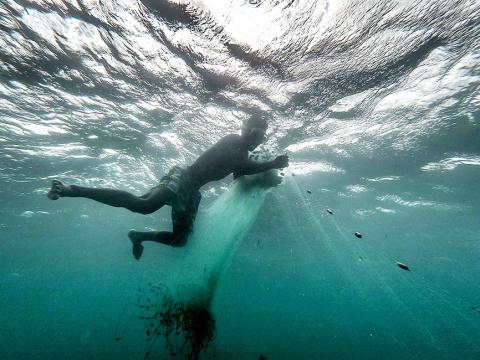
Photo: AFP
However, the arrival last year of six fishing trawlers off the coast and a subsequent deal between a local private body that promotes Madagascan businesses and Chinese investors have stirred anger at a time when the country is going to the polls in presidential elections.
“If this carries on, we’ll be eating sand,” said Fulgence, a fisherman in Anakao.
He does not dare venture out when the six Chinese vessels are at sea, saying that a number of his nets have been cut.
“The Chinese take everything and chuck the little dead fish back into the sea,” Marco Randrianjaka said, echoing the grievances of many of his fellow seafarers. “Without the small ones, they won’t be able to reproduce down the line.”
However, China’s Mapro South, the company responsible for the vessels, denies the claims.
Their nets’ mesh is large enough to allow the smaller fish to escape, said Li Lifujun, a company manager in Toliara, a port town one hour from Anakao by boat.
Against the backdrop of an already tense situation locally and nationally due to the elections, a fisheries deal with Chinese investors has provoked an outcry on the island where malnutrition is widespread.
The deal, which was not publicized, is understood to go much further than the six Chinese-funded trawlers already in operation.
The US$2.7 billion agreement includes, among other things, 330 modern, refrigerated vessels up to 14m long being delivered to Madagascan fishers.
They are to “replace the traditional wooden boats,” said the Madagascan Development and Business Promotion Agency (AMDP), which negotiated the deal with China’s Taihe consortium.
The ships, supplied to local fishers free of charge, would help them “increase their production capacity,” said an AMDP official, who declined to be named.
A proportion of fish caught by those participating in the scheme would be sold locally. The Chinese would buy the “surplus” at a favorable, but undisclosed price, the official said.
The deal would promote “local development” in Madagascar, he added.
The official blamed the outcry on the fishing community “prejudging” the project — something they deny.
The 330 new boats are to eventually produce 130,000 tonnes of fish annually, according to the AMDP — about the equivalent of the nation’s entire production in 2016.
“But we already face overfishing in some regions,” said Rijasoa Fanazava, a fisheries expert at the World Wildlife Fund in Madagascar.
Fanazava believes that tens of thousands of fishers risk losing their livelihoods if stocks are diminished.
“How will they live?” he asked.
A roundtable that brought together the AMDP and 30 affected organizations failed to allay their fears.
“The only impact assessments given by the AMDP have been economic in nature; we haven’t had anything on the environmental and social impacts of the project,” nonprofit groups said in a joint statement.
The AMDP said that the deal provides for an environmental initiative to protect the sustainability of marine life off Madagascar’s coasts.
However, campaign groups are “unconvinced” that the deal would truly create economic opportunities for local fishers and reiterated their opposition to the scheme.
Even Madagascan Minister for Agriculture and Fisheries Augustin Andriamananoro has his doubts — he said he was not even briefed on the deal.
It was signed on the sidelines of a China-Africa cooperation summit in Beijing in September attended by former Madagascan president Hery Rajaonarimampianina just days before he resigned to contest the polls.
He was knocked out in the first-round vote last month.
The AMDP “can’t sell treasures which aren’t even theirs,” Andriamananoro said.
“The deal isn’t at all legal” and should not be executed, added the minister, an ally of Andry Rajoelina, who is to stand in the second-round vote on Wednesday next week against Marc Ravalomanana.
However, the AMDP, although reluctant to comment publicly, is adamant that the project will go ahead.
The deal “is between two private companies from the two countries — it’s not an agreement between states,” the AMDP official said.
The first Chinese-made trawlers are due to be delivered within a year.
However, in Anakao, the fishing community fears “unfair competition.”
“We’re already catching less and less,” Mananaina said. “Before, it was more than 20kg a day — now just 10.”
“There’s simply not enough fish to feed everyone,” Fulgence added. “So why send them to China?”

Shamans in Peru on Monday gathered for an annual New Year’s ritual where they made predictions for the year to come, including illness for US President Donald Trump and the downfall of Venezuelan President Nicolas Maduro. “The United States should prepare itself because Donald Trump will fall seriously ill,” Juan de Dios Garcia proclaimed as he gathered with other shamans on a beach in southern Lima, dressed in traditional Andean ponchos and headdresses, and sprinkling flowers on the sand. The shamans carried large posters of world leaders, over which they crossed swords and burned incense, some of which they stomped on. In this

Near the entrance to the Panama Canal, a monument to China’s contributions to the interoceanic waterway was torn down on Saturday night by order of local authorities. The move comes as US President Donald Trump has made threats in the past few months to retake control of the canal, claiming Beijing has too much influence in its operations. In a surprising move that has been criticized by leaders in Panama and China, the mayor’s office of the locality of Arraijan ordered the demolition of the monument built in 2004 to symbolize friendship between the countries. The mayor’s office said in

‘TRUMP’S LONG GAME’: Minnesota Governor Tim Walz said that while fraud was a serious issue, the US president was politicizing it to defund programs for Minnesotans US President Donald Trump’s administration on Tuesday said it was auditing immigration cases involving US citizens of Somalian origin to detect fraud that could lead to denaturalization, or revocation of citizenship, while also announcing a freeze of childcare funds to Minnesota and demanding an audit of some daycare centers. “Under US law, if an individual procures citizenship on a fraudulent basis, that is grounds for denaturalization,” US Department of Homeland Security Assistant Secretary Tricia McLaughlin said in a statement. Denaturalization cases are rare and can take years. About 11 cases were pursued per year between 1990 and 2017, the Immigrant Legal Resource

‘RADICALLY DIFFERENT’: The Kremlin said no accord would be reached if the new deal with Kyiv’s input did not remain within the limits fixed by the US and Russia in August Ukrainian President Volodymyr Zelenskiy is to meet US President Donald Trump in Florida this weekend, but Russia on Friday accused him and his EU backers of seeking to “torpedo” a US-brokered plan to stop the fighting. Today’s meeting to discuss new peace proposals comes amidst Trump’s intensified efforts to broker an agreement on Europe’s worst conflict since World War II. The latest plan is a 20-point proposal that would freeze the war on its current front line, but open the door for Ukraine to pull back troops from the east, where demilitarized buffer zones could be created, according to details revealed by


 RSS
RSS