


Exiled Chinese dissident Wei Jingsheng (魏京生) has lived a good life in the US for more than 20 years, but the man often called the father of his country’s modern democracy movement still welcomes visitors the Chinese way — by offering them a cigarette.
In a lengthy interview at his home in a Maryland suburb, he lights one for himself — and starts unleashing harsh criticism of the “one-party dictatorship” in power in Beijing.
It is a familiar battle cry: For four decades, Wei has railed against state oppression of the Chinese public’s democratic aspirations.
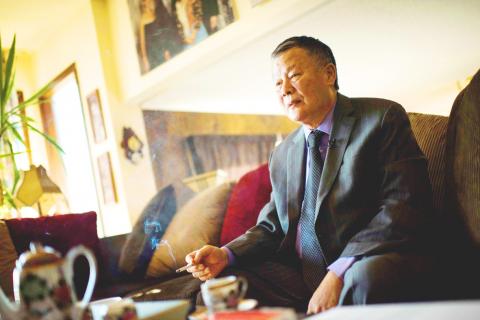
Photo: AFP
That battle cost him 18 years of his life, spent in a series of prison cells. In 1997, after international pressure — including a plea from then-US president Bill Clinton — he was released, ostensibly on medical grounds, and put on a plane to the US.
Now 68, Wei is hooked on Gauloises — strong French cigarettes that are hard to find in the US — but is otherwise in good shape. He runs his namesake foundation from his home, battling for human rights in China.
Tomorrow, he is to mark a landmark anniversary — on Dec. 5, 1978, he posted “The Fifth Modernization” on a wall in Beijing.
The essay said that then-Chinese leader Deng Xiaoping’s (鄧小平) “Four Modernizations” did not go far enough and called for democracy to be a goal for China alongside the four that Deng cited: the development of industry, agriculture, science and technology, and national defense.
Deng is considered the architect of China’s opening up to the world, but Wei, whose essay landed him in prison, said that Deng gets too much credit.
“I should correct a popular saying, both inside China and internationally, which claims that Deng Xiaoping is responsible for the opening-up and the reform,” he said, speaking in Mandarin.
“This reform only went halfway, economically, but not politically,” he lamented.
“Now, in the [Chinese President] Xi Jinping (習近平) era, politically it is even going further backwards,” he added, referring to the ongoing offensive against rights activists.
In the post-Mao Zedong (毛澤東) era that began in the late 1970s, China’s opening-up was prompted by a broad popular movement, supported not just by Deng, but by other senior Chinese Communist Party leaders.
In the end, “Communist China is a mix between a one-party dictatorship and capitalism,” Wei said. “When they suppress the people, it’s more severe than anywhere else.”
Sipping black tea from China’s Fujian Province, Wei did not hold back in his biting criticism of those who have followed Deng to the heights of power in Beijing.
An electrician by trade — he once worked at the Beijing Zoo — Wei accused former Chinese president Jiang Zemin (江澤民) of exploiting cheap labor at home and high prices in the West to reap huge profits that he shared with Western creditors.
“During the Mao Zedong years, China was a poor socialist country. Now China is a poor capitalist country. Overall, the average Chinese did not get the benefit,” he said.
As for Xi, who has a clear path to staying in power longer than the habitual 10 years after term limits on the presidency were abolished, Wei did not mince words.
“Xi Jinping doesn’t just want to become emperor after 2023,” when his first 10 years in office are to end, he said. “He wants to be the emperor now.”
Wei, who repeatedly said that the Chinese government “never follows the rules,” has gained traction in Washington’s political circles.
On the walls of his home, perched above a tributary of the Potomac River, are huge photographs of him with Clinton and former US president George H.W. Bush.
However, Wei, the winner of multiple human rights awards, including the Sakharov prize, said that he does not venture into the US capital too often anymore.
“The American government and European governments are concerned over my safety,” he said, without further explanation.
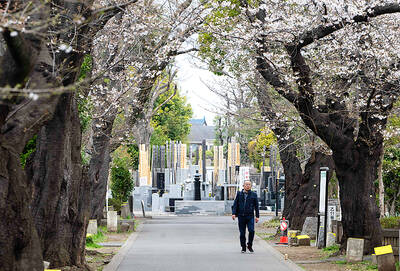
ROCKY RELATIONS: The figures on residents come as Chinese tourist numbers drop following Beijing’s warnings to avoid traveling to Japan The number of Chinese residents in Japan has continued to rise, even as ties between the two countries have become increasingly fractious, data released on Friday showed. As of the end of December last year, the number of Chinese residents had increased by 6.5 percent from the previous year to 930,428. Chinese people accounted for 22.6 percent of all foreign residents in Japan, making them by far the largest group, Japanese Ministry of Justice data showed. Beijing has criticized Tokyo in increasingly strident terms since Japanese Prime Minister Sanae Takaichi last year suggested that a military conflict around Taiwan could
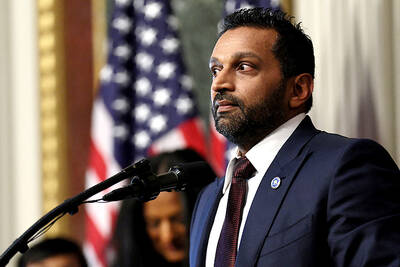
A pro-Iran hacking group claimed to breach FBI Director Kash Patel’s personal e-mail inbox and posted some of the contents online. The e-mails provided by the hacking group include travel details, correspondence with leasing agents in Washington and global entry, and loyalty account numbers. The e-mail address the hackers claim to have compromised has been previously tied to Patel’s personal details, and the leaked e-mails contain photos of Patel and others, in addition to correspondence with family members and colleagues. “The FBI is aware of malicious actors targeting Director Patel’s personal email information,” the agency said in a statement on
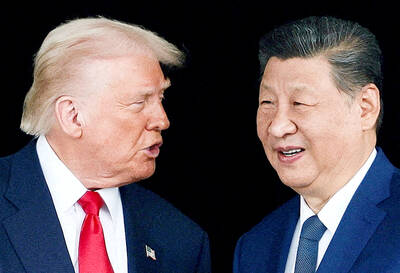
RIVALRY: ‘We know that these are merely symbolic investigations initiated by China, which is in fact the world’s most profligate disrupter of supply chains,’ a US official said China has started a pair of investigations into US trade practices, retaliating against similar probes by US President Donald Trump’s administration as the superpowers stake out positions before an expected presidential summit in May. The move, announced by the Chinese Ministry of Commerce on Friday, is a direct mirror of steps Trump took to revive his tariff agenda after the US Supreme Court last month struck down some of his duties. “China expresses its strong dissatisfaction and firm opposition to these actions,” a ministry spokesperson said in a statement, referring to the so-called Section 301 investigations initiated on March 11.

When a hiker fell from a 55m waterfall in wild New Zealand bush, rescuers were forced to evacuate the badly hurt woman without her dog, which could not be found. After strangers raised thousands of dollars for a search, border collie Molly was flown to safety by a helicopter pilot who was determined to reunite the pet and the owner. A week earlier, an emergency rescue helicopter found the woman with bruises and lacerations after a fall at a rocky spot at the waterfall on the South Island’s West Coast. She was airlifted on March 24, but they were forced to


 RSS
RSS