


Beneath the carved timber roof of a traditional marae meeting house at Wellington High School, dozens of students watch entranced as a play performed entirely in the Maori language unfolds.
Many only understand a smattering of the indigenous language, but pick up emotional cues from the performers. Some audience members are close to tears as the production ends.
It is a scene that actor Eds Eramiha says would have been difficult to imagine as recently as two decades ago, when te reo Maori was widely regarded as a dying language not worth teaching.

Photo: AFP
“Attitudes have changed immensely,” he said. “When I was at school, te reo Maori wasn’t held in high value, it wasn’t spoken, it wasn’t as freely available as it is to our kids today.”
Te reo was banned in schools for much of the 20th century which, combined with the urbanization of rural Maori, meant that by the 1980s, only 20 percent of indigenous New Zealanders were fluent in the language.
That number was virtually unchanged by 2013, when census figures showed that just 21.3 percent of the Maori population could converse in te reo.
An official report published in 2010 warned that the language was on the verge of extinction.
“Te reo Maori is approaching crisis point,” with older native speakers “simply not being replaced” as they passed away, it said.
The contrast with New Zealand today is striking. The language is enjoying a surge in popularity among Kiwis — Maori or otherwise — embracing their South Pacific nation’s indigenous culture.
Te reo courses are booked out at community colleges, while bands, poets and rappers perform using the language.
Te reo words such as kai (food), ka pai (congratulations), whanau (family) and mana (prestige) have entered everyday usage.
Even the way Kiwis define themselves has taken on a te reo tone, with an increasing number preferring to use Aotearoa rather than New Zealand.
New Zealand Prime Minister Jacinda Ardern is a passionate champion of the language, saying one of her great regrets is not being able to converse fluently in it.
“We have a guardianship role, a duty of care to te reo Maori,” she said this month.
“It’s our job to nurture it because it’s about more than a language,” she said.
Ardern chose to give her daughter, Neve, a Maori middle name “Te Aroha” (“the love”) when she was born in June.
Her government has set a target of having 1 million fluent te reo speakers by 2040.
With the Maori comprising only about 15 percent of New Zealand’s 4.5 million population, that would mean many non-Maori adopting the language.
It is a prospect that excites Charles Royal, a Maori academic and storyteller at the national museum Te Papa (Our Place).
“We’ve never had so many te reo speakers as we have now,” he said.
“What te reo enables me to do is articulate who I am in a very particular way... as a New Zealander,” he added.
“It’s the vehicle by which humanity first gained a voice in this part of the world,” he said.
Royal said the earlier rejection of te reo stemmed from a sense of inferiority and a mistaken belief that European history was more important than that of New Zealand.
However, he said Kiwis now felt more positive about their place in the world and the rising popularity of te reo was an expression of this confidence.
As an actor, Eramiha observes that te reo “flies off my tongue a bit better [than English], the flow’s different.”
Head teacher Angela Fieldes has noticed a similar phenomenon among toddlers exposed to te reo at the Wellington child care center she helps run.
“They pick it up really, really quickly, so it just becomes part of their day,” Fieldes said after the children performed a waiata (song), reciting Maori colors, numbers and vowels.
“They love the singing and I think a big part of learning te reo is that it’s so rich in the way you can use song,” she said.
Royal said there were still New Zealanders who maintained Maori culture was not valuable, but they were an ageing minority.
He said the fact that so many non-Maori, including pakeha (New Zealanders of European descent) wanted to learn te reo was “absolutely fantastic.”
“It makes me feel proud to be Maori. It’s an act of generosity on both sides,” he said.
Eramiha agrees, saying the passion for the language has been evident as his Taki Rua theater troupe performs in te reo across the nation.
He expressed confidence in the language’s future, saying: “People from other cultures come up to me after our shows and say: ‘Can you teach me how to say hello?’”
“It’s a treasure for us to be able to pass it on and a great gift to see other people wanting to learn it. It’s amazing,” he said.

PARLIAMENT CHAOS: Police forcibly removed Brazilian Deputy Glauber Braga after he called the legislation part of a ‘coup offensive’ and occupied the speaker’s chair Brazil’s lower house of Congress early yesterday approved a bill that could slash former Brazilian president Jair Bolsonaro’s prison sentence for plotting a coup, after efforts by a lawmaker to disrupt the proceedings sparked chaos in parliament. Bolsonaro has been serving a 27-year term since last month after his conviction for a scheme to stop Brazilian President Luiz Inacio Lula da Silva from taking office after the 2022 election. Lawmakers had been discussing a bill that would significantly reduce sentences for several crimes, including attempting a coup d’etat — opening up the prospect that Bolsonaro, 70, could have his sentence cut to
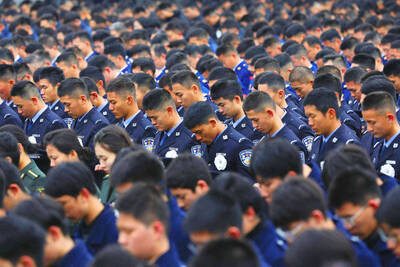
China yesterday held a low-key memorial ceremony for the 1937 Nanjing Massacre, with Chinese President Xi Jinping (習近平) not attending, despite a diplomatic crisis between Beijing and Tokyo over Taiwan. Beijing has raged at Tokyo since Japanese Prime Minister Sanae Takaichi last month said that a hypothetical Chinese attack on Taiwan could trigger a military response from Japan. China and Japan have long sparred over their painful history. China consistently reminds its people of the 1937 Nanjing Massacre, in which it says Japanese troops killed 300,000 people in what was then its capital. A post-World War II Allied tribunal put the death toll

A passerby could hear the cacophony from miles away in the Argentine capital, the unmistakable sound of 2,397 dogs barking — and breaking the unofficial world record for the largest-ever gathering of golden retrievers. Excitement pulsed through Bosques de Palermo, a sprawling park in Buenos Aires, as golden retriever-owners from all over Argentina transformed the park’s grassy expanse into a sea of bright yellow fur. Dog owners of all ages, their clothes covered in dog hair and stained with slobber, plopped down on picnic blankets with their beloved goldens to take in the surreal sight of so many other, exceptionally similar-looking ones.

‘UNWAVERING ALLIANCE’: The US Department of State said that China’s actions during military drills with Russia were not conducive to regional peace and stability The US on Tuesday criticized China over alleged radar deployments against Japanese military aircraft during a training exercise last week, while Tokyo and Seoul yesterday scrambled jets after Chinese and Russian military aircraft conducted joint patrols near the two countries. The incidents came after Japanese Prime Minister Sanae Takaichi triggered a dispute with Beijing last month with her remarks on how Tokyo might react to a hypothetical Chinese attack on Taiwan. “China’s actions are not conducive to regional peace and stability,” a US Department of State spokesperson said late on Tuesday, referring to the radar incident. “The US-Japan alliance is stronger and more


 RSS
RSS