


When the only private university in North Korea held a commencement in March, the school’s American president was not there, blocked by Washington’s ban on travel to the country.
Now, with the US and North Korea reshaping relations between the two old adversaries, Pyongyang University of Science and Technology (PUST) president Chon Yu-taik is hoping that he will soon be able to return to his campus in the North Korean capital.
The release in May of two PUST employees and another US citizen held in detention by the North helped open the door to last week’s historic summit between North Korean leader Kim Jong-un and US President Donald Trump.
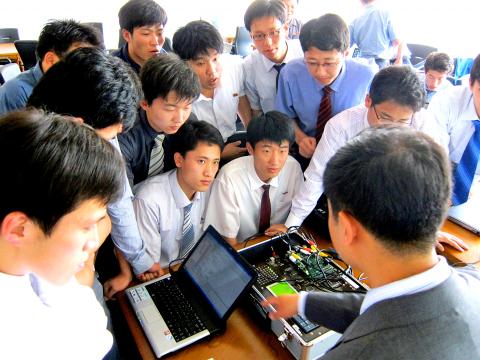
Photo courtesy of Pyongyang University of Science and Technology president Chon Yu-taik Chon
The leaders agreed to work toward complete denuclearization of the Korean Peninsula while Washington committed to provide security guarantees for its old enemy and halted major military drills with South Korea that had irked the North.
Chon reapplied to the US Department of State for clearance to return to Pyongyang after the release of the PUST workers, both Korean-Americans detained on charges of committing unspecified “hostile acts.”
“Those detained are all free. There’s no reason to block me anymore,” Chon told reporters in an interview in Seoul.
“Fears over any kind of war are gone and the two countries’ relationship is now totally different from what it was before,” he added.
Although the arrests of the PUST staff were not in connection with their work at the university, the incidents drew unwanted attention, Chon said.
“People thought that our school was a dangerous place,” he said.
The university took another hit from a travel ban in September last year, which affected US staff, who made up more than half of its 75 member faculty.
PUST was founded by and is chiefly funded by evangelical Christians, despite North Korea being a strictly atheist regime where proselytization is illegal.
School officials say Christian staff members are forbidden to preach.
Still, one Western source who has worked in Pyongyang said that the university’s ties to the international evangelical community make North Koreans suspicious, and often restrictive of what the school can do.
Nevertheless, the university teaches the progeny of the North Korean elite. About 550 students learn subjects ranging from capitalism to dentistry, all taught in English by an international faculty.
With those from the US banned, PUST recruited about 50 professors mostly from Europe and China, Chon said.
Nam Sung-wook, a professor of North Korean studies at Korea University, said that PUST students are top scholars, but also strongly ideologically supportive of the regime to minimize the risk of being subverted by Western ideas.
The university’s graduates would be well positioned to bridge a gap between Pyongyang and Washington should the reclusive country be open to outside world, school officials said.
“There are 520 graduates and now 550 students — a total of more than 1,000,” Chon said. “They understand us and have global insights, the ones who can talk to foreign investors and negotiate with them.”
A 77-year-old Pyongyang-born American, Chon spent 30 years in the oil industry working for companies such as Gulf Oil Corp and BP, before teaching electric engineering in China and North Korea.
Every faculty member, including Chon, works for free, and many of the school’s leadership are Korean-American evangelicals, including Chon himself.
Chon, who said he was inspired to help North Korea after a devastating famine in the mid-1990s, said that daily life at the school underlined changes in recent years.
Once reliant on a Soviet-style centrally planned economy, North Korea is now home to a thriving system of semi-legal but policed markets known as jangmadang, where individuals and wholesalers can buy and sell privately produced or imported goods.
Three times a week, staff at PUST shop for groceries at a big market called Tongil Market to feed their students and officials.
The market has an upper story that houses some offices and a currency-exchange booth, where Chon switched his US dollars for North Korean currency, he said.
“I think the country has already changed a lot over the years. People are more interested in foreign countries and more relaxed when facing us,” Chon said.
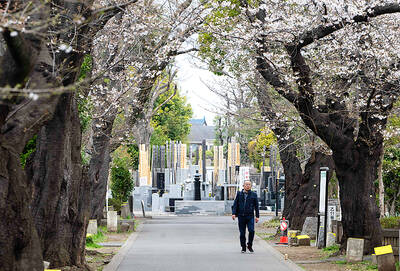
ROCKY RELATIONS: The figures on residents come as Chinese tourist numbers drop following Beijing’s warnings to avoid traveling to Japan The number of Chinese residents in Japan has continued to rise, even as ties between the two countries have become increasingly fractious, data released on Friday showed. As of the end of December last year, the number of Chinese residents had increased by 6.5 percent from the previous year to 930,428. Chinese people accounted for 22.6 percent of all foreign residents in Japan, making them by far the largest group, Japanese Ministry of Justice data showed. Beijing has criticized Tokyo in increasingly strident terms since Japanese Prime Minister Sanae Takaichi last year suggested that a military conflict around Taiwan could
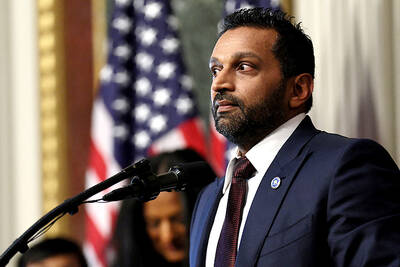
A pro-Iran hacking group claimed to breach FBI Director Kash Patel’s personal e-mail inbox and posted some of the contents online. The e-mails provided by the hacking group include travel details, correspondence with leasing agents in Washington and global entry, and loyalty account numbers. The e-mail address the hackers claim to have compromised has been previously tied to Patel’s personal details, and the leaked e-mails contain photos of Patel and others, in addition to correspondence with family members and colleagues. “The FBI is aware of malicious actors targeting Director Patel’s personal email information,” the agency said in a statement on
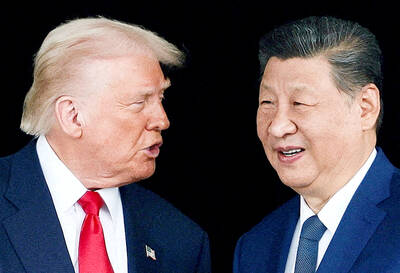
RIVALRY: ‘We know that these are merely symbolic investigations initiated by China, which is in fact the world’s most profligate disrupter of supply chains,’ a US official said China has started a pair of investigations into US trade practices, retaliating against similar probes by US President Donald Trump’s administration as the superpowers stake out positions before an expected presidential summit in May. The move, announced by the Chinese Ministry of Commerce on Friday, is a direct mirror of steps Trump took to revive his tariff agenda after the US Supreme Court last month struck down some of his duties. “China expresses its strong dissatisfaction and firm opposition to these actions,” a ministry spokesperson said in a statement, referring to the so-called Section 301 investigations initiated on March 11.

When a hiker fell from a 55m waterfall in wild New Zealand bush, rescuers were forced to evacuate the badly hurt woman without her dog, which could not be found. After strangers raised thousands of dollars for a search, border collie Molly was flown to safety by a helicopter pilot who was determined to reunite the pet and the owner. A week earlier, an emergency rescue helicopter found the woman with bruises and lacerations after a fall at a rocky spot at the waterfall on the South Island’s West Coast. She was airlifted on March 24, but they were forced to


 RSS
RSS