


Hand-reared for their color and beauty, koi have become an iconic symbol of Japan that can sell for hundreds of thousands of dollars and even participate in fishy beauty contests.
The nation’s koi were brought to the world’s attention when visiting US President Donald Trump was snapped unceremoniously dumping the last of a box of feed into a palace pond in Tokyo. However, the fish have for decades been popular in Japan, where top breeders take their most prized specimens — known as nishikigoi — to highly competitive “beauty parades.”
At one such competition in Tokyo, judges in sharp suits, notebooks in hand, strode around tanks lined up along a pedestrian street where the valuable koi strut their stuff.
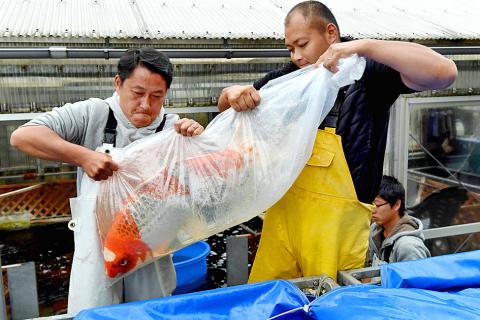
Photo: AFP
They come in all the colors of the rainbow: pearly white, bright red, cloudy gray, dark blue and gleaming golden yellow, but it is the curvature of the fish that accounts for 60 percent of the final score, said competition organizer Isamu Hattori, who runs Japan’s main association for breeders of koi, adding that color and contrast make up another 30 percent.
And the final 10 percent?
Hinkaku — a concept that is tricky to define and even harder to judge, best translated as the “presence” or “aura” of the fish.
“Hinkaku. It’s either there in the genes at birth, or it’s not,” mused Mikinori Kurikara, a koi breeder in Saitama, north of Tokyo, who said he can spot it in fish when they reach eight or nine months old.
“Put it this way, it’s like looking after your own children every day. You care for your kids and want them to grow healthy. In the same way, you take care of these fish, appreciate them and adore them,” he said.
At his farm, thousands of tiny nishikigoi, or colored carp, dart around deep basins of carefully purified water, meticulously divided by age and color.
A less glorious fate awaits the other koi that have not been fortunate enough to catch the eye of the breeder: They are sold off as feed for tropical fish.
“It’s a really delicate job, really difficult. Everything matters: the ground, the water quality, the food,” said the 48-year-old, who took over the farm from his father and is training his son, half his age, in the subtle arts of koi breeding.
“We have many secrets,” he added mischievously. “But even if we let them slip, it wouldn’t work. You have to be able to feel it.”
These days, any self-respecting traditional Japanese garden has plenty of colorful koi gracing its ponds, but it is a relatively recent tradition.
About 200 years ago, villagers in the mountainous region around Niigata in northwest Japan started to practice genetic engineering without knowing what they were doing. For the first time, they began to cross-breed rare colorful carp, not for food but for pure esthetic value.
The craze for nishikigoi gradually took over the whole of Japan and then spread into other parts of Asia.
They are especially popular in China, where carp swimming against the tide symbolize the idea of perseverance leading to riches — rather like people climbing the social ladder, Tokyo University Institute for Advanced Studies on Asia professor Yutaka Suga said.
Today, koi is big business and Japanese exports are booming: 90 percent of domestic production is exported and sold at auction.
In 2016, Japan exported a record 295 tonnes of koi, generating turnover of ¥3.5 billion (US$30.9 million), an increase of almost 50 percent from 2007, according to the Japanese Ministry of Agriculture, Forestry and Fisheries.
As for individual carp, “the prices have become insane,” Hattori said. “Today, two-year-old carp can sell for ¥30 million each, whereas 10 years ago, ¥2 million was already a very good price.”
Like racehorse owners, many foreign owners leave their prized possessions in their home Japanese farms so that they can compete in the most prestigious fishy pageants, which are only open to domestic rearers.
One such owner, Chinese koi collector Yuan Jiandong (袁建棟), was in Tokyo to cheer on some of his own carp.
“It’s not a way of making money. It’s a way of spending it for fun,” the pharmaceutical boss from Shanghai laughed.
However, owning koi is so much more than a vulgar display of wealth, Yuan said.
“When you see these beautiful fish gliding around in your pond, you forget the stresses of daily life and you find peace of mind,” he said.
And you cannot put a price on that.

FAKE NEWS? ‘When the government demands the press become a state mouthpiece under the threat of punishment, something has gone very wrong,’ a civic group said The top US broadcast regulator on Saturday threatened media outlets over negative coverage of the Middle East war, after US President Donald Trump slammed critical headlines from the “Fake News Media.” The US president since his first term has derided mainstream media as “fake news” and has sued major outlets over what he sees as unfair coverage. Brendan Carr, head of the US Federal Communications Commission — which oversees the nation’s radio, television and Internet media — said broadcasters risked losing their licenses over news coverage. “The law is clear. Broadcasters must operate in the public interest, and they will

INFLUTENTIAL THEORIST: Habermas was particularly critical of the ‘limited interest’ shown by German politicians in ‘shaping a politically effective Europe Jurgen Habermas, whose work on communication, rationality and sociology made him one of the world’s most influential philosophers and a key intellectual figure in his native Germany, has died. He was 96. Habermas’ publisher, Suhrkamp, said he died on Saturday in Starnberg, near Munich. Habermas frequently weighed in on political matters over several decades. His extensive writing crossed the boundaries of academic and philosophical disciplines, providing a vision of modern society and social interaction. His best-known works included the two-volume Theory of Communicative Action. Habermas, who was 15 at the time of Nazi Germany’s defeat, later recalled the dawn of
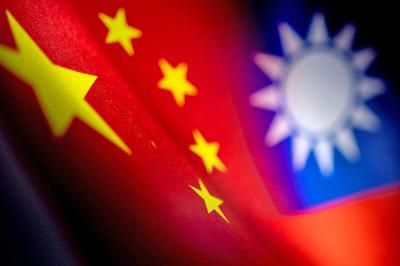
The Chinese public maintains relatively warm sentiments toward Taiwan and strongly prefers non-military paths to improving cross-strait relations, a recent survey conducted by the Atlanta, Georgia-based Carter Center and Emory University showed. The “China Pulse” research project, which polled 2,506 adults between Oct. 27 last year and Jan. 1 this year, found that 86 percent of respondents support strengthening cultural ties, while 81 percent favor deepening economic interaction. The report, co-authored by political scientists at Emory University and advisors at the Carter Center, indicates that the Chinese public views Taiwan’s importance through a lens of shared history and culture rather than geopolitical

Cannabis-based medicines have shown little evidence of effectiveness for treating most mental health and substance-use disorders, according to a large review of past studies published in a major medical journal on Monday. Medical use of cannabinoids has been expanding, including in the US, Canada and Australia, where many patients report using cannabis products to manage conditions such as anxiety, post-traumatic stress disorder and sleep problems. Researchers reviewed data from 54 randomized clinical trials conducted between 1980 and May last year involving 2,477 participants for their analysis published in The Lancet. The studies assessed cannabinoids as a primary treatment for mental disorders or substance-use


 RSS
RSS