


The earthquake that hit Mexico on Sept. 19 did not discriminate in its destruction, leveling homes in rich and poor neighborhoods alike.
However, one month on, the tragedies facing Mexico City’s newly homeless depend largely on class.
Residents of upscale neighborhoods like Roma and Condesa face a frenzied rush to rent or buy new homes in other neighborhoods nearby, creating a real-estate bubble.
Meanwhile, in far-flung corners like Xochimilco in the south, residents say the government has forgotten them and they fight to cling to whatever they can.
More than 8,000 homes and buildings were damaged or destroyed by a magnitude 7.1 quake, which left a trail of destruction that cut across Mexico City from north to south, hitting a broad cross-section of neighborhoods.
“You think it won’t happen to you, until it does,” said Gerardo Alvarez, who had to flee his home in the trendy Zona Rosa with his pregnant wife. “My house is collapsing, there are diagonal scars on the walls.”
For now, he and his wife are staying with friends, but they are struggling to find a new home.
Homeless and shell-shocked residents are exiting the capital’s hip central neighborhoods in drones, leading to a frothy real-estate bubble in surrounding neighborhoods built on more solid ground.
“Prices have gone through the roof,” said Paola Navarrete, a 31-year-old consultant.
She had to abandon her badly damaged building in Condesa. The authorities would only let her return to salvage three outfits of clothes and her documents.
Condesa, a hipster playground of trendy restaurants, bars and boutiques, looked like a wasteland after the quake, which killed 369 people, mostly in the capital.
There are no official figures on the number of newly homeless.
About 600 people are staying in shelters, but many more are staying with relatives, friends or colleagues — or a succession of all three.
These sometimes awkward stays have revived an old expression in Mexico: “There are two things that start to stink after three days: dead bodies and guests.”
Demand for new office buildings with the latest earthquake resistant features has surged by 30 percent to 40 percent since the same period last year, according to figures from real-estate agency Coldwell Banker Mexico, cited in the newspaper El Financiero.
Far from the froth, many modest homes are also in ruins or on the verge of collapse in Xochimilco, on the southern outskirts of the capital.
The area, a UNESCO World Heritage Site, is popular with tourists for its ancient floating gardens and languid canals.
Some quake exiles have taken to setting up communal tables on the unpaved streets outside their wrecked homes, fighting tragedy with conviviality.
Residents have also instituted a rotating night watch to help each other fend off looters.
However, solidarity cannot fix all their problems.
“We still have no water and the electricity only just came back,” said Hortensia Fernandez, 50, in the empty plot where her house used to stand.
She has cleared away the rubble of her former home, leaving her with a desk, some broken wooden chairs, a small yard and an apple tree. She uses a plastic tarp to protect a few boxes of scattered belongings from the elements.
“We’re all sitting here waiting for them to come rebuild our homes, even if it’s just a ramshackle little house,” she said. “But this is just a neighborhood of little houses, not big buildings like the ones that collapsed so spectacularly.”
Across the way, the Lopez family house is on the verge of collapse, its windows broken and its porch covered in rubble.
“The authorities said they’d have to tear it down, but then they never came back. They’ve forgotten about us,” Lorena Lopez said.
Her family of six is staying with her sister-in-law down the street, but that house is damaged too.
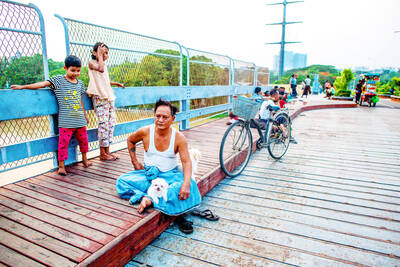
As the sun sets on another scorching Yangon day, the hot and bothered descend on the Myanmar city’s parks, the coolest place to spend an evening during yet another power blackout. A wave of exceptionally hot weather has blasted Southeast Asia this week, sending the mercury to 45°C and prompting thousands of schools to suspend in-person classes. Even before the chaos and conflict unleashed by the military’s 2021 coup, Myanmar’s creaky and outdated electricity grid struggled to keep fans whirling and air conditioners humming during the hot season. Now, infrastructure attacks and dwindling offshore gas reserves mean those who cannot afford expensive diesel

Does Argentine President Javier Milei communicate with a ghost dog whose death he refuses to accept? Forced to respond to questions about his mental health, the president’s office has lashed out at “disrespectful” speculation. Twice this week, presidential spokesman Manuel Adorni was asked about Milei’s English Mastiff, Conan, said to have died seven years ago. Milei, 53, had Conan cloned, and today is believed to own four copies he refers to as “four-legged children.” Or is it five? In an interview with CNN this month, Milei referred to his five dogs, whose faces and names he had engraved on the presidential baton. Conan,
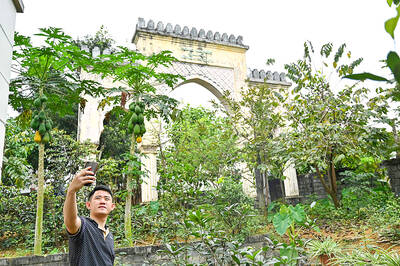
Le Tuan Binh keeps his Moroccan soldier father’s tombstone at his village home north of Hanoi, a treasured reminder of a man whose community in Vietnam has been largely forgotten. Mzid Ben Ali, or “Mohammed” as Binh calls him, was one of tens of thousands of North Africans who served in the French army as it battled to maintain its colonial rule of Indochina. He fought for France against the Viet Minh independence movement in the 1950s, before leaving the military — as either a defector or a captive — and making a life for himself in Vietnam. “It’s very emotional for me,”
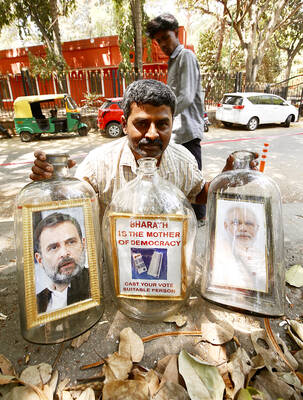
Indian Prime Minister Narendra Modi reaffirmed his pledge to replace India’s religion-based marriage and inheritance laws with a uniform civil code if he returns to office for a third term, a move that some minority groups have opposed. In an interview with the Times of India listing his agenda, Modi said his government would push for making the code a reality. “It is clear that separate laws for communities are detrimental to the health of society,” he said in the interview published yesterday. “We cannot be a nation where one community is progressing with the support of the Constitution while the other


 RSS
RSS