


Haruta Saito, a young Japanese amputee who dreams of becoming a paralympian, remembers strapping on a prosthetic “running blade” for the first time.
The 10-year-old boy, who had his right leg amputated at age two, never had the chance to use a blade because it was too expensive.
That changed in April when he was given early access to Japan’s new Blade Library in Tokyo, which lets people try on prosthetic limbs for running for a small fee.

Photo: Reuters
“It’s difficult to leap forward with the prosthetic limb I usually use. It’s different from this one [the blade],” Saito said during a weekend ceremony when the library officially opened to the public.
“But this blade jumps and leaps ... it lets me run faster,” he said after running and shooting basketballs on the library’s sports track.
The curved prosthetic blades are often made of carbon fiber and bend and spring as a person runs.
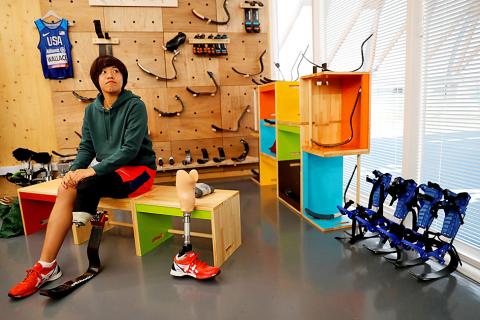
Photo: Reuters
The blades, which can cost thousands of dollars each, generally do not qualify for government subsidies in Japan because they are not deemed “essential to daily life,” an official at the Japanese Ministry of Health and Welfare said.
The Blade Library allows people to try any of its 24 prosthetic blades for a daily fee of about ¥1,000 (US$9).
The library was opened by Xiborg, a Japanese company that researches and develops prosthetic limbs for runners. The company collected more than ¥17.5 million in crowdfunding to open the facility.
“It’s sad that having your leg amputated becomes the reason why you can’t run,” Xiborg chief executive Ken Endo said.
“I want to create an environment where everyone can run and have fun,” he said.
Chie Yamashita, a 20-year-old university student whose left leg was amputated a decade ago after a car accident, played tennis with a regular prosthetic limb because blades were too expensive.
“If there is a place like this library, then I can borrow them without hesitation and that’s wonderful,” she said.

‘CROSSING THE LINE’: China’s embassy in Seoul criticized US Forces Korea Commander General Xavier Brunson, asking if his ‘hostile’ remarks were authorized by Washington South Korea and the US are in talks over recent public remarks by the commander of US Forces Korea, Seoul’s presidential office said yesterday, after the comments drew sharp criticism from China. In a recent podcast interview, US Forces Korea Commander General Xavier Brunson described South Korea as “the dagger in the heart of Asia” from China’s east coast, prompting the Chinese embassy in Seoul to say that he had “truly crossed the line.” The interview came amid growing speculation that Washington might seek to expand the role of US Forces Korea in countering the growing regional influence of China, a key

Through the noise of rushing papers and whirring belts at a print factory in Kyoto, two creators watch their photo essay come to life in broadsheet form — part of an effort to win new audiences in the age of artificial intelligence (AI). Despite the decline of the publishing industry, self-publication and handmade “zine” magazines are growing in popularity in Japan, reflecting the nation’s enduring love of paper in the digital era. While speaking to Agence France-Presse at the plant, his hands black with ink, one of the creators, Kazuma Obara, said: “I think [paper] is a medium that engages all five

Australian researchers have trained lab-grown brain cells on a silicon computer chip to play the 1990s shooter game Doom and said they are just scratching the surface of what the neurons could be capable of doing. It is the science-fiction work of biotech boffins at Cortical Labs, who researched and developed the technology that harnesses the workings of the brain’s networking system. Each so-called “biological computer” contains about 200,000 living human brain cells, grown from stem cells that were harvested from blood donations. Having mastered the simple computer game Pong, where a paddle is moved up and down to send a ball

A surprising gut feeling may help pigeons find their way home. Animals use various techniques to navigate, including following the stars and remembering key landmarks. Birds, fish and turtles orient themselves using Earth’s magnetic field as a compass, but it is not yet clear how exactly they do this. Pigeons are a well-known group of frequent flyers that can traverse hundreds of kilometers in a single day. For thousands of years, humans have used them to carry news, notes and military messages. Scientists have long tried to untangle how pigeons travel without getting lost. Some think the birds detect magnetic cues using light-sensitive


 RSS
RSS