


When Chinese President Xi Jinping (習近平) last visited Lankao County, it was famous for two things — poverty and the government official who reputedly died trying to end it.
Three years later, the hardscrabble area has undergone a Cinderella-like transformation, waltzing across the national poverty line just in time for the Chinese Communist Party’s twice-a-decade congress that opens on Wednesday next week.
With its freshly paved roads, modern community center and memorial to Xi’s visit, Lankao’s Zhangzhuang village has become a showpiece for the president’s ambitious and politically critical campaign to wipe out rural poverty by 2020.
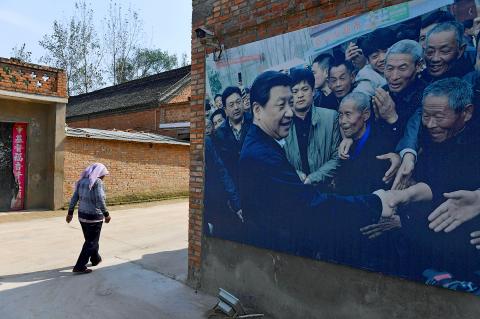
Photo: AFP
However, a drastically different picture emerges on the outskirts, where farmers still live in ramshackle homes and move along rutted lanes.
The contrast highlights the difficulty of spreading the wealth of the world’s second-largest economy, a central mission for Xi as he prepares to accept a second five-year term as general secretary of the Chinese Communist Party.
Success is crucial for the credibility of the party, which came to power promising a radical redistribution of the nation’s wealth, and it would help solidify Xi’s stature as the most powerful leader in decades.
In the three years since Xi’s visit, Lankao’s official poverty rate dropped from 12 percent to less than 2 percent, making it just the second county to be removed from a national registry of almost 600 poor areas.
Officials attribute the success to better directed aid and low-interest micro-loans that have helped needy families increase their income by buying livestock and farming equipment, but Xi also took personal responsibility for the area of more than 760,000 in 2014 as part of a program that paired top party leaders with local governments.
He chose Lankao — and Zhangzhuang specifically — for its association with Jiao Yulu (焦裕祿), an official who became a national hero after famously working himself to death helping farmers eke out a living along the flood-prone Yellow River five decades ago.
The president’s visit “gave us encouragement and inspiration,” said local official Wang Qifu, speaking by a massive monument to Jiao in the bustling county seat.
After the president visited, “doing poorly wouldn’t do,” Wang said.
However, life in Xi’s dream village is surrounded by another reality.
While everyone agrees Lankao has changed enormously since Xi’s visits in March and May 2014, those on Zhangzhuang’s outskirts complain the gains have not been equitable.
The backs of houses along the road to the village have been whitewashed to give the appearance of wealth, but on the other side, narrow, muddy streets run past homes with broken windows and crumbling bricks.
“We haven’t seen any changes here,” said one elderly woman, a farmer who declined to give her name. “The people with connections to the village government have all shaken off poverty. Those without connections haven’t.”
Many residents still feel poor, complaining there is little money in farming and earning more means moving to urban areas.
To tackle the problem, the county has encouraged cooperatives to grow more profitable crops such as melons, established industrial parks and also dedicated several large memorials to Jiao — and its own Xi-fueled success — hoping “red tourism” would create much-needed jobs.
A busload of Chinese Ministry of Foreign Affairs employees sporting Chinese Communist Party lapel pins recently made the pilgrimage, stopping at Jiao’s memorial hall and a village that has prospered by making traditional Chinese instruments.
In May, 27-year-old Peng Biao — a village official — and his wife turned their family home near the Yellow River into a small, stylish restaurant, hoping to cash in on the tourism boom.
Three dishes cost about 40 yuan (US$6.50), almost a week’s income for one of the 23 households still on the village’s poverty list.
Lankao has made good progress, Peng said, but if the county cannot create more jobs “it’s just a bubble economy. On the surface, people may seem well-off, but actually, they won’t have even a single yuan in their wallet.”
Ahead of the congress, state media have heavily promoted the “Lankao Model” and the “Jiao Yulu spirit” to combat poverty.
According to official figures, about 700 million have escaped poverty since China began its economic reforms in 1978, but the gap between rich and poor “has become quite alarming” for Beijing, said Cheng Li (鄭立), an expert on Chinese leadership at Washington’s Brookings Institution. “The whole thing about China’s economic rise is you see the economic disparity has become a bottleneck.”
Last year, about 43.3 million rural residents still lived below the nation’s official poverty line of 2,300 yuan a year at 2010 prices, according to official statistics.
The threshold changes based on location, but Lankao’s US$460 is still well below the US$694 that the World Bank considers “extreme poverty.”
Achieving Xi’s goal of “moderate prosperity” by 2020 could prove difficult even for a county that has benefited from the president’s support.
“In other places it might not be a big problem, but we just shook off poverty,” Wang said.
ROCKY RELATIONS: The figures on residents come as Chinese tourist numbers drop following Beijing’s warnings to avoid traveling to Japan The number of Chinese residents in Japan has continued to rise, even as ties between the two countries have become increasingly fractious, data released on Friday showed. As of the end of December last year, the number of Chinese residents had increased by 6.5 percent from the previous year to 930,428. Chinese people accounted for 22.6 percent of all foreign residents in Japan, making them by far the largest group, Japanese Ministry of Justice data showed. Beijing has criticized Tokyo in increasingly strident terms since Japanese Prime Minister Sanae Takaichi last year suggested that a military conflict around Taiwan could
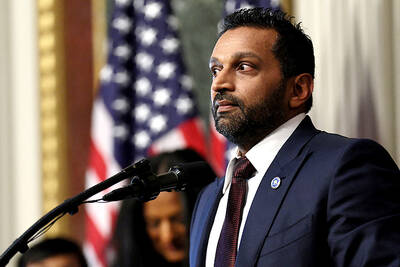
A pro-Iran hacking group claimed to breach FBI Director Kash Patel’s personal e-mail inbox and posted some of the contents online. The e-mails provided by the hacking group include travel details, correspondence with leasing agents in Washington and global entry, and loyalty account numbers. The e-mail address the hackers claim to have compromised has been previously tied to Patel’s personal details, and the leaked e-mails contain photos of Patel and others, in addition to correspondence with family members and colleagues. “The FBI is aware of malicious actors targeting Director Patel’s personal email information,” the agency said in a statement on
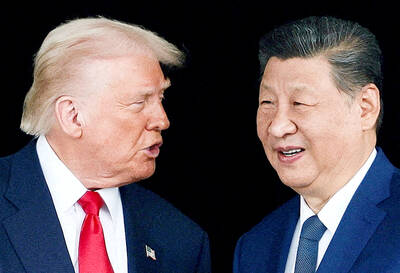
RIVALRY: ‘We know that these are merely symbolic investigations initiated by China, which is in fact the world’s most profligate disrupter of supply chains,’ a US official said China has started a pair of investigations into US trade practices, retaliating against similar probes by US President Donald Trump’s administration as the superpowers stake out positions before an expected presidential summit in May. The move, announced by the Chinese Ministry of Commerce on Friday, is a direct mirror of steps Trump took to revive his tariff agenda after the US Supreme Court last month struck down some of his duties. “China expresses its strong dissatisfaction and firm opposition to these actions,” a ministry spokesperson said in a statement, referring to the so-called Section 301 investigations initiated on March 11.

When a hiker fell from a 55m waterfall in wild New Zealand bush, rescuers were forced to evacuate the badly hurt woman without her dog, which could not be found. After strangers raised thousands of dollars for a search, border collie Molly was flown to safety by a helicopter pilot who was determined to reunite the pet and the owner. A week earlier, an emergency rescue helicopter found the woman with bruises and lacerations after a fall at a rocky spot at the waterfall on the South Island’s West Coast. She was airlifted on March 24, but they were forced to


 RSS
RSS