


Customers in Lorena’s shop place innocuous white pebbles on an electronic scale. In exchange they take away staples like cooking oil and eggs — in the depths of the Colombian jungle, you pay with cocaine base paste.
“Everything is bought and sold this way. Cash is very rare and kept for emergencies,” said the 26-year-old woman, adding that in her lifetime, more white powder had passed through her hands than cash.
It is the same whether locals are paying for beer or the company of a prostitute: Cocaine — or in this case its raw material, coca paste — is king.
Lorena has lived in the tiny jungle village of La Paz for seven years, a hamlet of 300 people whose reddish earth streets turn to mud in the rain.
It lies on the banks of the Inirida River in the remote southeastern department of Guaviare, Colombia’s most underdeveloped region.
The lush greenery of the landscape lends itself to the production of the coca leaf, the basic ingredient of cocaine, of which Colombia, despite the efforts of the Colombian government and the US, is the world’s largest producer.
There is no electricity here, no potable water, no doctor and no police.
Authority is exercised by dissident Revolutionary Armed Forces of Colombia members (FARC) who have rejected a historic peace deal to remain in the jungle.
“This is another Colombia. There is no healthcare, nothing. And there are seven-year-old children here who have never seen money,” local community leader Orland Castilla said.
The only links to the outside world for La Paz’s 300 residents are the river, one dirt road and two telephone lines. A loudspeaker announces incoming telephone calls.
Everyone here owes their existence to the cultivation and processing of the coca leaf.
Contrary to the end product, flown the classic route from grass airstrips in Colombia to Mexico and on to the US, producing coca paste is far from lucrative.
The price of 1g of cocaine in the US is about US$150, but for the producers here, the gram of coca paste never exceeds 2,000 Colombian pesos (US$0.68).
The state guarantees aid to those campesinos or farmers who will substitute coca for legal crops. Those who refuse have to sometimes face the consequences of police raids, leading to occasional clashes.
A police officer was held for three days by campesinos after clashes on July 20 on the banks of the Inirida.
Under pressure from the US, the main market for Colombia’s cocaine, Bogota, plans to reclaim 100,000 hectares from coca cultivation this year, by force if necessary.
A hoped-for dividend on the peace deal with FARC signed in December last year is that the former guerrilla movement will encourage a move to legal crops.
From first light on the farm of Miguel “Mangos,” laborers empty bags of freshly picked coca leaves in a makeshift jungle laboratory.
Miguel, 56, runs a garden trimmer through the leaves and then sprinkles a mixture of water and lime over them. It is the beginning of a lengthy chemical process involving cement, fertilizer, gasoline and acids to extract cocaine.
The coca paste that emerges from the first rudimentary process in La Paz has a cocaine content of about 35 percent.
For every US$1,000 he invests, he makes US$1,200. It allows him to survive, he said.
“I have planted bananas, maize, cassava, but it is not profitable,” Miguel said.
To bring bananas to the market requires transport and he ends up trading at a loss because of the costs involved, he said.
“1kg of coca, I can take it in my pocket,” he said.
“When people come to buy the merchandise, we do not ask who they are and where they are going,” community leader Diego Parra said.
Buyers make themselves scare when the army or police get involved and might not return for a long time.
Then the campesinos venture out with the coca to the city of San Jose, almost four hours away by car, risking arrest.
“They tell us we are guerrillas or that we are drug traffickers,” Cielo Rueda said. “But we are the last link in the chain. In all of the drug business, we are the poorest.”

When a hiker fell from a 55m waterfall in wild New Zealand bush, rescuers were forced to evacuate the badly hurt woman without her dog, which could not be found. After strangers raised thousands of dollars for a search, border collie Molly was flown to safety by a helicopter pilot who was determined to reunite the pet and the owner. A week earlier, an emergency rescue helicopter found the woman with bruises and lacerations after a fall at a rocky spot at the waterfall on the South Island’s West Coast. She was airlifted on March 24, but they were forced to

CONFIDENCE BOOSTER: ’After parkour ... you dare to do a lot of things that you think only young people can do,’ a 67-year-old parkour enthusiast said In a corner of suburban Singapore, Betty Boon vaults a guardrail, crawls underneath a slide, executes forward shoulder rolls and scales a steep slope, finishing the course to applause. “Good job,” the 69-year-old’s coach cheers. This is “geriatric parkour,” where about 20 retirees learned to tackle a series of relatively demanding exercises, building their agility and enjoying a sense of camaraderie. Boon, an upbeat grandmother, said learning parkour has aided her confidence and independence as she ages. “When you’re weak, you will be dependent on someone,” she said after sweating it out with her parkour classmates in suburban Toa Payoh,
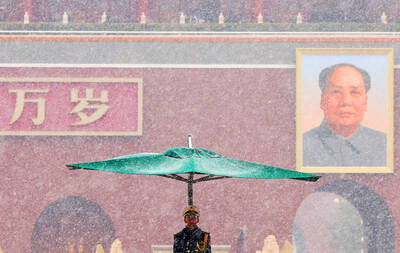
Chinese dissident artist Gao Zhen (高兟), famous for making provocative satirical sculptures of former Chinese leader Mao Zedong (毛澤東), was tried on Monday over accusations of “defaming national heroes and martyrs,” his wife and a rights group said. Gao, 69, who was detained in 2024 during a visit from the US, faces a maximum three-year prison sentence, said his wife, Zhao Yaliang (趙雅良), and Shane Yi, a researcher at the Chinese Human Rights Defenders group which operates outside the nation. The closed-door, one-day trial took place at Sanhe City People’s Court in Hebei Province neighboring the capital, Beijing, and ended without a
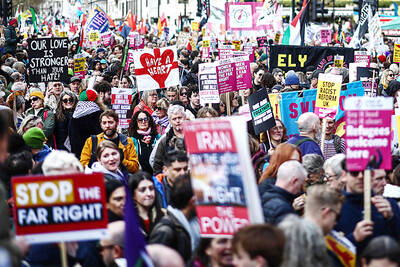
‘TOXIC CLIMATE’: ‘I don’t really recognize Labour anymore... The idea that you can implement far-right ideas in order to stop the far right is nonsense,’ a protester said Tens of thousands of people on Saturday marched through central London to protest against the far right, weeks ahead of local elections and six months after Britain saw one of its largest far-right demonstrations. Organized by hundreds of civic groups, including trade unions, anti-racism campaigners and Muslim representative bodies, Saturday’s Together Alliance event was billed as the biggest in UK history to counter right-wing extremism. A separate pro-Palestinian march had also converged with the main rally. While organizers claimed 500,000 had turned out in total, the police gave a figure of about 50,000. Protesters carrying placards with slogans such as


 RSS
RSS