


For centuries, the only use humans found for the lugworm — dark pink, slimy and inedible — was on the end of a fish hook. However, the invertebrates’ unappreciated status is about to change.
Their blood, French researchers said, has an extraordinary ability to load up with life-giving oxygen.
Harnessing it for human needs could transform medicine, providing a blood substitute that could save lives, speed recovery after surgery and help transplant patients, they said.
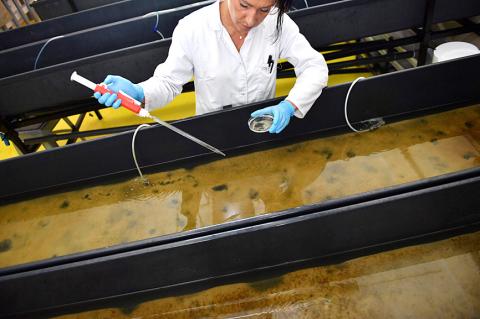
Photo: AFP
“The hemoglobin of the lugworm can transport 40 times more oxygen from the lungs to tissues than human hemoglobin,” said Gregory Raymond, a biologist at Aquastream, a fish-farming facility on the Brittany coastline. “It also has the advantage of being compatible with all blood types.”
Raymond and his team, which specializes in fish egg production, joined forces with biotech firm Hemarina in 2015 in the hope of securing a reliable means of lugworm production.
The facility now churns out more than 1.3 million of the creatures each year, each providing tiny amounts of the precious hemoglobin.
“We started basically from zero. Since the worm had never been studied, all parameters needed inventing from scratch, from feeding to water temperature,” project researcher Gwen Herault said.
Medical interest in the lugworm — Arenicola marina — dates back to 2003, when the outbreak of mad cow disease in Europe and the worldwide HIV epidemic began to affect blood supplies.
The problem was that animal hemoglobins, as a substitute for the human equivalent, can cause allergic reaction, potentially damaging the kidneys.
In lugworms, though, hemoglobin dissolves in the blood and is not contained within red blood cells as in humans — so blood type is not an issue — and its structure is almost the same as human hemoglobin.
In 2006, the worm’s potential was validated in a major study.
Scientists at Roscoff, close to Plomeur, extracted and purified hemoglobin from local-caught lugworms and tested it on lab mice. The rodents were fine and showed no sign of the immune response that dogged other animal substitutes.
If proven safe for humans, the researchers said, the worms’ oxygen-rich blood could tackle septic shock — a crash in blood pressure that can cause fatal multiple organ failure — and help to conserve organs for transplantation.
Clinical trials of the blood product began in 2015. Lugworm hemoglobin was used last year in 10 human kidney transplants at a hospital in the western French city of Brest and 60 patients are currently enrolled in tests of the blood product across France.
The secrets of lugworm hemoglobin lie in its ability to survive in extreme conditions, burrowing into sand at the edges of the tide. The worm grows to about 25cm in length and has several bushy external gills along its body. At high tide, submerged in water, the worm builds up stocks of oxygen that, astonishingly, allow it to survive more than eight hours out of the water at low tide.
Anyone who has walked along a sandy beach at low tide will see evidence of lugworms, from the tiny coiled casts of sand they throw up from their burrow, 10cm below the surface.
However, apart from anglers who dig up the creatures for bait, lugworms are rarely seen — and breeding them is a novel challenge.
“The main difficulty is working with a small animal that lives its life hidden,” Raymond said.
Aquastream struggled at first with basic rearing problems — including how to tell a male lugworm from a female.
After nine months of testing, “50 percent of adult worms survived and a good deal of them produced eggs,” Herault said.
Aquastream director Nathalie Le Rouilly said that her firm’s collaboration with Hemarina could provide the world of medical science with a sustainable supply of the worms.
“There is nowhere else in France or the world that has the capacity to produce lugworms in a controlled environment to ensure a supply of their hemoglobin,” she said.
Scientists are excited by the potential of lugworm hemoglobin — although they also point to a rigorous testing procedure before the molecule can be certified as safe and effective for humans.
“The properties of extracellular hemoglobin extracted from the lugworm could help protect skin grafts, promote bone regeneration and lead to universal blood,” Raymond said.
If this vision turns real, lugworm blood may also allow donor organs to live longer outside the bodies, potentially helping thousands of recipients each year.

Through the noise of rushing papers and whirring belts at a print factory in Kyoto, two creators watch their photo essay come to life in broadsheet form — part of an effort to win new audiences in the age of artificial intelligence (AI). Despite the decline of the publishing industry, self-publication and handmade “zine” magazines are growing in popularity in Japan, reflecting the nation’s enduring love of paper in the digital era. While speaking to Agence France-Presse at the plant, his hands black with ink, one of the creators, Kazuma Obara, said: “I think [paper] is a medium that engages all five

‘ABSURD MISTAKE’: The election commission said that there had been a failure to anticipate turnout after 14 polling stations ran short of ballot papers South Korean riot police yesterday cleared protesters from a Seoul polling station after a 35-hour blockade sparked by a shortage of ballot papers during local elections earlier this week. Wednesday’s election was the first nationwide vote since South Korean President Lee Jae-myung took office following the ouster of Yoon Suk-yeol over his short-lived martial law declaration. Lee’s ruling Democratic Party swept most races, but failed to flip the crucial Seoul mayoral seat. The South Korean National Election Commission apologized, blaming a failure to anticipate turnout after 14 polling stations in Seoul ran short of ballot papers. Some polling stations stayed open until 10pm to

Australian researchers have trained lab-grown brain cells on a silicon computer chip to play the 1990s shooter game Doom and said they are just scratching the surface of what the neurons could be capable of doing. It is the science-fiction work of biotech boffins at Cortical Labs, who researched and developed the technology that harnesses the workings of the brain’s networking system. Each so-called “biological computer” contains about 200,000 living human brain cells, grown from stem cells that were harvested from blood donations. Having mastered the simple computer game Pong, where a paddle is moved up and down to send a ball

France experienced its hottest spring on record, the French weather service said on Tuesday, after an exceptional early heat wave that also broke highs for the season in England and Wales. Meteo-France said the average nationwide temperature over March to May was 13.8°C — about 1.7°C above the norm, and surpassing records set in 2011 and 2020. “The warmest spring since records began in 1900,” it said in a bulletin. All three months were warmer than average, but the onset of an “unprecedented heatwave” late last month pushed the mercury to highs typically seen at the height of the summer. “Our country had never


 RSS
RSS