


A typeface has sparked uproar in Pakistan after documents using the font were produced in a corruption case against Pakistani Prime Minister Nawaz Sharif — despite being dated a year before the design was released.
Microsoft’s Calibri font was used to type certified papers naming Sharif’s daughter, Maryam Safdar, as a trustee for several of the family’s high-end London properties.
The plush apartments are at the heart of the case against the Sharif family, with authorities and the opposition questioning the legitimacy of the funds used to buy them via offshore companies.
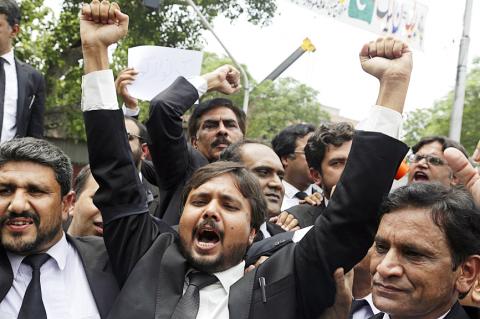
Photo: AP
The identity of the legal beneficiaries has formed part of the probe and the documents were meant to show that Safdar, who is Sharif’s presumptive political heir, was a trustee only, but the papers were dated February 2006 — a year before the font in which they are typed was in widespread commercial use, its creator said.
The same conclusion was drawn by a joint investigative team (JIT) tasked by the Pakistani Supreme Court with examining the corruption claims, which had London’s Radley Forensic Document Laboratory assess the documents.
Based on that assessment, the JIT rejected the papers as “falsified” in a report issued earlier this week.
The conclusion, dubbed Fontgate, set Pakistani social media alight with jokes and memes, and was widely repeated in mainstream media, adding fuel to opposition calls for the prime minister to step down.
“Today #calibri was searched more than porn in Pakistan,” Twitter user Sherry wrote.
Journalist Mubashir Zaidi said the prime minister should now write his resignation “in #Calibri font.”
Supporters of Sharif’s ruling PML-N party argued that Calibri has been publicly available since 2004, but the font’s creator, a Dutch designer named Lucas de Groot, said in a statement that it was “unlikely” Calibri had been used in any official documents in 2006.
“In my opinion the document in question was produced much later,” De Groot said.
De Groot said he began designing Calibri in 2002 and sent the finalized version to Microsoft in 2004. After that, he said, it was used in beta versions that would have required “serious effort” to obtain.
The first Microsoft product to use Calibri on a large scale was Office 2007, he said, which was available to resellers by Nov. 20, 2006, and for retail by Jan. 30, 2007.
“So in theory it would have been possible to make a document with Calibri in 2006,” he said. “However ... It should have been taken from a beta operating system, from the hands of computer nerds. Why would anyone use a completely unknown font for an official document in 2006? If the person using Calibri was such a font lover that he or she had to use the new Calibri, then he or she should be able to prove that other documents were printed with Calibri in 2006 and these prints should be in the hands of other people as well.”
Safdar, herself a regular Twitter user, has not yet commented publicly on the Calibri claim, although she vowed the report itself would be “decimated” in court.
The corruption controversy which has engulfed her family erupted last year with the publication of 11.5 million secret documents from Panamanian law firm Mossack Fonseca, revealing the offshore dealings of many of the world’s rich and powerful.
Along with Safdar, two more of Sharif’s four children — his sons Hasan and Hussein — were also implicated in the papers.
Sharif’s PML-N party insists the wealth used to purchase the properties was acquired legally, through family businesses in Pakistan and the Gulf, but the JIT report, commissioned by the Pakistani Supreme Court in April, said there was a “significant disparity” between Nawaz Sharifs’ income and lifestyle.
The Sharif family has consistently denied the allegations against it and rejected the JIT report, with allies denouncing it as “trash.”
The court is considering its next steps and is to begin deciding what action to take next week.
SEE PAKISTAN ON PAGE 10
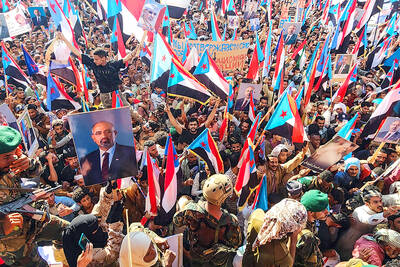
Yemen’s separatist leader has vowed to keep working for an independent state in the country’s south, in his first social media post since he disappeared earlier this month after his group briefly seized swathes of territory. Aidarous al-Zubaidi’s United Arab Emirates (UAE)-backed Southern Transitional Council (STC) forces last month captured two Yemeni provinces in an offensive that was rolled back by Saudi strikes and Riyadh’s allied forces on the ground. Al-Zubaidi then disappeared after he failed to board a flight to Riyadh for talks earlier this month, with Saudi Arabia accusing him of fleeing to Abu Dhabi, while supporters insisted he was

The Chinese Embassy in Manila yesterday said it has filed a diplomatic protest against a Philippine Coast Guard spokesman over a social media post that included cartoonish images of Chinese President Xi Jinping (習近平). Philippine Coast Guard spokesman Jay Tarriela and an embassy official had been trading barbs since last week over issues concerning the disputed South China Sea. The crucial waterway, which Beijing claims historic rights to despite an international ruling that its assertion has no legal basis, has been the site of repeated clashes between Chinese and Philippine vessels. Tarriela’s Facebook post on Wednesday included a photo of him giving a
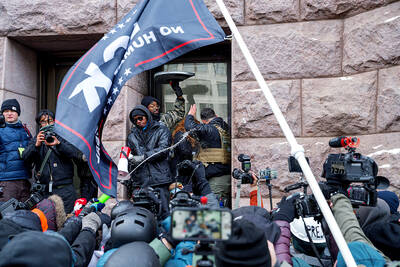
‘MOBILIZED’: While protesters countered ICE agents, Minnesota Governor Tim Walz activated the state’s National Guard to ‘support the rights of Minnesotans’ to assemble Hundreds of counterprotesters drowned out a far-right activist’s attempt to hold a small rally in support of US President Donald Trump’s latest immigration crackdown in Minneapolis, Minnesota, on Saturday, as the governor’s office announced that National Guard troops were mobilized and ready to assist law enforcement, although not yet deployed to city streets. There have been protests every day since the US Department of Homeland Security (DHS) ramped up immigration enforcement in the Twin Cities of Minneapolis and Saint Paul by bringing in more than 2,000 federal officers. Conservative influencer Jake Lang organized an anti-Islam, anti-Somali and pro-US Immigration and Customs Enforcement
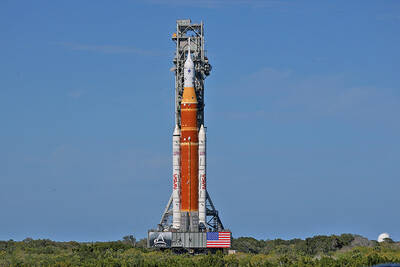
NASA on Saturday rolled out its towering Space Launch System (SLS) rocket and Orion spacecraft as it began preparations for its first crewed mission to the Moon in more than 50 years. The maneuver, which takes up to 12 hours, would allow the US space agency to begin a string of tests for the Artemis 2 mission, which could blast off as early as Feb. 6. The immense orange and white SLS rocket, and the Orion vessel were slowly wheeled out of the Vehicle Assembly Building at the Kennedy Space Center in Florida, and painstakingly moved 6.5km to Launch Pad 39B. If the


 RSS
RSS