


Grueling foot drills and camouflage uniforms are part of life for some Hong Kongers as military-style youth groups become increasingly popular, despite there being no army to join.
Some follow the traditions of former British colonial forces, while others are newly invented military-flavored boot camps designed to keep young people in shape.
However, as the semi-autonomous territory prepares to mark 20 years since it was handed back by Britain to China in 1997, there are concerns that politics is taking over with the formation of secretive new groups.
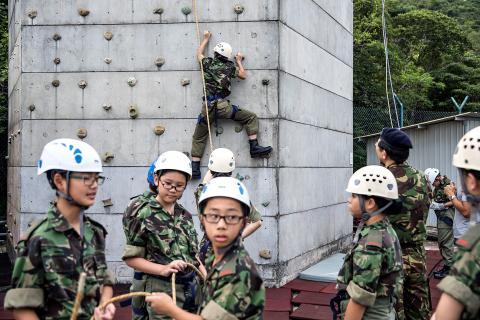
Photo: AFP
Speculation is rife about the Hong Kong Army Cadets Association (HKACA), whose members wear green uniforms reminiscent of China’s People’s Liberation Army (PLA).
Its Web site describes it as a uniform group that provides training in discipline and Chinese-style foot drills, to “cultivate strong willpower ... unity and vigor.”
It was launched in 2015 — a year after huge student-led pro-democracy rallies in Hong Kong brought parts of the territory to a standstill in an unprecedented challenge to Beijing.
Some observers say the cadets could be a way to get a pro-China message across at a time when younger generations are pushing back, with some campaigning for a split from the mainland.
The aim was likely “patriotic education,” political analyst Ma Ngok (馬嶽) said.
“Both local and central authorities would have thought it necessary and urgent to start trying to win young hearts and minds,” he said.
An official attempt to implement a patriotic curriculum in schools failed in 2012 after massive demonstrations by students, parents and teachers concerned it would amount to brainwashing.
The new cadet group’s commander-in-chief is the wife of Beijing-friendly Hong Kong Chief Executive Leung Chun-ying (梁振英), and some of its honorary patrons include members of the PLA and China’s liaison office in Hong Kong.
The PLA has a garrison in central Hong Kong and is responsible for defending the territory, but only recruits Chinese citizens.
Hong Kong does not have its own separate army.
After the handover some feared the PLA would be heavy-handed, given the army’s crackdown on student protesters in Beijing’s Tiananmen Square in 1989.
Instead they have maintained a very low profile and are barred from interfering in local affairs.
However, some Hong Kong lawmakers have questioned whether the PLA is providing training or financial support for the cadets.
The youth group’s chairman, Bunny Chan (陳振彬), has denied such links.
The HKACA turned down multiple interview requests and when one youth member was approached he said he could not comment.
Last year, in response to the foundation of the cadets, anti-China party Civic Passion launched its own military-flavor youth group.
The dedicated Passion Teens Squad has 1,900 Facebook followers and says its aim is physical training and learning Hong Kong’s “real history and culture.”
The group’s trainer, who identified himself only as Wan, told reporters that activities included hiking, orientation and survival skills.
“We are resisting other youth groups that have links with China,” he said.
However, members of many more established youth groups say they simply enjoy getting out of the urban sprawl to learn new skills.
At a Saturday session with the Hong Kong Adventure Corps, young recruits marched, climbed walls and spoke into walkie-talkies at their training ground in the territory’s rural Sai Kung district.
The group has about 4,200 youth members and was set up by former staff of the Royal Hong Kong Regiment, also known as The Volunteers, a local branch of the British Army disbanded in 1995.
Tang Chi-shing, 12, said he did not like it when he joined 18 months ago, but grew to enjoy the challenging training.
“This organization is one of the toughest in Hong Kong,” he told reporters, saying he no longer feared his school teachers as a result.
Members wear green camouflage and berets and learn everything from map-reading to abseiling.
“I just wanted to play the games and go rock climbing,” new recruit Hosanna Tse, 14, told reporters, saying she enjoyed wearing the uniform.
Director Matthew Wong (黃衛民) served in The Volunteers for 14 years and said that even though the Adventure Corps inherited their drills from the British Army, there was no political aim.
“Our objective is not to train soldiers, but to develop their personal qualities,” he said.
Military historian Kwong Chi-man (鄺智文) said Hong Kong parents considered the numerous uniform groups — which also include non-military-style organizations such as the Girl Guides — as a way to help children become more self-reliant and confident.
Kwong, assistant professor at Hong Kong Baptist University, said any political slant would put them off. “If they knew their kids were entering those organizations to become ideological, many of those parents, I would say, would withhold.”

When a hiker fell from a 55m waterfall in wild New Zealand bush, rescuers were forced to evacuate the badly hurt woman without her dog, which could not be found. After strangers raised thousands of dollars for a search, border collie Molly was flown to safety by a helicopter pilot who was determined to reunite the pet and the owner. A week earlier, an emergency rescue helicopter found the woman with bruises and lacerations after a fall at a rocky spot at the waterfall on the South Island’s West Coast. She was airlifted on March 24, but they were forced to
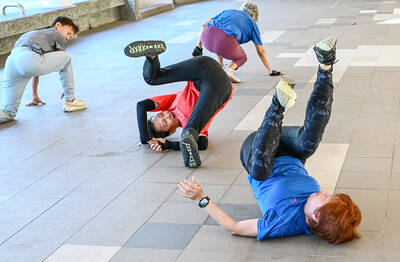
CONFIDENCE BOOSTER: ’After parkour ... you dare to do a lot of things that you think only young people can do,’ a 67-year-old parkour enthusiast said In a corner of suburban Singapore, Betty Boon vaults a guardrail, crawls underneath a slide, executes forward shoulder rolls and scales a steep slope, finishing the course to applause. “Good job,” the 69-year-old’s coach cheers. This is “geriatric parkour,” where about 20 retirees learned to tackle a series of relatively demanding exercises, building their agility and enjoying a sense of camaraderie. Boon, an upbeat grandmother, said learning parkour has aided her confidence and independence as she ages. “When you’re weak, you will be dependent on someone,” she said after sweating it out with her parkour classmates in suburban Toa Payoh,
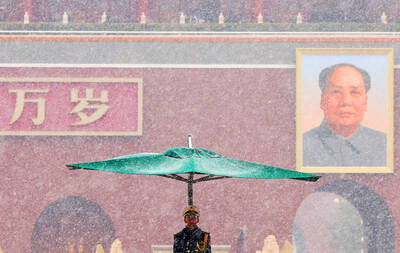
Chinese dissident artist Gao Zhen (高兟), famous for making provocative satirical sculptures of former Chinese leader Mao Zedong (毛澤東), was tried on Monday over accusations of “defaming national heroes and martyrs,” his wife and a rights group said. Gao, 69, who was detained in 2024 during a visit from the US, faces a maximum three-year prison sentence, said his wife, Zhao Yaliang (趙雅良), and Shane Yi, a researcher at the Chinese Human Rights Defenders group which operates outside the nation. The closed-door, one-day trial took place at Sanhe City People’s Court in Hebei Province neighboring the capital, Beijing, and ended without a

‘TOXIC CLIMATE’: ‘I don’t really recognize Labour anymore... The idea that you can implement far-right ideas in order to stop the far right is nonsense,’ a protester said Tens of thousands of people on Saturday marched through central London to protest against the far right, weeks ahead of local elections and six months after Britain saw one of its largest far-right demonstrations. Organized by hundreds of civic groups, including trade unions, anti-racism campaigners and Muslim representative bodies, Saturday’s Together Alliance event was billed as the biggest in UK history to counter right-wing extremism. A separate pro-Palestinian march had also converged with the main rally. While organizers claimed 500,000 had turned out in total, the police gave a figure of about 50,000. Protesters carrying placards with slogans such as


 RSS
RSS