


British inventor Richard Browning lifted off from the shore of Vancouver Harbour on Thursday in a personal flight suit that inspired references to comic superhero Iron Man.
Using thrusters attached to his arms and back, Browning flew in a circle and hovered a short distance from the ground, captivating attendees at a TED Conference.
The personal flight suit is capable of propelling the wearer much higher and faster, its creators said.
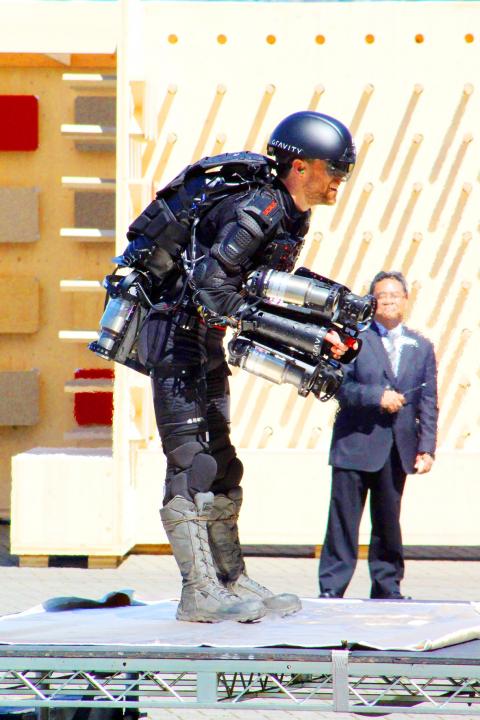
Photo: AFP
“The hypothesis was that the human mind and body, if properly augmented, could achieve some pretty cool stuff,” the extreme athlete and engineer said at the gathering a short time earlier.
Browning told of experimenting with various numbers and arrays of essentially miniature jet engines on his limbs.
Along the way, he said, there were more than a few crashes to the ground.
“The whole journey was about trying and failing, and learning from that,” Browning said.
The first reasonably stable, six-second flight with the gear inspired his team to press on.
His start-up, Gravity, formally debuted about a month ago with an early-version suit called “Daedalus.”
A 55-second video clip of the suit in action has logged more than 1 million views since being posted on YouTube about three weeks ago.
Browning said he is already getting interest from investors and some in the British military, who told him they had given up on the flight feature of an Iron Man suit until seeing his human-propulsion gear.
“I don’t think anyone is going to be going down to Wal-Mart with it or taking anybody to school for quite a while, but the team at Gravity is moving it along,” Browning said.
He dreams of a flight suit that one day would allow its wearer to launch from a beach, soar along the coast and then perhaps hop into a helicopter in the air to continue their journey.
Browning has already seen the early-version flight suit compared with the Iron Man armor worn by Marvel Comics character Tony Stark, but stressed that his goal is firmly rooted in the real world.
He also described the project as part of a personal journey, inspired by an engineer father with a love for flying machines, but who died when he was just a teenager.
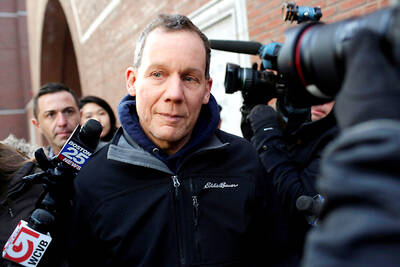
An American scientist convicted of lying to US authorities about payments from China while he was at Harvard University has rebuilt his research lab in Shenzhen, China, to pursue technology the Chinese government has identified as a national priority: embedding electronics into the human brain. Charles Lieber, 67, is among the world’s leading researchers in brain-computer interfaces. The technology has shown promise in treating conditions such as amyotrophic lateral sclerosis and restoring movement in paralyzed people. It also has potential military applications: Scientists at the Chinese People’s Liberation Army have investigated brain interfaces as a way to engineer super soldiers by boosting

Indonesian police have arrested 13 people after shocking images of alleged abuse against small children at a daycare center went viral, sparking outrage across the nation, officials said on Monday. Police on Friday last week raided Little Aresha, a daycare center in Yogyakarta on Java island, following a report from a former employee. CCTV footage circulating on social media showed children, most younger than two, lying on the floor wearing only diapers, their hands and feet bound with rags. The police have confirmed that the footage is authentic. Police said they also found 20 children crammed into a room just 3m by 3m. “So
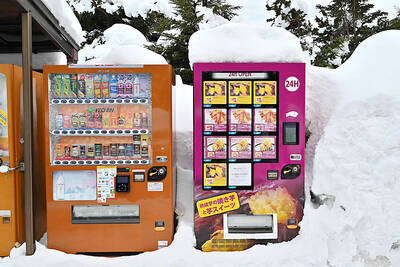
From post offices and parks to stations and even the summit of Mount Fuji, Japan’s vending machines are ubiquitous, but with the rapid pace of inflation cooling demand for their drinks, operators are being forced to rethink the business. Last month beverage giant DyDo Group Holdings announced it would remove about 20,000 vending machines — about 7 percent of their stock nationwide — by January next year, to “reconstruct a profitable network.” Pokka Sapporo Food & Beverage, based in Nagoya, also said last month it would sell its 40,000-machine operation to Osaka-based Lifedrink Co. “The strength of the vending machine
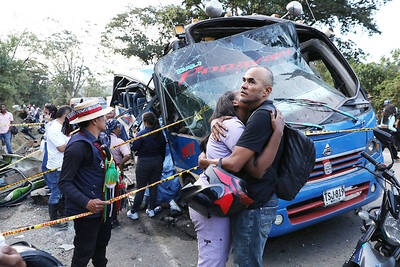
A highway bomb attack in a restive region of southwestern Colombia on Saturday killed 14 people and injured at least 38, the latest spate of violence ahead of next month’s presidential election. Authorities blamed the attack in the Cauca department — a conflict-ridden, coca-growing region — on dissidents of the now-disbanded FARC guerrilla army, who have been sowing violence across the country. “Those who carried out this attack ... are terrorists, fascists and drug traffickers,” Colombian President Gustavo Petro said on social media. “I want our very best soldiers to confront them,” he added. The leftist leader blamed the bombing


 RSS
RSS