


Men from three Florida counties should not donate sperm because of a small risk of spreading the Zika virus, US health officials said on Monday.
The guidance had previously applied to Miami-Dade County, the only place in Florida where there is evidence the virus was spread by mosquitoes. However, infections were reported in people in South Florida who could not clearly be linked to Miami-Dade.
The US Centers for Disease Control and Prevention (CDC) said the advice should extend to two counties north of Miami — Broward and Palm Beach.
The recommendation applies to men who lived or traveled in those counties since June 15. Zika is mainly spread by mosquito bites but it can also be spread through sex. People can be infected without getting sick and the virus can remain in semen for months.
There is no evidence of a pregnant women being infected by Zika through a sperm donation, and such a risk is considered low, centers officials said.
Infection during pregnancy can lead to brain-related birth defects.
The US Food and Drug Administration (FDA) regulates sperm donations and previously advised sperm banks they should not accept donors if they had been diagnosed with Zika or had been to an area with widespread Zika within the past six months.
Sperm banks should heed the centers’ advice discouraging donations from men in the three counties, an FDA spokeswoman said.
There are 12 sperm donor banks in the three south Florida counties, centers officials said.
While blood donations can be tested for Zika, there is not a good test for semen, the FDA said.
The last case of mosquito transmission of Zika in Florida was in December last year. However, officials think mosquitoes might start spreading it again this summer. In the continental US last year, 221 people got Zika from mosquitoes, most in the Miami area.
There is no evidence that mosquitoes in Broward or Palm Beach were spreading it, said Denise Jamieson, who is leading the centers’ Zika emergency efforts.
Officials suspect the local infections occurred in Miami-Dade, she said.

Two medieval fortresses face each other across the Narva River separating Estonia from Russia on Europe’s eastern edge. Once a symbol of cooperation, the “Friendship Bridge” connecting the two snow-covered banks has been reinforced with rows of razor wire and “dragon’s teeth” anti-tank obstacles on the Estonian side. “The name is kind of ironic,” regional border chief Eerik Purgel said. Some fear the border town of more than 50,0000 people — a mixture of Estonians, Russians and people left stateless after the fall of the Soviet Union — could be Russian President Vladimir Putin’s next target. On the Estonian side of the bridge,

Jeremiah Kithinji had never touched a computer before he finished high school. A decade later, he is teaching robotics, and even took a team of rural Kenyans to the World Robotics Olympiad in Singapore. In a classroom in Laikipia County — a sparsely populated grasslands region of northern Kenya known for its rhinos and cheetahs — pupils are busy snapping together wheels, motors and sensors to assemble a robot. Guiding them is Kithinji, 27, who runs a string of robotics clubs in the area that have taken some of his pupils far beyond the rural landscapes outside. In November, he took a team

Civil society leaders and members of a left-wing coalition yesterday filed impeachment complaints against Philippine Vice President Sara Duterte, restarting a process sidelined by the Supreme Court last year. Both cases accuse Duterte of misusing public funds during her term as education secretary, while one revives allegations that she threatened to assassinate former ally Philippine President Ferdinand Marcos Jr. The filings come on the same day that a committee in the House of Representatives was to begin hearings into impeachment complaints against Marcos, accused of corruption tied to a spiraling scandal over bogus flood control projects. Under the constitution, an impeachment by the
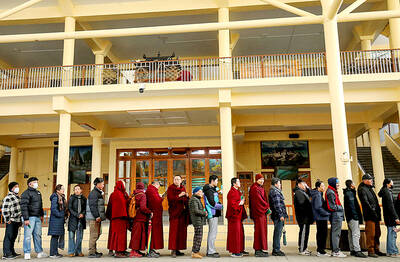
Exiled Tibetans began a unique global election yesterday for a government representing a homeland many have never seen, as part of a democratic exercise voters say carries great weight. From red-robed Buddhist monks in the snowy Himalayas, to political exiles in megacities across South Asia, to refugees in Australia, Europe and North America, voting takes place in 27 countries — but not China. “Elections ... show that the struggle for Tibet’s freedom and independence continues from generation to generation,” said candidate Gyaltsen Chokye, 33, who is based in the Indian hill-town of Dharamsala, headquarters of the government-in-exile, the Central Tibetan Administration (CTA). It


 RSS
RSS