


Chinese officials are issuing new warnings about the specter of global religious extremism seeping into the country, following reports of fighters from China’s Muslim minority fighting alongside militants in Syria and Iraq.
Sharhat Ahan, a top political and legal affairs party official in Xinjiang Province, on Sunday became the latest official from a predominantly Muslim region to warn about China becoming destabilized by the “international anti-terror situation” and called for a “people’s war.”
In the past year, regional leaders in Xinjiang, home to the Uighur minority, have ramped up surveillance measures and police patrols and staged massive rallies intended to showcase the power of the security forces.
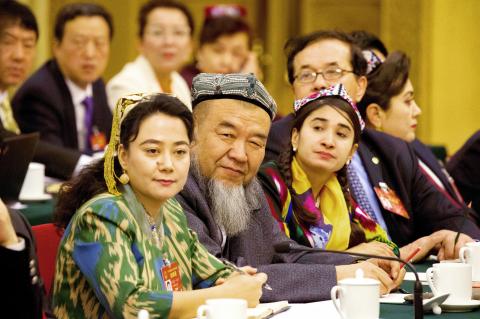
Photo: AP
Those demonstrations are intended to “declare war against terrorists, to showcase the party and the government’s resolve to fight terror, resolve to preserve public safety and [China’s] mighty combat strength,” Ahan told officials gathered in Beijing for this month’s National People’s Congress.
Although some academics question whether global militant networks are active in China, top Chinese officials are increasingly echoing strands of international discourse to back up claims that extremism is growing worldwide and needs to be rolled back.
In recent years, hundreds have died in violent incidents mainly in Xinjiang that officials blame on Uighur separatists inspired by the global militant cause.
While it has provided little evidence, the government says Xinjiang faces a grave separatist threat from Uighur fighters linked to al-Qaeda and the Islamic State group.
The Islamic State group released a video late last month purportedly showing Uighur fighters training in Iraq and vowing to strike China, the SITE Intelligence Group said.
Officials from Ningxia Hui Autonomous Region — which has an ethnic Hui population that is predominantly Muslim but, unlike Xinjiang, rarely sees separatist or religious violence — warned similarly this past week about the perils of militant extremism.
Speaking at a regional meeting open to the media, Ningxia Communist Party Secretary Li Jian-hua (CHAR) drew comparisons with the policies of US President Donald Trump’s administration to make his point.
“What the Islamic State and extremists push is jihad, terror, violence,” Li said. “This is why we see Trump targeting Muslims in a travel ban. It does not matter whether anti-Muslim policy is in the interests of the US or it promotes stability, it is about preventing religious extremism from seeping into all of US culture.”
Wu Shi-min (Char), a former ethnic affairs official from Ningxia, said that ideological work must be strengthened in the region to promote a Chinese identity among its Hui population, the descendants of Muslim traders plying the Silk Road centuries ago.
“The roots of the Hui are in China,” Wu said. “To discuss religious consciousness, we must first discuss Chinese consciousness. To discuss the feelings of minorities, we must first discuss the feelings of the Chinese people.”
The officially atheistic Chinese Communist Party has long viewed religion with suspicion, but has generally granted a fair degree of religious freedom to its Hui minority, especially in their heartland of Ningxia, where mosques dot the skyline.
The party has kept a far tighter grip over Xinjiang’s Uighurs — who have a language, culture and physical features that are more closely linked to Central Asia — partly due to the existence of a decades-old separatist movement.
However, the comments by party officials in Ningxia, seen as traditionally more lax on ethnic and religious policy, reflected the top Chinese leadership’s growing anxieties about Islam more broadly over the past year, analysts said.
“There’s a strengthening trend of viewing Islam as a problem in Chinese society,” said Mohammed al-Sudairi, a doctoral student at the University of Hong Kong. “Xi Jinping has been quite anxious about what he saw as the loss of party-state control over the religious sphere when he entered power, which necessitated this intervention. I don’t think things will take a softer turn.”
ROCKY RELATIONS: The figures on residents come as Chinese tourist numbers drop following Beijing’s warnings to avoid traveling to Japan The number of Chinese residents in Japan has continued to rise, even as ties between the two countries have become increasingly fractious, data released on Friday showed. As of the end of December last year, the number of Chinese residents had increased by 6.5 percent from the previous year to 930,428. Chinese people accounted for 22.6 percent of all foreign residents in Japan, making them by far the largest group, Japanese Ministry of Justice data showed. Beijing has criticized Tokyo in increasingly strident terms since Japanese Prime Minister Sanae Takaichi last year suggested that a military conflict around Taiwan could
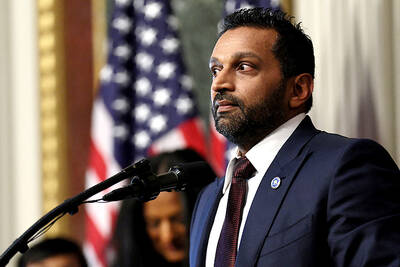
A pro-Iran hacking group claimed to breach FBI Director Kash Patel’s personal e-mail inbox and posted some of the contents online. The e-mails provided by the hacking group include travel details, correspondence with leasing agents in Washington and global entry, and loyalty account numbers. The e-mail address the hackers claim to have compromised has been previously tied to Patel’s personal details, and the leaked e-mails contain photos of Patel and others, in addition to correspondence with family members and colleagues. “The FBI is aware of malicious actors targeting Director Patel’s personal email information,” the agency said in a statement on
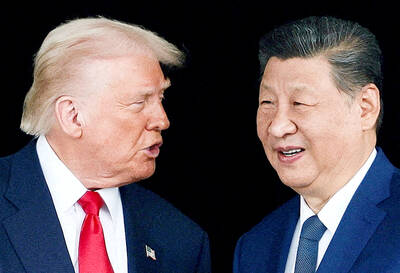
RIVALRY: ‘We know that these are merely symbolic investigations initiated by China, which is in fact the world’s most profligate disrupter of supply chains,’ a US official said China has started a pair of investigations into US trade practices, retaliating against similar probes by US President Donald Trump’s administration as the superpowers stake out positions before an expected presidential summit in May. The move, announced by the Chinese Ministry of Commerce on Friday, is a direct mirror of steps Trump took to revive his tariff agenda after the US Supreme Court last month struck down some of his duties. “China expresses its strong dissatisfaction and firm opposition to these actions,” a ministry spokesperson said in a statement, referring to the so-called Section 301 investigations initiated on March 11.

When a hiker fell from a 55m waterfall in wild New Zealand bush, rescuers were forced to evacuate the badly hurt woman without her dog, which could not be found. After strangers raised thousands of dollars for a search, border collie Molly was flown to safety by a helicopter pilot who was determined to reunite the pet and the owner. A week earlier, an emergency rescue helicopter found the woman with bruises and lacerations after a fall at a rocky spot at the waterfall on the South Island’s West Coast. She was airlifted on March 24, but they were forced to


 RSS
RSS