


With hundreds of millions of people heading home for the Lunar New Year holiday in China, popular software charging extra to improve the odds of getting coveted rail tickets has been criticized by state media and some users as being akin to modern-day touting.
Plugged by app developers as a way to simplify purchasing, the use of the “ticket snatching” software has ballooned in recent years as more people buy on mobile devices.
“High demand for rail tickets during the New Year season cannot be an excuse for snatching apps to rob consumers, disturb public order and even push up the price,” the People’s Daily said in a commentary earlier this month.

Photo: Bloomberg
Chinese authorities say they want to ensure equal access to rail tickets for all during the Lunar New Year holiday, which starts today; about 3 billion trips will be made in the world’s biggest mass migration.
The number of buyers outstrips seats available on trains, and leads to long lines and jostling for position when tickets go on sale.
When purchasing moved online, “snatching” software sprang up from travel and tech companies hoping to increase users’ chances of making it to the front of the virtual line.
Shuang Xu, who works for a travel company in Beijing, started looking for tickets to her home city of Chongqing two weeks before she planned to leave for the New Year, but the official train booking Web site, www.12306.cn, kept crashing.
Xu paid 60 yuan (US$8.72) extra to buy two high-speed train tickets, worth 1,535 yuan, from the capital to the southwestern city.
“I had no choice but to try other ways,” she said.
This year, almost half of all train tickets are expected to be sold via mobile apps compared with 27 percent last year, according to a report by Zhixing Railway Tickets, a booking app company bought by online travel agent Ctrip in 2015.
Software provided by the likes of Ctrip.com International Ltd and search engines, including Qihoo 360 Technology Co, gives users a better chance, though no guarantee, of securing a spot on China’s trains.
The cost for improving the odds varies across platforms and can range from an extra 20 to 200 yuan.
More than 50 Chinese travel and tech companies have rolled out ticket snatching software in recent years, acquiring rival apps to help ensure a piece of the growing market for digital ticket booking services.
Ctrip, China’s biggest online travel company, has acquired a number of rival companies with ticket-selling apps, which combined make the company the largest provider of the mobile app.
Most apps, including those by Ctrip, only charge users if they successfully secure tickets, although critics say bundled insurance and other add-ons create price competition regardless of the policy.
Ctrip declined to be interviewed for this article.
Qihoo 360’s company policy stated it used “safe, no add-ons, no bundles” ticket snatching.
“We have never charged any kind of fee from our users in any way,” said Wang Yinhua, chief ticket snatching engineer at 360 Browser, a popular Web browser developed by Qihoo 360.
“Before the age of online ticket purchases, people had no choice, but to queue up through the night at railway stations and ticket windows,” Wang said.
Yet the software bears some similarity to ticket touts, said Zhao Zhanling, a legal adviser to the Internet Society of China, which is a non-governmental body backed by the Ministry of Industry and Information Technology.
“Using ticket snatching software is in effect allowing [buyers] to cut in line,” he said. “If there are people who use technology to cut in the line, this means more people who use 12306 [without software] do not get tickets.”
One traveler wrote on the Sina Weibo messaging service: “I didn’t see the difference between snatching apps and scalpers.”
Touting is illegal in China, and companies cannot charge more than 5 yuan on top of a train ticket’s set price as a service charge. However, snatching software is seen as entrusting a third party to buy the ticket on your behalf, so it does not break the rules.
National railway operator China Railway Corp did not respond to faxed requests for comment.

An American scientist convicted of lying to US authorities about payments from China while he was at Harvard University has rebuilt his research lab in Shenzhen, China, to pursue technology the Chinese government has identified as a national priority: embedding electronics into the human brain. Charles Lieber, 67, is among the world’s leading researchers in brain-computer interfaces. The technology has shown promise in treating conditions such as amyotrophic lateral sclerosis and restoring movement in paralyzed people. It also has potential military applications: Scientists at the Chinese People’s Liberation Army have investigated brain interfaces as a way to engineer super soldiers by boosting

Indonesian police have arrested 13 people after shocking images of alleged abuse against small children at a daycare center went viral, sparking outrage across the nation, officials said on Monday. Police on Friday last week raided Little Aresha, a daycare center in Yogyakarta on Java island, following a report from a former employee. CCTV footage circulating on social media showed children, most younger than two, lying on the floor wearing only diapers, their hands and feet bound with rags. The police have confirmed that the footage is authentic. Police said they also found 20 children crammed into a room just 3m by 3m. “So

A grieving mother has ended her life at a clinic in Switzerland four years after the death of her only child. Wendy Duffy, 56, a physically healthy woman, died at the Pegasos clinic in Basel after struggling to cope with the death of her 23-year-old son, Marcus. The former care worker, from the West Midlands, England, had previously attempted to take her own life. The case comes as assisted dying would not become law in England and Wales after proposed legislation, branded “hopelessly flawed” by opponents, ran out of time. Ruedi Habegger, the founder of Pegasos, described Duffy’s death as
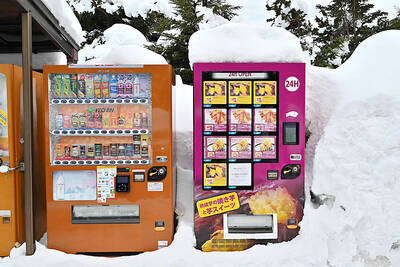
From post offices and parks to stations and even the summit of Mount Fuji, Japan’s vending machines are ubiquitous, but with the rapid pace of inflation cooling demand for their drinks, operators are being forced to rethink the business. Last month beverage giant DyDo Group Holdings announced it would remove about 20,000 vending machines — about 7 percent of their stock nationwide — by January next year, to “reconstruct a profitable network.” Pokka Sapporo Food & Beverage, based in Nagoya, also said last month it would sell its 40,000-machine operation to Osaka-based Lifedrink Co. “The strength of the vending machine


 RSS
RSS