


Facebook sparked fear — and anger — among Thailand’s social media users after its Safety Check feature triggered a false bomb alert in Bangkok.
The check-in feature allows users to signal to friends that they are safe after an event in their area such as a terror attack or natural disaster.
However, it appeared to misfire late on Tuesday, creating an alert called “The Explosion in Bangkok” that said a blast in the capital had been confirmed by “multiple sources.”
The page gave no other details about the incident, but linked to articles about a bombing in Bangkok in August last year which killed 20 people.
After numerous city residents marked themselves as safe, the alert was deactivated about one hour later at 10pm, leaving netizens relieved, but also frustrated over the false alarm.
“Facebook issued false news that has destroyed Thailand’s image,” wrote Thai user Prasit Silhanisong.
“It’s close to the New Year and now tourists might not come,” he added, calling on the social media giant to apologize.
Facebook swiftly defended the algorithm, saying the alert was activated by reports of small explosives that a protester had thrown near the Government House of Thailand earlier on Tuesday.
The incident, which caused no injuries or damage, was covered in local media.
“Safety Check was activated yesterday in Thailand following an explosion,” a Facebook spokesperson said in a statement to reporters, adding that a “trusted third party” had confirmed the incident.
It is not the first time the check-in feature has caused controversy.
In March the company apologized after a bug sent a Safety Check notification to users around the world following a deadly suicide bombing in Pakistan.
The social network also faced criticism in November last year for selectively activating the feature after attacks in Paris, but not in Beirut.
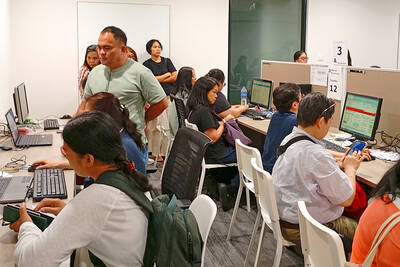
A new online voting system aimed at boosting turnout among the Philippines’ millions of overseas workers ahead of Monday’s mid-term elections has been marked by confusion and fears of disenfranchisement. Thousands of overseas Filipino workers have already cast their ballots in the race dominated by a bitter feud between President Ferdinand Marcos Jr and his impeached vice president, Sara Duterte. While official turnout figures are not yet publicly available, data from the Philippine Commission on Elections (COMELEC) showed that at least 134,000 of the 1.22 million registered overseas voters have signed up for the new online system, which opened on April 13. However,

EUROPEAN FUTURE? Albanian Prime Minister Edi Rama says only he could secure EU membership, but challenges remain in dealing with corruption and a brain drain Albanian Prime Minister Edi Rama seeks to win an unprecedented fourth term, pledging to finally take the country into the EU and turn it into a hot tourist destination with some help from the Trump family. The artist-turned-politician has been pitching Albania as a trendy coastal destination, which has helped to drive up tourism arrivals to a record 11 million last year. US President Donald Trump’s son-in-law, Jared Kushner, also joined in the rush, pledging to invest US$1.4 billion to turn a largely deserted island into a luxurious getaway. Rama is expected to win another term after yesterday’s vote. The vote would
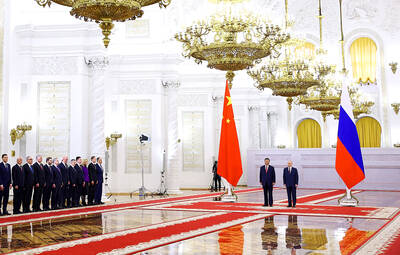
ALLIES: Calling Putin his ‘old friend,’ Xi said Beijing stood alongside Russia ‘in the face of the international counter-current of unilateralism and hegemonic bullying’ Chinese President Xi Jinping (習近平) yesterday was in Moscow for a state visit ahead of the Kremlin’s grand Victory Day celebrations, as Ukraine accused Russia’s army of launching air strikes just hours into a supposed truce. More than 20 foreign leaders were in Russia to attend a vast military parade today marking 80 years since the defeat of Nazi Germany in World War II, taking place three years into Russia’s offensive in Ukraine. Putin ordered troops into Ukraine in February 2022 and has marshaled the memory of Soviet victory against Nazi Germany to justify his campaign and rally society behind the offensive,
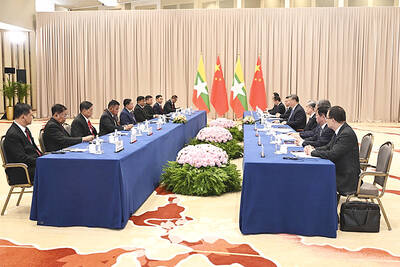
Myanmar’s junta chief met Chinese President Xi Jinping (習近平) for the first time since seizing power, state media reported yesterday, the highest-level meeting with a key ally for the internationally sanctioned military leader. Senior General Min Aung Hlaing led a military coup in 2021, overthrowing Myanmar’s brief experiment with democracy and plunging the nation into civil war. In the four years since, his armed forces have battled dozens of ethnic armed groups and rebel militias — some with close links to China — opposed to its rule. The conflict has seen Min Aung Hlaing draw condemnation from rights groups and pursued by the


 RSS
RSS