


With its regular live broadcasts, routine tirades and daily — often curiously intimate — photograph posts, the Facebook page of Cambodian Prime Minister Hun Sen has won a remarkable 5 million fans.
However, a surge of “likes” from countries including India and the Philippines has reignited allegations that his digital adoration is purchased from so-called “click farms.”
The 64-year-old strongman, a once self-confessed technology dinosaur who tolerates little dissent, has embraced Facebook with gusto in the past year after opponents used the platform to reach out to younger voters.
He has vowed to remain prime minister until he is 74 with the next elections due in 2018.
To do so he will need the support of Cambodia’s young people — a huge, tech-savvy demographic who voted in droves for the opposition at the last polls, wearied by the endemic corruption, rights abuses and political repression seen as the hallmarks of Hun Sen’s rule.
With loyalists controlling nearly all of Cambodia’s mainstream media outlets, Hun Sen was initially wary of social media.
However, in the past year he has embraced the digital sphere — while ramping up prosecutions against people for online comments.
However, that success has been dogged by allegations that a significant chunk of fans come from click farms — networks of fake and real users controlled by digital middlemen who sell likes.
In recent months, opposition groups, local media, analysts and even many of Hun Sen’s own Facebook followers have all remarked on the unusual and erratic surges in likes that his page receives.
An analysis of Hun Sen’s Facebook followers over the past six months using data from SocialBakers.com shows two periods when overseas likes have dramatically spiked — the most recent in the past three weeks.
Only 55 percent of Hun Sen’s 5 million Facebook followers now come from inside Cambodia. Many of the likes originate in countries notorious for hosting click farms, such as India, Indonesia and the Philippines.
In contrast, 82 percent of followers for Cambodian opposition leader Sam Rainsy are listed as Cambodian, the analysis showed.
That has led Rainsy, who lives in self-imposed exile in France, to accuse Hun Sen of buying friends.
“In his deceitful, but childish logic, Hun Sen needs to push his popularity on Facebook in order to justify his repressive policies,” he told reporters by e-mail.
India now accounts for the largest chunk of overseas love for Hun Sen’s page — about 562,000 fans, or 11.4 percent, dwarfing even Thailand, where there is a huge diaspora of Cambodian workers.
In March and April, Indian likes tripled from 175,000 to 517,000. Then from early May the rate of likes dipped slightly, only to once more rebound between July 4 and Monday last week, taking the number from 512,000 to 560,000.
Similar patterns have taken place this year with fans from the Philippines and Indonesia. Between Feb. 15 and May 9, Indonesian likes more than tripled from 42,000 to 150,000 and then stopped. Hun Sen’s page then garnered a sudden 35,000 further likes over the past three weeks.
Philippine likes also tripled over the same period, leveling off until the middle of last month. Since when they have surged from 207,000 to 259,000.
Hun Sen has repeatedly denied allegations that his fans are purchased.
“I think it is a pride for our nation that foreigners pay attention to the leader of our government through modern technology,” ruling Cambodian People’s Party spokesman Sok Eysan told reporters.
“If we have money we will build roads, wells and health centres for the people, we would not spend money on buying Facebook likes,” he said, adding that the click farm allegations were being fueled by “jealous” opposition politicians.
Independent political analyst Ou Virak said there were “limited reasonable explanations” for why Hun Sen’s Facebook account has seen such time-limited surges in overseas likes. However, he added that it was no surprise he and other politicians had flocked to social media in a country where two thirds of the population are under 30.
“It makes sense they are chasing their constituents,” he said.

When a hiker fell from a 55m waterfall in wild New Zealand bush, rescuers were forced to evacuate the badly hurt woman without her dog, which could not be found. After strangers raised thousands of dollars for a search, border collie Molly was flown to safety by a helicopter pilot who was determined to reunite the pet and the owner. A week earlier, an emergency rescue helicopter found the woman with bruises and lacerations after a fall at a rocky spot at the waterfall on the South Island’s West Coast. She was airlifted on March 24, but they were forced to

CONFIDENCE BOOSTER: ’After parkour ... you dare to do a lot of things that you think only young people can do,’ a 67-year-old parkour enthusiast said In a corner of suburban Singapore, Betty Boon vaults a guardrail, crawls underneath a slide, executes forward shoulder rolls and scales a steep slope, finishing the course to applause. “Good job,” the 69-year-old’s coach cheers. This is “geriatric parkour,” where about 20 retirees learned to tackle a series of relatively demanding exercises, building their agility and enjoying a sense of camaraderie. Boon, an upbeat grandmother, said learning parkour has aided her confidence and independence as she ages. “When you’re weak, you will be dependent on someone,” she said after sweating it out with her parkour classmates in suburban Toa Payoh,
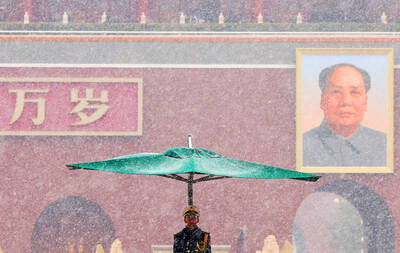
Chinese dissident artist Gao Zhen (高兟), famous for making provocative satirical sculptures of former Chinese leader Mao Zedong (毛澤東), was tried on Monday over accusations of “defaming national heroes and martyrs,” his wife and a rights group said. Gao, 69, who was detained in 2024 during a visit from the US, faces a maximum three-year prison sentence, said his wife, Zhao Yaliang (趙雅良), and Shane Yi, a researcher at the Chinese Human Rights Defenders group which operates outside the nation. The closed-door, one-day trial took place at Sanhe City People’s Court in Hebei Province neighboring the capital, Beijing, and ended without a
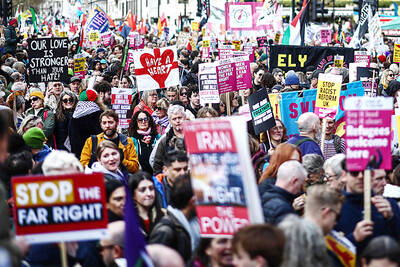
‘TOXIC CLIMATE’: ‘I don’t really recognize Labour anymore... The idea that you can implement far-right ideas in order to stop the far right is nonsense,’ a protester said Tens of thousands of people on Saturday marched through central London to protest against the far right, weeks ahead of local elections and six months after Britain saw one of its largest far-right demonstrations. Organized by hundreds of civic groups, including trade unions, anti-racism campaigners and Muslim representative bodies, Saturday’s Together Alliance event was billed as the biggest in UK history to counter right-wing extremism. A separate pro-Palestinian march had also converged with the main rally. While organizers claimed 500,000 had turned out in total, the police gave a figure of about 50,000. Protesters carrying placards with slogans such as


 RSS
RSS