


At US$100,000 a head, the puppies frolicking around the fenced lawn in western Seoul do not come cheap — but at least their owners know exactly what they are getting.
The lawn belongs to the Sooam Biotech Research Foundation, a world leader in pet cloning that has run a thriving commercial business over the past decade catering to dog owners who want to clone their pets forever.
With a client list including princes, celebrities and billionaires, the foundation offers owners protection against loss and grief with a cloning service that promises the perfect replacement for a beloved pet.
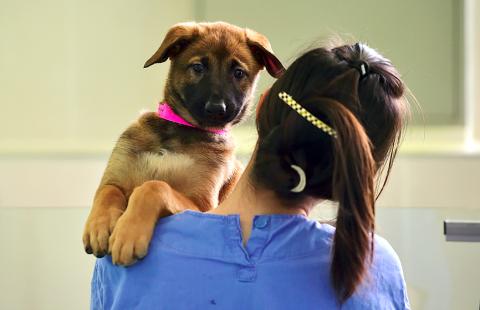
Photo: AFP
Since 2006, the facility has cloned about 800 dogs, commissioned by owners or state agencies seeking to replicate their best sniffer and rescue dogs.
“These people have very a strong bond with their pets ... and cloning provides a psychological alternative to the traditional method of just letting the pet go and keeping their memory,” said Wang Jae-woong, a researcher and spokesman for Sooam.
“With cloning, you have a chance to bring back the pets,” he said in the facility’s “care room” where each cloned puppy is kept in a glass-fronted, temperature-controlled pen and monitored by researchers around the clock.
Ever since the milestone birth of Dolly the sheep in 1996, the rights and wrongs of cloning have been a topic of heated debate and Sooam Biotech has been regarded with particular suspicion because of its founder, Hwang Woo-suk.
In two articles published in the journal Science in 2004 and 2005, Hwang claimed to have derived stem-cell lines from cloned human embryos, a world first.
He was lauded as a national hero in South Korea before it emerged that his research was fraudulent and riddled with ethical lapses.
Hwang was given a two-year suspended prison sentence in 2009, after being convicted of embezzlement and bioethical violations.
Sooam Biotech clones many animals, including cattle and pigs for medical research and breed preservation, but is best known for its commercial dog service.
The process involves harvesting a mature cell from the dog to be copied and transferring its DNA to a donor egg cell that has had its own genetic material removed.
The cell and the egg are “fused” with an electrical jolt, and the resulting embryo is implanted in a surrogate mother dog, which would give birth about two months later.
Despite the US$100,000 price tag, requests for the service have poured in from around the world, Wang said — around half from North America.
Some have sought clones of other pets like cats, snakes and even chinchillas, but Wang said the demand for such animals was too small to justify the cost.
Walls around the five-story Sooam Biotech center are adorned with dozens of photos of cloned dogs and their smiling owners — tagged with their national flags including the US, Mexico, Dubai, Russia, Japan, China and Germany.
“[The clients] understand that a clone is an identical twin of the original pet, but also has a lot of genetic predispositions and the potential to develop as the original pet,” Wang said.
One well publicized cloning was of Trakr, a former police dog hailed as a hero after discovering the last survivor of the Sept. 11, 2001, attack on the World Trade Center.
Sooam produced five clones after Trakr’s owner won a contest for the world’s most “clone-worthy” dog.
High-profile clients have included Princess Shaikha Latifah of Dubai, who last year cloned her pet dog and helped launch a joint research study into cloning camel breeds known for high milk production.
For the most part, the foundation’s clients and financial supporters of Hwang Woo-suk’s research prefer to remain anonymous.
“Few of our backers — even the most loyal ones — want to voice their support publicly,” said Sooam Biotech’s general manager Kim Hoon, who acknowledged that the scandal involving the facility’s founder had tainted its image.
“I think the only way to win the public’s trust back is making more genuine scientific breakthroughs,” he said.
The center does not conduct any human stem cell research after being repeatedly denied state approval to do so.
However, it is pushing a number of ambitious projects, most notably an effort to clone an extinct mammoth.
Since 2012, Hwang’s team has attempted to cultivate living cells from the frozen remains of mammoths in Siberia.
For medical research purposes, Sooam Biotech also produces genetically engineered animals, or “disease models” that are predisposed to Alzheimer’s, diabetes or certain cancers.
During a visit to the clinic by reporters, Hwang himself was leading a procedure to inject the embryo of a Beagle into a surrogate mother dog’s womb.
“This dog, once born, has a possibility to become a disease model for human brain tumors,” Hwang said.
Sooam is also involved in a joint venture with Chinese biotechnology firm Boyalife to set up what is to be the world’s largest animal cloning factory in the northeastern Chinese port city of Tianjin.
However, head researcher Jeong Yeon-woo said the dog cloning remained his favorite service because of the reaction of owners when they see the puppies.
“They look like they found a child that had been missing,” Jeong said. “The moment of pure joy like that ... makes me realize again why I’m doing this.”
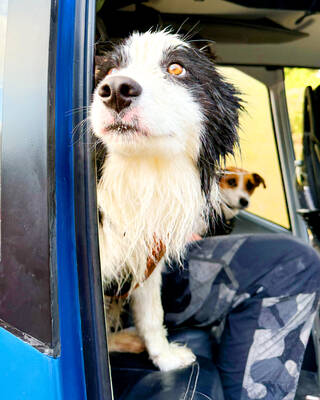
When a hiker fell from a 55m waterfall in wild New Zealand bush, rescuers were forced to evacuate the badly hurt woman without her dog, which could not be found. After strangers raised thousands of dollars for a search, border collie Molly was flown to safety by a helicopter pilot who was determined to reunite the pet and the owner. A week earlier, an emergency rescue helicopter found the woman with bruises and lacerations after a fall at a rocky spot at the waterfall on the South Island’s West Coast. She was airlifted on March 24, but they were forced to
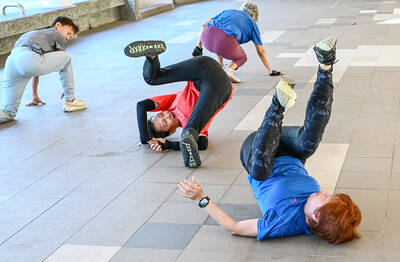
CONFIDENCE BOOSTER: ’After parkour ... you dare to do a lot of things that you think only young people can do,’ a 67-year-old parkour enthusiast said In a corner of suburban Singapore, Betty Boon vaults a guardrail, crawls underneath a slide, executes forward shoulder rolls and scales a steep slope, finishing the course to applause. “Good job,” the 69-year-old’s coach cheers. This is “geriatric parkour,” where about 20 retirees learned to tackle a series of relatively demanding exercises, building their agility and enjoying a sense of camaraderie. Boon, an upbeat grandmother, said learning parkour has aided her confidence and independence as she ages. “When you’re weak, you will be dependent on someone,” she said after sweating it out with her parkour classmates in suburban Toa Payoh,

Chinese dissident artist Gao Zhen (高兟), famous for making provocative satirical sculptures of former Chinese leader Mao Zedong (毛澤東), was tried on Monday over accusations of “defaming national heroes and martyrs,” his wife and a rights group said. Gao, 69, who was detained in 2024 during a visit from the US, faces a maximum three-year prison sentence, said his wife, Zhao Yaliang (趙雅良), and Shane Yi, a researcher at the Chinese Human Rights Defenders group which operates outside the nation. The closed-door, one-day trial took place at Sanhe City People’s Court in Hebei Province neighboring the capital, Beijing, and ended without a

‘TOXIC CLIMATE’: ‘I don’t really recognize Labour anymore... The idea that you can implement far-right ideas in order to stop the far right is nonsense,’ a protester said Tens of thousands of people on Saturday marched through central London to protest against the far right, weeks ahead of local elections and six months after Britain saw one of its largest far-right demonstrations. Organized by hundreds of civic groups, including trade unions, anti-racism campaigners and Muslim representative bodies, Saturday’s Together Alliance event was billed as the biggest in UK history to counter right-wing extremism. A separate pro-Palestinian march had also converged with the main rally. While organizers claimed 500,000 had turned out in total, the police gave a figure of about 50,000. Protesters carrying placards with slogans such as


 RSS
RSS