


The UN Security Council on Friday unanimously adopted a resolution setting the stage for deployment of UN police to Burundi, where killings, torture and increased disappearances have created a climate of fear and led more than 250,000 people to flee to neighboring countries.
The resolution requests that UN Secretary-General Ban Ki-moon consults Burundi’s government and coordinates with the African Union to present options within 15 days for deployment of UN police to increase monitoring of the security situation, promote respect for human rights and advance the rule of law.
Burundi has been hit by unrest since April last year, when Burundian President Pierre Nkurunziza announced his decision to seek a third term, which he eventually won.
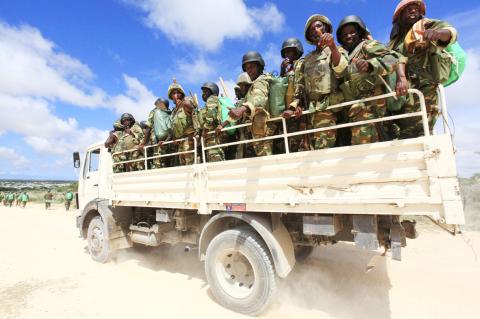
Photo: Reuters
His government has been wary of outside intervention, last year rejecting the idea of an AU peacekeeping force and calling foreign troops an “invasion.”
The French-drafted resolution welcomes the consent of Burundi’s authorities to increase the number of African Union human rights observers from 100 to 200 and allow 100 African Union military experts.
It says that 30 human rights observers and 15 military observers have been deployed so far.
Burundian Ambassador to the UN Albert Shingiro said the government “is ready to discuss and to come to an agreement on the nature, the size and the missions” of a UN police presence that is unarmed.
Shingiro said that the option of an “international unarmed presence” was a recommendation of the last African Union heads of state summit.
French Ambassador to the UN Francois Delattre said the main objective of the resolution is to back African efforts to help Burundi emerge from its crisis.
The resolution strongly condemns human rights violations including extra-judicial killings, sexual violence, torture, intimidation of civil society organizations and journalists and restrictions on fundamental freedoms.
Two weeks ago, UN Human Rights High Commissioner Zeid Ra’ad al-Hussein told the council that many people in Burundi are living in “terror” with almost daily grenade attacks and arbitrary arrests, while perpetrators go unpunished.
The resolution reiterates deep concern at “the persisting political impasse in the country” and stresses the urgency of convening “a genuine and inclusive inter-Burundian dialogue.”
The final draft was changed to overcome an objection from the US. A reference to “disarmament” was removed from a section calling for the UN team to work with the government and other parties “in the areas of disarmament, security and rule of law.”

‘CROSSING THE LINE’: China’s embassy in Seoul criticized US Forces Korea Commander General Xavier Brunson, asking if his ‘hostile’ remarks were authorized by Washington South Korea and the US are in talks over recent public remarks by the commander of US Forces Korea, Seoul’s presidential office said yesterday, after the comments drew sharp criticism from China. In a recent podcast interview, US Forces Korea Commander General Xavier Brunson described South Korea as “the dagger in the heart of Asia” from China’s east coast, prompting the Chinese embassy in Seoul to say that he had “truly crossed the line.” The interview came amid growing speculation that Washington might seek to expand the role of US Forces Korea in countering the growing regional influence of China, a key

Through the noise of rushing papers and whirring belts at a print factory in Kyoto, two creators watch their photo essay come to life in broadsheet form — part of an effort to win new audiences in the age of artificial intelligence (AI). Despite the decline of the publishing industry, self-publication and handmade “zine” magazines are growing in popularity in Japan, reflecting the nation’s enduring love of paper in the digital era. While speaking to Agence France-Presse at the plant, his hands black with ink, one of the creators, Kazuma Obara, said: “I think [paper] is a medium that engages all five

Australian researchers have trained lab-grown brain cells on a silicon computer chip to play the 1990s shooter game Doom and said they are just scratching the surface of what the neurons could be capable of doing. It is the science-fiction work of biotech boffins at Cortical Labs, who researched and developed the technology that harnesses the workings of the brain’s networking system. Each so-called “biological computer” contains about 200,000 living human brain cells, grown from stem cells that were harvested from blood donations. Having mastered the simple computer game Pong, where a paddle is moved up and down to send a ball

A surprising gut feeling may help pigeons find their way home. Animals use various techniques to navigate, including following the stars and remembering key landmarks. Birds, fish and turtles orient themselves using Earth’s magnetic field as a compass, but it is not yet clear how exactly they do this. Pigeons are a well-known group of frequent flyers that can traverse hundreds of kilometers in a single day. For thousands of years, humans have used them to carry news, notes and military messages. Scientists have long tried to untangle how pigeons travel without getting lost. Some think the birds detect magnetic cues using light-sensitive


 RSS
RSS