


At a registry office in Beijing, Sun Xiangshu and Shi Ci pose for photographs, their wedding certificates in hand, having just officially become man and wife.
However, like many unions in China this is a marriage that will not last long. In fact, their wedding is a piece of performance art staged by an artist known as Nut Brother (堅果兄弟).
The two strangers have been brought together to tie the knot then divorce within 48 hours in an attempt to stir debate about the meaning of the institution of marriage in modern China, which has a soaring divorce rate.
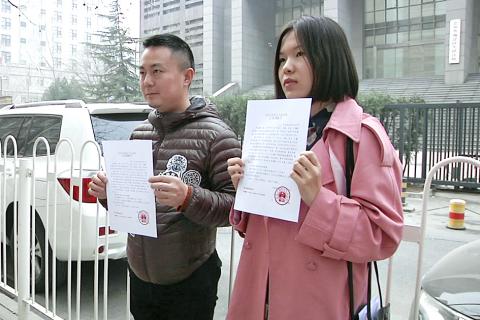
Photo: Reuters
“I have a lot of friends who have been forced to get married. Marriage has taken on a lot of things it shouldn’t; it has become mixed up with things like sex, property, care for the elderly and social stability,” Nut Brother said.
The decision to get married in China has long been a family affair, with parents traditionally having the last word on their children’s spouses.
With a patchy social welfare system and Confucian expectations that the younger generation will take care of the old, questions of material wealth are often more important than compatibility when young people come under pressure to get married and produce the next generation of the family line.
Young people who decide they do not want to tread the traditional marriage path find themselves fighting against established values championed by those at the very top.
“No matter how much times change, no matter how much social structures change, we must all emphasize building a family,” Chinese President Xi Jinping (習近平) said in a Spring Festival address last year.
Traditional Chinese family values were key to social harmony, he added.
However, as traditional notions of family obligations increasingly come into conflict with more individualistic aspirations, the divorce rate has soared.
From 2011 to 2014, the most recent years for which data is available, the number of divorces increased 27 percent, fueled in part by those who find it impossible to maintain a marriage that might appear rosy, but lacks real love.
This is what happened to Shi Ci, who divorced his wife of eight years after it became clear to him he had been chosen because he could provide for her, not because she loved him.
“It was bad for both of us, you need mutual appreciation and love to feel like you have any quality of life,” Shi Ci said.
Shi Ci said that for the time being he was not considering marriage again — but he would never say never.
“Now I think love is most important. Only if I have love will I consider marriage,” he said.

An American scientist convicted of lying to US authorities about payments from China while he was at Harvard University has rebuilt his research lab in Shenzhen, China, to pursue technology the Chinese government has identified as a national priority: embedding electronics into the human brain. Charles Lieber, 67, is among the world’s leading researchers in brain-computer interfaces. The technology has shown promise in treating conditions such as amyotrophic lateral sclerosis and restoring movement in paralyzed people. It also has potential military applications: Scientists at the Chinese People’s Liberation Army have investigated brain interfaces as a way to engineer super soldiers by boosting

Jailed media entrepreneur Jimmy Lai (黎智英) has been awarded Deutsche Welle’s (DW) freedom of speech award for his contribution to Hong Kong’s pro-democracy movement. The German public broadcaster on Thursday said Lai would be presented in absentia with the 12th iteration of the award on June 23 at the DW Global Media Forum in Bonn. Deutsche Welle director-general Barbara Massing praised the 78-year-old founder of the now-shuttered news outlet Apple Daily for standing “unwaveringly for press freedom in Hong Kong at great personal risk.” “With Apple Daily, he gave journalists a platform for free reporting and a voice to the democracy movement in
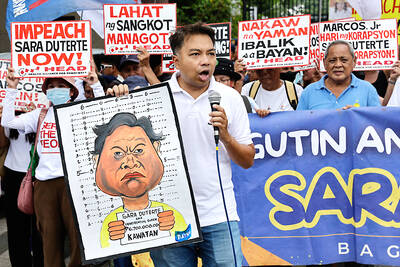
PHILIPPINE COMMITTEE: The head of the committee that made the decision said: ‘If there is nothing to hide, there is no reason to hide, there is no reason to obstruct’ A Philippine congressional committee on Wednesday ruled that there was “probable cause” to impeach Philippine Vice President Sara Duterte after hearing allegations of unexplained wealth, misuse of state funds and threats to have the president assassinated. The unanimous decision of the 53-member committee in the Philippine House of Representatives sends the two impeachment complaints to deliberations and voting by the entire lower chamber, which has more than 300 lawmakers. The complaints centered on Duterte’s alleged illegal use and mishandling of intelligence funds from the vice president’s office, and from her time as education secretary under Philippine President Ferdinand Marcos Jr. Duterte and the

Burmese President Min Aung Hlaing yesterday cut all prisoners’ sentences by one-sixth, a blanket measure that a source close to deposed leader Aung San Suu Kyi said would further shorten her detention. Aung San Suu Kyi has been sequestered since a 2021 military coup, but the senior member of her dissolved National League for Democracy (NLD) party said that while her term had been reduced, her remaining sentence is still unclear. “We also don’t know exactly how many years she has left,” the source told reporters, speaking on condition of anonymity for security reasons. The military toppled Aung San Suu Kyi’s elected government


 RSS
RSS