


Chalit Pongpitakwiset has always felt like a man. Now the 25-year-old wants everyone else to see it too.
However, unlike most transgender people in Asia, who are left to self-administer hormone supplements, Chalit is being helped by a pioneering clinic.
“I am in the hands of doctors,” said Chalit, who was born female, but identifies as a man.
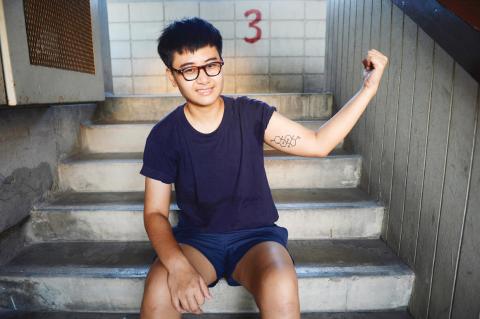
Photo: AFP
“I’m not doing it by myself, so it isn’t dangerous,” the software company worker said.
Several days after receiving his first testosterone injection, Chalit returned to get a blood test at Tangerine, the new clinic inside a Red Cross center in Bangkok.
The center is a pilot program that organizers hope could be replicated across Asia.
Its location is no accident — Thailand has a large and visible transgender population and is one of the world’s top destinations for sex-reassignment surgery, but just like elsewhere in Asia-Pacific, a region home to more than 9 million transgender people according UN estimates, long-term care for patients is patchy at best.
The clinic is a rare place providing follow-up treatment, both physical and mental, for those who have undergone sex-reassignment surgeries, procedures where patients are often at risk of infection.
“Most of the centers where the surgery is performed only provide short-term post-surgical care,” said Nittaya Phanuphak, the head doctor at Tangerine.
In Thailand, hormones are commonly purchased on the Internet or in local pharmacies, and administered on advice gleaned from friends or Web forums.
Benyapon Chimsud, a recent university graduate who was born a man, but identifies as female, said she has been taking hormones for two years.
“I have been taking hormones by myself for two years, I consult with my friends,” to determine the proper doses, she said.
She also gets monthly black market estrogen injections at a rudimentary neighborhood clinic.
That leaves her cut off from regulated healthcare, prone to receiving inaccurate medical advice and at risk of over-consuming hormones in a rush to see rapid results.
Chalit, on the other hand, met with a psychiatrist several times before receiving his first injection to prepare for the changes to his body.
“The psychiatrist asked me how long I’ve wanted to be a man, and whether my friends and other people around me would accept it if I changed,” Chalit said.
Now he is getting hormone injections every two weeks.
“The hormones will stop my periods, change my voice, give me a beard and moustache and develop my muscles,” he said. “All things that will help me no longer be a woman anymore.”
That should insulate him from the dangers of taking the wrong doses of hormones which experts say can lead to liver and cardiovascular problems. HIV is also always a risk if needles are shared.
Rights groups like the Asia-Pacific Transgender Network (APTN) say this public health issue is largely neglected by the mainstream medical community.
“There are no official guidelines on the administration and monitoring of hormones among trans people,” Joe Wong of the APTN said.
Although Thailand can appear tolerant on transgender issues from the outside, many segments of society remain deeply conservative.
Nittaya said discrimination remains widespread in medical centers, making access to proper healthcare a challenge for many transgenders, but Chalit is one of a small number of people to have been made aware of the dangers and commitment that comes with long-term hormonal therapy.
Several days after starting his treatment, Chalit, who is considering an operation, got a tattoo of the testosterone molecule on his arm.
“I have to take hormones for the rest of my life,” he said. “This tattoo will also stay with me for the rest of my life.”

When a hiker fell from a 55m waterfall in wild New Zealand bush, rescuers were forced to evacuate the badly hurt woman without her dog, which could not be found. After strangers raised thousands of dollars for a search, border collie Molly was flown to safety by a helicopter pilot who was determined to reunite the pet and the owner. A week earlier, an emergency rescue helicopter found the woman with bruises and lacerations after a fall at a rocky spot at the waterfall on the South Island’s West Coast. She was airlifted on March 24, but they were forced to

CONFIDENCE BOOSTER: ’After parkour ... you dare to do a lot of things that you think only young people can do,’ a 67-year-old parkour enthusiast said In a corner of suburban Singapore, Betty Boon vaults a guardrail, crawls underneath a slide, executes forward shoulder rolls and scales a steep slope, finishing the course to applause. “Good job,” the 69-year-old’s coach cheers. This is “geriatric parkour,” where about 20 retirees learned to tackle a series of relatively demanding exercises, building their agility and enjoying a sense of camaraderie. Boon, an upbeat grandmother, said learning parkour has aided her confidence and independence as she ages. “When you’re weak, you will be dependent on someone,” she said after sweating it out with her parkour classmates in suburban Toa Payoh,

Chinese dissident artist Gao Zhen (高兟), famous for making provocative satirical sculptures of former Chinese leader Mao Zedong (毛澤東), was tried on Monday over accusations of “defaming national heroes and martyrs,” his wife and a rights group said. Gao, 69, who was detained in 2024 during a visit from the US, faces a maximum three-year prison sentence, said his wife, Zhao Yaliang (趙雅良), and Shane Yi, a researcher at the Chinese Human Rights Defenders group which operates outside the nation. The closed-door, one-day trial took place at Sanhe City People’s Court in Hebei Province neighboring the capital, Beijing, and ended without a

‘TOXIC CLIMATE’: ‘I don’t really recognize Labour anymore... The idea that you can implement far-right ideas in order to stop the far right is nonsense,’ a protester said Tens of thousands of people on Saturday marched through central London to protest against the far right, weeks ahead of local elections and six months after Britain saw one of its largest far-right demonstrations. Organized by hundreds of civic groups, including trade unions, anti-racism campaigners and Muslim representative bodies, Saturday’s Together Alliance event was billed as the biggest in UK history to counter right-wing extremism. A separate pro-Palestinian march had also converged with the main rally. While organizers claimed 500,000 had turned out in total, the police gave a figure of about 50,000. Protesters carrying placards with slogans such as


 RSS
RSS