


A man who was left brain-dead after suffering serious side effects during a drug trial in France died on Sunday, according to the hospital which had been treating him.
The CEO of the Portuguese pharmaceutical company that was developing the drug said he was “profoundly shocked” by the death and pledged an investigation.
Five other volunteers hospitalized a week ago when the drug trial went wrong were “in a stable condition,” Rennes University Hospital said in a statement.
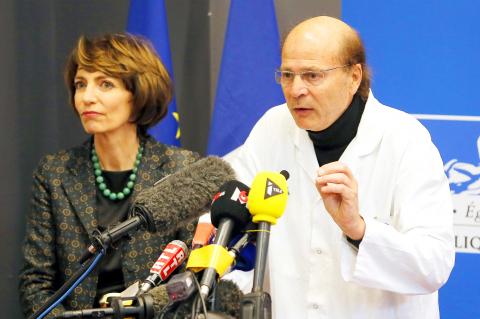
Photo: AP
France-based private laboratory Biotrial was testing a new pain and mood disorder medication on humans for pharmaceutical Bial, in what is known as a phase 1 trial, to test the drug’s safety.
A total of 108 volunteers took part in the trial, 90 of whom received the drug at varying doses, while the rest were given placebos.
The six men who were hospitalized, aged 28 to 49, were the group which received the highest dose.
Bial CEO Antonio Portela said he was “profoundly shocked by the situation,” according to Portugal’s Lusa news agency.
“On my behalf and the behalf of Bial, I would like to express my deepest apologies to the family of the volunteer who died after participating in the Phase I trial of our experimental molecule,” he added.
Portela said Bial staff in France and Portugal were “working tirelessly to understand the causes of this accident.”
Rennes University Hospital head of neurology Pierre-Gilles Edan on Friday said that three of the men were suffering a “handicap that could be irreversible” and another also had neurological problems.
The sixth volunteer had no symptoms, but was being monitored.
“The 84 other volunteers exposed to the drug” have been contacted, the hospital said, adding that 10 of them were examined and did not have the “anomalies” seen in the hospitalized patients.
The incident is the worst of its kind ever to have taken place in France, which has launched three separate probes to determine whether the tragedy was caused by an error in the trial’s procedures or in the substance tested.
Bial is cooperating with the investigation and vows it followed “international best practice” in developing the drug.
Biotrial on Sunday said in a statement that it planned to work with the international scientific community to develop “changes to the standards governing such trials,” without giving further details.
The company, which has been carrying out drug trials on behalf of pharmaceutical companies since 1989, said the situation is “even more upsetting given that there is as yet no explanation.”
Previous testing, notably on animals, had not generated unusual results.
Such serious mishaps are rare during the development of a drug, which begins in the laboratory before being animal tested and then three phases of human trials before it can be brought to market.
French public body ONIAM, which is responsible for compensating the victims of medical accidents, said it had in its files only about 10 cases of accidents during drug trials over the past 15 years, and “with consequences infinitely less serious” than the case in Rennes.
Although a rarity, there have been precedents in other countries.
A comparable accident took place in 2006 in London when six people taking German drug manufacturer TeGenero’s TGN1412, which it was developing to treat certain types of cancer and other immunological diseases, fell seriously ill, with one suffering from multiple organ failure.
Two of the volunteers were in critical condition and one lost all his fingers and toes. The victims said they had the impression that their brains were on fire and that their eyes were coming out of their sockets.
Although they all survived, experts said at the time that their immune systems would be damaged for life.

An American scientist convicted of lying to US authorities about payments from China while he was at Harvard University has rebuilt his research lab in Shenzhen, China, to pursue technology the Chinese government has identified as a national priority: embedding electronics into the human brain. Charles Lieber, 67, is among the world’s leading researchers in brain-computer interfaces. The technology has shown promise in treating conditions such as amyotrophic lateral sclerosis and restoring movement in paralyzed people. It also has potential military applications: Scientists at the Chinese People’s Liberation Army have investigated brain interfaces as a way to engineer super soldiers by boosting
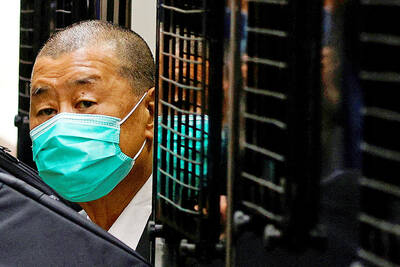
Jailed media entrepreneur Jimmy Lai (黎智英) has been awarded Deutsche Welle’s (DW) freedom of speech award for his contribution to Hong Kong’s pro-democracy movement. The German public broadcaster on Thursday said Lai would be presented in absentia with the 12th iteration of the award on June 23 at the DW Global Media Forum in Bonn. Deutsche Welle director-general Barbara Massing praised the 78-year-old founder of the now-shuttered news outlet Apple Daily for standing “unwaveringly for press freedom in Hong Kong at great personal risk.” “With Apple Daily, he gave journalists a platform for free reporting and a voice to the democracy movement in

PHILIPPINE COMMITTEE: The head of the committee that made the decision said: ‘If there is nothing to hide, there is no reason to hide, there is no reason to obstruct’ A Philippine congressional committee on Wednesday ruled that there was “probable cause” to impeach Philippine Vice President Sara Duterte after hearing allegations of unexplained wealth, misuse of state funds and threats to have the president assassinated. The unanimous decision of the 53-member committee in the Philippine House of Representatives sends the two impeachment complaints to deliberations and voting by the entire lower chamber, which has more than 300 lawmakers. The complaints centered on Duterte’s alleged illegal use and mishandling of intelligence funds from the vice president’s office, and from her time as education secretary under Philippine President Ferdinand Marcos Jr. Duterte and the

Burmese President Min Aung Hlaing yesterday cut all prisoners’ sentences by one-sixth, a blanket measure that a source close to deposed leader Aung San Suu Kyi said would further shorten her detention. Aung San Suu Kyi has been sequestered since a 2021 military coup, but the senior member of her dissolved National League for Democracy (NLD) party said that while her term had been reduced, her remaining sentence is still unclear. “We also don’t know exactly how many years she has left,” the source told reporters, speaking on condition of anonymity for security reasons. The military toppled Aung San Suu Kyi’s elected government


 RSS
RSS