


It provoked years of legal wrangling, diplomatic intrigue and dogged sleuthing by detectives from Scotland Yard seeking clues in abstruse nuclear science.
However, in the end, the mystery behind the poisoning death of Alexander Litvinenko — a former officer of the KGB, a whistleblower and a foe of the Kremlin — was unlocked by a discovery in the waste pipe under the wash basin of Room 382 in London’s upscale Millennium Hotel, a prominent lawyer in the case said on Friday.
There, detectives found “a mangled clump of debris” laced with polonium-210, the rare radioactive toxin that killed Litvinenko in 2006, the lawyer representing the widowed Marina Litvinenko, Ben Emmerson said.
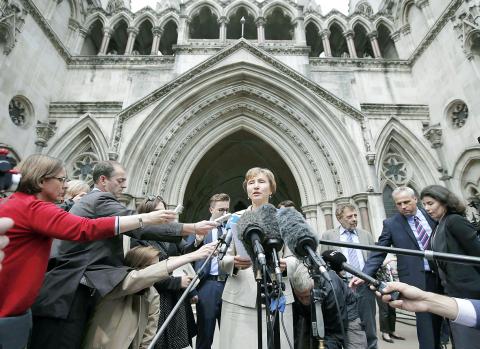
Photo: Reuters
“The inevitable conclusion is that the person who poured that solution down the sink was knowingly handling the murder weapon itself,” Emmerson said on Friday during closing arguments of the public inquiry into the death.
The oft-delayed investigation opened in January and involved testimony from 62 witnesses in 34 days of hearings. However, the inquiry was boycotted or ignored by Russian officials, including Russian President Vladimir Putin, whom Emmerson on Friday again blamed directly for the poisoning.
The Russian leader has dismissed the accusation, and the country has refused to extradite the two Russian citizens, Andrei Lugovoi and Dmitry Kovtun, whom British prosecutors have accused of the killing.
The case has fascinated Britons and, at one point, plunged relations between London and Moscow into a chill that recalled the Cold War. British prosecutors say Litvinenko died after sipping green tea from a pot laced with polonium when he met Lugovoi, a former KGB bodyguard, and Kovtun, a former Red Army officer, on Nov. 1, 2006, in the Pine Bar at the Millennium Hotel in central London’s Grosvenor Square. Litvinenko died 22 days later aged 43.
Weeks before his death, Litvinenko and his family, who fled Russia in 2000, had been granted British citizenship.
“It is a truism that most criminal cases, not matter how complex they are, ultimately turn on one item of evidence,” Emmerson said shortly before Judge Robert Owen closed the inquiry on Friday.
In this case that item was the clump of debris in the hotel plumbing, Emmerson said.
“The reason that evidence is so pivotal, of course, is because Dmitry Kovtun stayed in that room on the very day that he and Lugovoi administered the fatal dose of polonium some floors below in the Pine Bar of the same hotel,” he said.
The lawyer’s dramatic flourish wove one more strand into a convoluted saga that has unfolded despite attempts by the British government to block scrutiny and to exclude public testimony by intelligence officials.
Counsel to the inquiry Robin Tam on Friday said that the judge had held closed hearings with unidentified witnesses.
Litvinenko died without knowing what had killed him. Only in the last few hours of his life did the authorities identify polonium 210 — an isotope once used as a nuclear trigger and manufactured almost exclusively in Russia — as the cause of death.
Once British scientists made that discovery, investigators identified traces of polonium at a string of places visited by Kovtun and Lugovoi, according to testimony at the inquiry.
A central theme at the inquiry was whether the Russian state had been involved in the killing.
Emmerson said that since the poisoning, Kovtun and Lugovoi had benefited from a “wall of protection by corrupt elements in the Kremlin.”
Lugovoi secured a seat in the Russian Duma, and this year received a medal of honor from Putin for “services to the motherland.”
In March, as the inquiry was initially set to conclude, Kovtun signaled that he would testify by video link from Moscow. However, citing legal restrictions, he refused to do so when the link was set up this week.
“The approach of the Russian authorities from start to finish speaks volumes and provides powerful support for the conclusion that Putin and his cronies in the Kremlin were not only behind the murder, but even now stand four square behind the murderers,” Emmerson said.
The polonium used in the poisoning, he said, was manufactured in Russia and “could not have been diverted for use as a murder weapon without the knowledge of Russian officials and the approval of Mr Putin personally.”
The Russian embassy in London issued a statement saying that the inquiry had failed to follow international law and that it had been politicized and biased.
At the time of his death, Litvinenko was investigating the Kremlin and Putin, seeking evidence of links with organized crime.
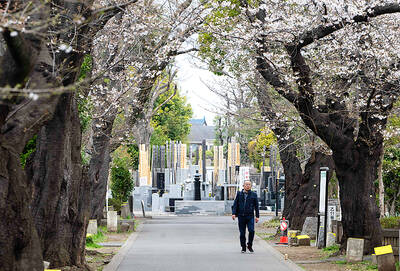
ROCKY RELATIONS: The figures on residents come as Chinese tourist numbers drop following Beijing’s warnings to avoid traveling to Japan The number of Chinese residents in Japan has continued to rise, even as ties between the two countries have become increasingly fractious, data released on Friday showed. As of the end of December last year, the number of Chinese residents had increased by 6.5 percent from the previous year to 930,428. Chinese people accounted for 22.6 percent of all foreign residents in Japan, making them by far the largest group, Japanese Ministry of Justice data showed. Beijing has criticized Tokyo in increasingly strident terms since Japanese Prime Minister Sanae Takaichi last year suggested that a military conflict around Taiwan could
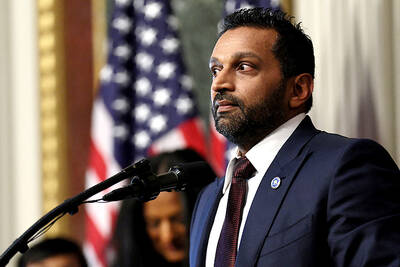
A pro-Iran hacking group claimed to breach FBI Director Kash Patel’s personal e-mail inbox and posted some of the contents online. The e-mails provided by the hacking group include travel details, correspondence with leasing agents in Washington and global entry, and loyalty account numbers. The e-mail address the hackers claim to have compromised has been previously tied to Patel’s personal details, and the leaked e-mails contain photos of Patel and others, in addition to correspondence with family members and colleagues. “The FBI is aware of malicious actors targeting Director Patel’s personal email information,” the agency said in a statement on
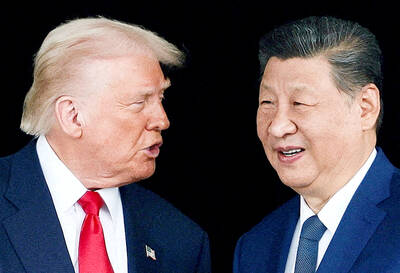
RIVALRY: ‘We know that these are merely symbolic investigations initiated by China, which is in fact the world’s most profligate disrupter of supply chains,’ a US official said China has started a pair of investigations into US trade practices, retaliating against similar probes by US President Donald Trump’s administration as the superpowers stake out positions before an expected presidential summit in May. The move, announced by the Chinese Ministry of Commerce on Friday, is a direct mirror of steps Trump took to revive his tariff agenda after the US Supreme Court last month struck down some of his duties. “China expresses its strong dissatisfaction and firm opposition to these actions,” a ministry spokesperson said in a statement, referring to the so-called Section 301 investigations initiated on March 11.

When a hiker fell from a 55m waterfall in wild New Zealand bush, rescuers were forced to evacuate the badly hurt woman without her dog, which could not be found. After strangers raised thousands of dollars for a search, border collie Molly was flown to safety by a helicopter pilot who was determined to reunite the pet and the owner. A week earlier, an emergency rescue helicopter found the woman with bruises and lacerations after a fall at a rocky spot at the waterfall on the South Island’s West Coast. She was airlifted on March 24, but they were forced to


 RSS
RSS