


Scientists have discovered what appear to be red blood cells and collagen fibers in the fossilized remains of dinosaurs.
Traces of the soft tissues were found by accident when researchers at London’s Imperial College analyzed eight rather shabby fossils that had been dug up in Canada a century ago before finding their way to the Natural History Museum in London.
The finding suggests that scores of dinosaur fossils in museums around the world could retain soft tissues, and with it the answers to major questions about dinosaur physiology. More speculatively, it has made scientists ponder whether dinosaur DNA might also be found.
Most of the fossils the scientists studied were only fragments and in very poor condition. They included a claw from a meat-eating therapod, perhaps a gorgosaurus, some limb and ankle bones from a duck-billed dinosaur, and a toe bone from triceratops-like animal.
Intact soft tissue has been spotted in dinosaur fossils before, most famously by Mary Schweitzer at North Carolina State University, who in 2005 found flexible, transparent collagen in the fossilized leg of a Tyrannosaurus rex specimen.
What makes the latest discovery so remarkable is that the blood cells and collagen were found in specimens that the researchers themselves describe as “crap.”
If soft tissue can survive in these fossils, then museum collections of more impressive remains could harbor troves of soft dinosaur tissue. Those could help unravel mysteries of dinosaur physiology and behavior that have been impossible to crack with bony remains alone.
“It’s really difficult to get curators to allow you to snap bits off their fossils. The ones we tested are crap, very fragmentary, and they are not the sorts of fossils you’d expect to have soft tissue,” Imperial College paleontologist Susannah Maidment said.
Imperial College materials scientist Sergio Bertazzo had been working on the build up of calcium in human blood vessels when he met Maidment and asked if he could study some fossils with an array of electron microscope techniques.
Months after the specimens arrived, Bertazzo began to look at thin sections of the fossils. He began with the therapod claw.
“One morning, I turned on the microscope, increased the magnification, and thought ‘wait — that looks like blood,’” he said.
Mammals are unusual among vertebrates in having red blood cells that lack a cell nucleus. If the fossil’s blood cells had nuclei, they could not be human. When they sliced through one of the cells to check, they saw what looked like a nucleus.
University College paleontologist Anjali Goswami said that if dinosaur soft tissues were found in many more fossils, it could have a transformative effect on research.
“If we can expand the data we have on soft tissues, from fossils that are poorly preserved, that has real implications for our understanding of life in deep time,” she said.
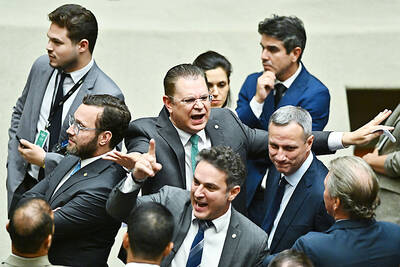
PARLIAMENT CHAOS: Police forcibly removed Brazilian Deputy Glauber Braga after he called the legislation part of a ‘coup offensive’ and occupied the speaker’s chair Brazil’s lower house of Congress early yesterday approved a bill that could slash former Brazilian president Jair Bolsonaro’s prison sentence for plotting a coup, after efforts by a lawmaker to disrupt the proceedings sparked chaos in parliament. Bolsonaro has been serving a 27-year term since last month after his conviction for a scheme to stop Brazilian President Luiz Inacio Lula da Silva from taking office after the 2022 election. Lawmakers had been discussing a bill that would significantly reduce sentences for several crimes, including attempting a coup d’etat — opening up the prospect that Bolsonaro, 70, could have his sentence cut to
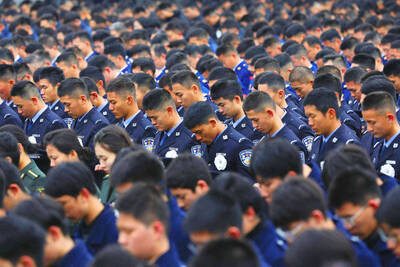
China yesterday held a low-key memorial ceremony for the 1937 Nanjing Massacre, with Chinese President Xi Jinping (習近平) not attending, despite a diplomatic crisis between Beijing and Tokyo over Taiwan. Beijing has raged at Tokyo since Japanese Prime Minister Sanae Takaichi last month said that a hypothetical Chinese attack on Taiwan could trigger a military response from Japan. China and Japan have long sparred over their painful history. China consistently reminds its people of the 1937 Nanjing Massacre, in which it says Japanese troops killed 300,000 people in what was then its capital. A post-World War II Allied tribunal put the death toll
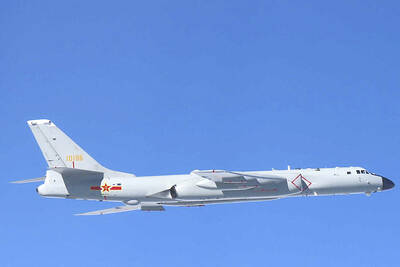
‘UNWAVERING ALLIANCE’: The US Department of State said that China’s actions during military drills with Russia were not conducive to regional peace and stability The US on Tuesday criticized China over alleged radar deployments against Japanese military aircraft during a training exercise last week, while Tokyo and Seoul yesterday scrambled jets after Chinese and Russian military aircraft conducted joint patrols near the two countries. The incidents came after Japanese Prime Minister Sanae Takaichi triggered a dispute with Beijing last month with her remarks on how Tokyo might react to a hypothetical Chinese attack on Taiwan. “China’s actions are not conducive to regional peace and stability,” a US Department of State spokesperson said late on Tuesday, referring to the radar incident. “The US-Japan alliance is stronger and more
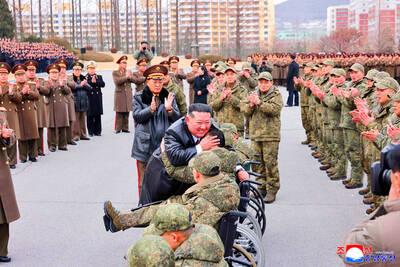
FALLEN: The nine soldiers who were killed while carrying out combat and engineering tasks in Russia were given the title of Hero of the Democratic People’s Republic of Korea North Korean leader Kim Jong-un attended a welcoming ceremony for an army engineering unit that had returned home after carrying out duties in Russia, North Korean state media KCNA reported on Saturday. In a speech carried by KCNA, Kim praised officers and soldiers of the 528th Regiment of Engineers of the Korean People’s Army (KPA) for “heroic” conduct and “mass heroism” in fulfilling orders issued by the ruling Workers’ Party of Korea during a 120-day overseas deployment. Video footage released by North Korea showed uniformed soldiers disembarking from an aircraft, Kim hugging a soldier seated in a wheelchair, and soldiers and officials


 RSS
RSS