


Chinese police officers carry out “appalling” torture of criminal suspects, campaigners said yesterday, as they released a report that they say details Beijing’s failure to combat abusive interrogations.
Despite China claiming to have confronted alleged forced confessions through a series of reforms, Chinese prosecutors and judges “ignore clear evidence of mistreatment” while the police are covering up abuse, the Human Rights Watch (HRW) report said.
The New York-based campaign group said Chinese police officers manipulate video interrogations so that confessions are made on-camera, while torture — using methods that leave no visible injuries — takes place out of sight.
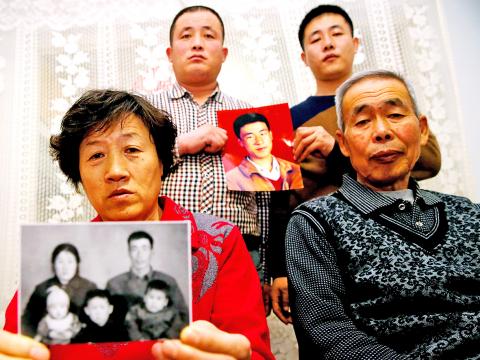
Photo: AP
The use of ruthless “cell bosses” — fellow detainees who oversee detention centers for police departments — is also widespread, the report said.
Suspects are sometimes strapped into metal “tiger chairs” for days, deprived of sleep and food as their legs and buttocks become swollen, according to the report, titled Tiger Chairs and Cell Bosses: Police Torture of Criminal Suspects in China.
“We heard appalling stories of detainees being hung by the wrists, shackled for years and terrorized by cell bosses, yet having no real means to hold their tormentors to account,” HRW China Director Sophie Richardson said in the report.
“Police continue to be expected to produce confessions in order to secure a conviction,” Richardson told reporters in a news conference in Hong Kong yesterday.
“The expectation of a conviction is one of the main drivers of this kind of abuse,” she said.
The group analyzed hundreds of newly published court verdicts and interviewed 48 recent detainees, as well as family members, lawyers and former Chinese officials.
Of the 432 verdicts that made reference to torture allegations, just 23 resulted in a court throwing out evidence, and there were no acquittals, the report said.
HRW found only one torture prosecution — concerning three police officers — but none served prison time. It also found evidence that health workers and lawyers were unwilling to assist torture victims with their complaints.
After a series of high-profile police brutality cases in 2009 and 2010, the Chinese government vowed to crack down on abuses and revised its criminal procedure law.
The new measures were intended to strengthen detainees’ rights to access lawyers, and to ban confessions and written statements obtained through torture.
The Chinese Communist Party claims to have made the “rule of law with Chinese characteristics” one of its top priorities.
However, the massive challenge that authorities face tackling abuse was highlighted in December last year when state media admitted that forced confessions were “not rare” in China.
A total of 99.93 percent of criminal defendants in China are found guilty, official figures show.
The HRW report calls on China to transfer the management of detention centers from police departments to the Chinese Ministry of Justice, and to free the judiciary from political control.
“It is not even close to being a fair fight. The police hold so much power — not just relative to the suspects, but relative to the courts — that the defense is so weak from the very beginning of any given case,” Richardson said, adding that defendants have very limited access to lawyers or their families.
“Unless the police have their powers dramatically circumscribed in a number of different ways, we are not going to see real change,” she said.
ROCKY RELATIONS: The figures on residents come as Chinese tourist numbers drop following Beijing’s warnings to avoid traveling to Japan The number of Chinese residents in Japan has continued to rise, even as ties between the two countries have become increasingly fractious, data released on Friday showed. As of the end of December last year, the number of Chinese residents had increased by 6.5 percent from the previous year to 930,428. Chinese people accounted for 22.6 percent of all foreign residents in Japan, making them by far the largest group, Japanese Ministry of Justice data showed. Beijing has criticized Tokyo in increasingly strident terms since Japanese Prime Minister Sanae Takaichi last year suggested that a military conflict around Taiwan could

A pro-Iran hacking group claimed to breach FBI Director Kash Patel’s personal e-mail inbox and posted some of the contents online. The e-mails provided by the hacking group include travel details, correspondence with leasing agents in Washington and global entry, and loyalty account numbers. The e-mail address the hackers claim to have compromised has been previously tied to Patel’s personal details, and the leaked e-mails contain photos of Patel and others, in addition to correspondence with family members and colleagues. “The FBI is aware of malicious actors targeting Director Patel’s personal email information,” the agency said in a statement on

RIVALRY: ‘We know that these are merely symbolic investigations initiated by China, which is in fact the world’s most profligate disrupter of supply chains,’ a US official said China has started a pair of investigations into US trade practices, retaliating against similar probes by US President Donald Trump’s administration as the superpowers stake out positions before an expected presidential summit in May. The move, announced by the Chinese Ministry of Commerce on Friday, is a direct mirror of steps Trump took to revive his tariff agenda after the US Supreme Court last month struck down some of his duties. “China expresses its strong dissatisfaction and firm opposition to these actions,” a ministry spokesperson said in a statement, referring to the so-called Section 301 investigations initiated on March 11.

When a hiker fell from a 55m waterfall in wild New Zealand bush, rescuers were forced to evacuate the badly hurt woman without her dog, which could not be found. After strangers raised thousands of dollars for a search, border collie Molly was flown to safety by a helicopter pilot who was determined to reunite the pet and the owner. A week earlier, an emergency rescue helicopter found the woman with bruises and lacerations after a fall at a rocky spot at the waterfall on the South Island’s West Coast. She was airlifted on March 24, but they were forced to


 RSS
RSS