


In a grimy Kabul street, the director gives the order to roll the cameras and filming starts on a remarkable new television drama that boldly challenges taboos about women in conservative Afghanistan.
Shereen, the star, enters the scene and buys a few things from street vendors when suddenly her husband, a possessive and brutal man, grabs her.
However, tough no-nonsense Shereen will not back down and a row ensues.
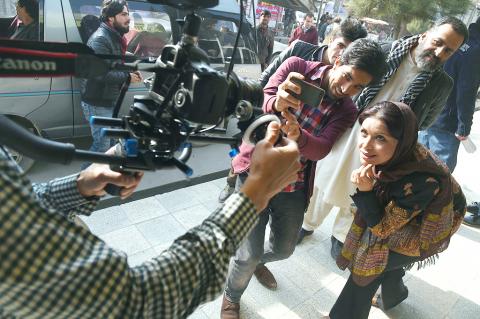
Photo: AFP
Shereen’s Law, due to be aired on Afghan television before the end of the year, tells the story of a 36-year-old woman who brings up three children on her own while forging a career as a clerk at a court in Kabul.
Such a character is already shocking in an overwhelmingly patriarchal society, where most women are confined to lives of menial domesticity.
However, the show deliberately ramps up the impact. Shereen fights corruption, harassment and rape, and tries to divorce her husband, whom she wed in a forced marriage.
More than 13 years after the fall of the Taliban, Afghanistan remains deeply wedded to traditional customs and its airwaves have never hosted anything like this before.
“It is the first such drama — that is about women, that is about empowering women, that is about the struggles of women in Afghanistan,” said Leena Alam, the Afghan actress who plays Shereen.
Women in Afghanistan still suffer brutal violence on a daily basis. On March 19, a young woman was beaten to death and her body burned in central Kabul for allegedly burning a Koran.
Defying entrenched conventions in such a country comes with a risk, as Alam — who moved to the US as a child with her family before returning in 2007 — admits.
“It’s a bit dangerous, even for myself. Yesterday we were shooting outside. When ... I’m waiting for the shot I’m always scared that somebody may throw acid on me or somebody may hit me with a knife,” she said.
Casting the show was not easy — several actors said no to a storyline they found just too challenging. One, who played a lawyer friend of Shereen, was forced to pull out, because her husband was unhappy with the show.
As well as portraying a strong female character, the series attacks the Afghan judicial system, where rampant corruption is hidden behind a wall of silence.
“It takes a lot of courage to write something like this and it takes a lot of courage to play something like Shereen,” said Alam, a producer who has also appeared in several Afghan films.
“But I think it’s time, after more than 30 years, to move on and educate people and give them the information as bluntly as Shereen,” she said.
Apart from the exterior street scenes, the show’s action takes place in a studio with sets decked out to look like a courtroom, Shereen’s house and legal offices.
No detail has been missed, from the portrait of Afghan President Ashraf Ghani in the courtroom to the stapler on Shereen’s desk.
Director and writer Max Walker, an Australian who came to work in Afghanistan, says he took advice in advance on how to avoid drawing too much attention from conservative clerics.
“There’s been an enormous consultation, an enormous review of the script and of the whole storytelling process to make sure that it raises these issues, but it doesn’t raise them so bluntly and so offensively that it’s going to make the program go off air,” Walker said.
Under the Taliban’s hardline 1996-2001 regime, television was banned, but now 58 percent of homes have a set, according to the Asia Foundation development organization.
Shereen’s Law will face tough competition for viewers from popular imported Turkish and Indian soap operas.
Frenchwoman Anne Jasim Falher, the founder and head of consultancy firm ATR in Kabul and a long-term observer of Afghan society, says television has a role to play in changing attitudes.
“Television has allowed people to shake things up on forced marriage, probably also on violence against women and violence within families,” she said.
The 12 45-minute episodes are being made by the Tolo TV channel, one of the big successes of Afghanistan’s new media scene, largely funded by foreign donors when it was launched in 2004.
The Moby group, which owns Tolo, claims a pioneering role for itself, notably for being the first Afghan channel to have female and male presenters alongside one another.
“You have to cross the barriers sometimes and you have to do something where you give the voice to the women,” Moby director of programming Massoud Sanjer said.
“Afghanistan is a country where if you tell directly people ‘do this,’ they won’t do it. But if you just give them a reason, make them think themselves, they will do it,” Sanjer said.
“So a TV show will definitely help the men who are the dominant power of the society to think that a woman is also part of this country, a woman is part of their lives, and a woman is part of their family,” Sanjer added.
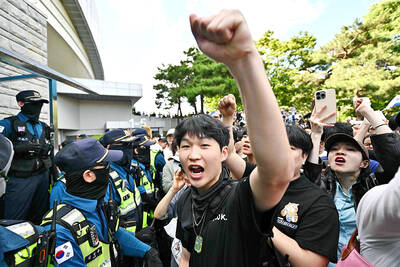
‘ABSURD MISTAKE’: The election commission said that there had been a failure to anticipate turnout after 14 polling stations ran short of ballot papers South Korean riot police yesterday cleared protesters from a Seoul polling station after a 35-hour blockade sparked by a shortage of ballot papers during local elections earlier this week. Wednesday’s election was the first nationwide vote since South Korean President Lee Jae-myung took office following the ouster of Yoon Suk-yeol over his short-lived martial law declaration. Lee’s ruling Democratic Party swept most races, but failed to flip the crucial Seoul mayoral seat. The South Korean National Election Commission apologized, blaming a failure to anticipate turnout after 14 polling stations in Seoul ran short of ballot papers. Some polling stations stayed open until 10pm to

France experienced its hottest spring on record, the French weather service said on Tuesday, after an exceptional early heat wave that also broke highs for the season in England and Wales. Meteo-France said the average nationwide temperature over March to May was 13.8°C — about 1.7°C above the norm, and surpassing records set in 2011 and 2020. “The warmest spring since records began in 1900,” it said in a bulletin. All three months were warmer than average, but the onset of an “unprecedented heatwave” late last month pushed the mercury to highs typically seen at the height of the summer. “Our country had never

A Sherpa guide was found crawling to base camp on Mount Everest a week after he went missing and was reunited with his family, who had given up hope he would return. Dawa Sherpa was last seen on Friday last week descending the mountain, but he did not reach base camp even though his client did. The pair were among the last climbers on the mountain as the climbing season came to an end and the route was dismantled. Dawa was located by a cleaning crew on Thursday morning as he was crawling down the snowy slopes around the Khumbu Icefall, just above
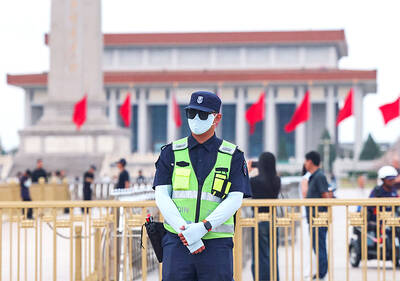
Chinese authorities are snuffing out any remembrance of the deadly 1989 military crackdown on student-led pro-democracy protests in Tiananmen Square, which happened 37 years ago yesterday, in a further tightening of a years-long campaign to erase what happened from public memory. Police told relatives of the victims they would not be allowed to visit a cemetery in Beijing on the anniversary of the crackdown, a person with knowledge of the matter said. Relatives of the victims visited the cemetery on the anniversary for more than 30 years to read memorial statements with police keeping watch, Amnesty International said. Hundreds of people,


 RSS
RSS