


Vo Van Duong’s bamboo and coconut leaf house looks much like others deep in Vietnam’s Mekong Delta. However, unlike them, his abode is designed to withstand typhoons, flooding and earthquakes — and at a cost of less than US$4,000 could herald a new wave of low-cost, sustainable housing.
The natural materials on its surface belie the high-tech internal structure of the farmer’s new home, which uses steel struts and wall panels to defend against the elements in this disaster-prone region.
“The new house is safer; I am not afraid that it will collapse,” the 48-year-old papaya farmer told reporters inside the house he moved into nine months ago.
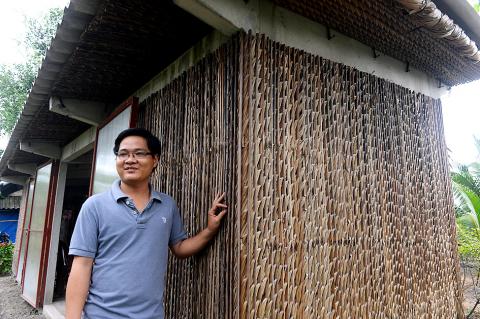
Photo: AFP
Duong is testing a prototype by an award-winning Vietnamese architecture firm that is developing low-cost housing solutions for communities vulnerable to climate change.
His “S-House 2” was free, but if rolled out on a wider scale could be sold for less than US$4,000.
“There was water coming down from the roof in my old house. Sometimes, when there was a strong wind, I was so afraid the house would not survive,” Duong said, adding that his new home was the envy of his neighbors.
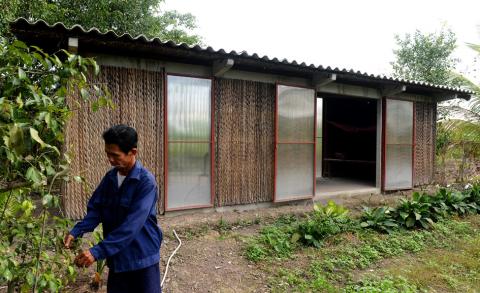
Photo: AFP
The home is the brainchild of architect Vo Trong Nghia, who joins other architects around the world in trying to fill a demand for cheap and easy to assemble housing.
He says that all architects have a duty to help impoverished people.
“I do not want people to be looking at it as ‘cheap houses,’ but as resort-quality accommodation close to nature, so [residents] can live a life of the highest quality,” he says.
The design is still being refined by his team, who aim to create a flat-pack home. The newest version, S-House 3, can be built by five people in three hours.
“Our goal for S-House is for the owner to construct it by themselves,” firm partner Kosuke Nishijima said.
The latest design also allows for multiple houses to be tacked together, a function that could allow the construction of a storm-proof school that is easily transportable to remote areas or a larger family home, for example.
Nghia has been approached by non-governmental agencies in Bangladesh and the Philippines, but is not yet ready to supply the house commercially.
Nghia’s firm found that one of the problems facing Vietnamese who live in traditional bamboo shelters or stilted riverbank houses is the costly upkeep that the homes require to withstand extreme weather.
Although the S-House 2’s outer casing of coconut leaves needs replacing every four years, the structure itself should require no expensive maintenance, engineer Lien Phuoc Huy Phuong said.
“It can last a long time; the structure is sound,” he said during a tour of the small building.
Despite its solid exterior, the house is spacious and airy inside, with large windows and doors.
“We tried to design this house with the best ventilation system, with spaces by the roof and windows for better air flow,” Phuong said.
Nghia, who used bamboo as a key element in Vietnam’s national pavilion for the 2010 World Expo in Shanghai, has long sought to incorporate natural and local materials into his work.
One of his first projects in Ho Chi Minh City was an ecologically conscious take on a traditional Vietnamese tube home, known as the Stacking Green house.
Built for about US$150,000 in 2011, the home is made of a series of concrete slabs and gaps filled with plants to provide privacy while still admitting plenty of air and light.
Nghia is in strong demand for high-end projects from hotels to private houses, but said the low-cost S-House is his personal obsession.
“I want to live in S-House. If my family will agree,” he said.

An American scientist convicted of lying to US authorities about payments from China while he was at Harvard University has rebuilt his research lab in Shenzhen, China, to pursue technology the Chinese government has identified as a national priority: embedding electronics into the human brain. Charles Lieber, 67, is among the world’s leading researchers in brain-computer interfaces. The technology has shown promise in treating conditions such as amyotrophic lateral sclerosis and restoring movement in paralyzed people. It also has potential military applications: Scientists at the Chinese People’s Liberation Army have investigated brain interfaces as a way to engineer super soldiers by boosting

Indonesian police have arrested 13 people after shocking images of alleged abuse against small children at a daycare center went viral, sparking outrage across the nation, officials said on Monday. Police on Friday last week raided Little Aresha, a daycare center in Yogyakarta on Java island, following a report from a former employee. CCTV footage circulating on social media showed children, most younger than two, lying on the floor wearing only diapers, their hands and feet bound with rags. The police have confirmed that the footage is authentic. Police said they also found 20 children crammed into a room just 3m by 3m. “So

Jailed media entrepreneur Jimmy Lai (黎智英) has been awarded Deutsche Welle’s (DW) freedom of speech award for his contribution to Hong Kong’s pro-democracy movement. The German public broadcaster on Thursday said Lai would be presented in absentia with the 12th iteration of the award on June 23 at the DW Global Media Forum in Bonn. Deutsche Welle director-general Barbara Massing praised the 78-year-old founder of the now-shuttered news outlet Apple Daily for standing “unwaveringly for press freedom in Hong Kong at great personal risk.” “With Apple Daily, he gave journalists a platform for free reporting and a voice to the democracy movement in

PHILIPPINE COMMITTEE: The head of the committee that made the decision said: ‘If there is nothing to hide, there is no reason to hide, there is no reason to obstruct’ A Philippine congressional committee on Wednesday ruled that there was “probable cause” to impeach Philippine Vice President Sara Duterte after hearing allegations of unexplained wealth, misuse of state funds and threats to have the president assassinated. The unanimous decision of the 53-member committee in the Philippine House of Representatives sends the two impeachment complaints to deliberations and voting by the entire lower chamber, which has more than 300 lawmakers. The complaints centered on Duterte’s alleged illegal use and mishandling of intelligence funds from the vice president’s office, and from her time as education secretary under Philippine President Ferdinand Marcos Jr. Duterte and the


 RSS
RSS