


Strapped into a black nylon harness, Venom abseils down 30m from a helicopter to a bush clearing. The two-year-old Belgian shepherd’s master Marius slides down in tandem and unclips the dog. Then it races across the grass and tears down a man wearing a felt-stuffed bite suit.
Venom is one of an army of dogs being trained as part of South African defense company Paramount Group’s contribution to fighting poachers in the nation, home to most of the world’s rhinoceroses. Prized for their horns, which are used in Asian traditional medicine, a record 1,020 rhinoceroses have been slaughtered this year, triple the number recorded three years ago.
The Belgian Malinois, as the breed is also known, “can work in extreme conditions,” said Henry Holsthyzen, who runs Paramount’s K9 Solutions dog academy, at a presentation of the year-old school on Thursday. “It’s been proven useful in Iraq and Afghanistan. It’s high-energy, highly intelligent and very fast. It’s an awesome package.”
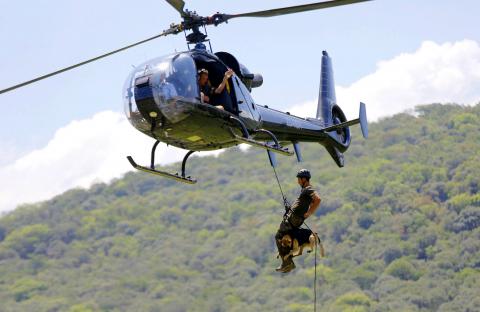
Photo: EPA
Rhinoceros horns are made of the same material as human hair or fingernails, yet are more valuable than gold by weight. Prices per kilogram range between US$65,000 and US$95,000 in China and Vietnam, where consumers buy them in a powdered form to ingest as a supposed cure for cancer and to try to improve their libido.
South Africa is trying a number of measures to end poaching, including setting up a protection zone within Kruger National Park, moving rhinoceroses to private ranches and deploying soldiers to fight poachers.
Johannesburg-based Paramount, run by the Ichikowitz family, last year contributed a helicopter to help catch poachers in Kruger.
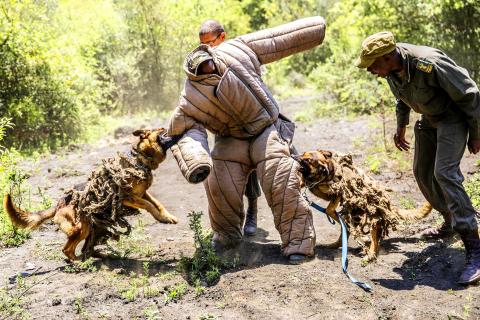
Photo: AFP
The K9 academy is about two hours’ drive from Johannesburg, beside the Magaliesburg ridge that stretches out to the west of the city. About 60 adult dogs, some Malinois, some bred with German shepherds, which are bigger and slower, and 60 puppies are preparing for deployment in South Africa’s war on poaching.
Venom’s snout is long and black. The rest of the 30kg dog is covered in a short fawn coat. He pants to keep cool in the more than 30?C heat. A Malinois can sell for as much as 100,000 rands (US$9,093). From the age of about six weeks, the dogs start being trained in the arts of hunting, tracking and detecting.
“With all of the technology in the world, one of the most successful solutions is one of the simplest; man and dog,” foundation director Eric Ichikowitz said.
With a few sharp commands in Afrikaans from Marius, it takes Venom seconds to sniff out a small capsule of rhinoceros horn shavings tucked into the wheel arch of a black Toyota Prado sports utility vehicle (SUV). Marius rewards him by throwing a tennis ball that the dog chases down. Then he sniffs out a rifle in another SUV.
“For the dog, this is a game,” Holsthyzen said. “He does not know how important his contribution is. His reward is play.”
In another training exercise, Marius and Venom leap out of a helicopter into a muddy lake to apprehend a fleeing suspect.
Holsthyzen, a dog trainer for more than 20 years, has arms that are criss-crossed with scars from training sessions with attack dogs.
He deployed the first dog he trained for anti-poaching activities, named Ngwenya, in the Kruger Park in 2010. Weeks later it tracked down poachers who had sawed off a rhinoceros’ horn in the dead of night.
Using the right breed is imperative. When Holsthyzen tried using Blueticks, a hunting dog first bred in Louisiana, the US, he found that the dogs were so fast while tracking that their handlers could not keep up. The foundation is now exploring whether they can fit them with signal-emitting collars and track them with drones.
National parks in South Africa and other countries send their rangers to be trained alongside the dogs, before they return to their reserves as a unit.
It costs the Ichikowitz foundation about 130,000 rands to groom one dog for action and then about 50,000 rands per year in upkeep. In the bush, they are deployed with mobile ranger units for three days before being airlifted home.
As rangers lie in the dust firing R1 rifles at boards 90m away, the dogs start barking in the distance.
“When the shots are fired, for the dogs it’s time to get aggressive,” Holsthyzen said.

The death of a former head of China’s one-child policy has been met not by tributes, but by castigation of the abandoned policy on social media this week. State media praised Peng Peiyun (彭珮雲), former head of China’s National Family Planning Commission from 1988 to 1998, as “an outstanding leader” in her work related to women and children. The reaction on Chinese social media to Peng’s death in Beijing on Sunday, just shy of her 96th birthday, was less positive. “Those children who were lost, naked, are waiting for you over there” in the afterlife, one person posted on China’s Sina Weibo platform. China’s
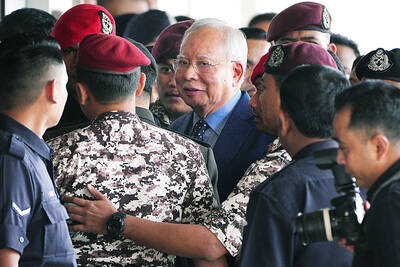
‘NO COUNTRY BUMPKIN’: The judge rejected arguments that former prime minister Najib Razak was an unwitting victim, saying Najib took steps to protect his position Imprisoned former Malaysian prime minister Najib Razak was yesterday convicted, following a corruption trial tied to multibillion-dollar looting of the 1Malaysia Development Berhad (1MDB) state investment fund. The nation’s high court found Najib, 72, guilty on four counts of abuse of power and 21 charges of money laundering related to more than US$700 million channeled into his personal bank accounts from the 1MDB fund. Najib denied any wrongdoing, and maintained the funds were a political donation from Saudi Arabia and that he had been misled by rogue financiers led by businessman Low Taek Jho. Low, thought to be the scandal’s mastermind, remains

‘POLITICAL LOYALTY’: The move breaks with decades of precedent among US administrations, which have tended to leave career ambassadors in their posts US President Donald Trump’s administration has ordered dozens of US ambassadors to step down, people familiar with the matter said, a precedent-breaking recall that would leave embassies abroad without US Senate-confirmed leadership. The envoys, career diplomats who were almost all named to their jobs under former US president Joe Biden, were told over the phone in the past few days they needed to depart in the next few weeks, the people said. They would not be fired, but finding new roles would be a challenge given that many are far along in their careers and opportunities for senior diplomats can

Australian Prime Minister Anthony Albanese yesterday announced plans for a national bravery award to recognize civilians and first responders who confronted “the worst of evil” during an anti-Semitic terror attack that left 15 dead and has cast a heavy shadow over the nation’s holiday season. Albanese said he plans to establish a special honors system for those who placed themselves in harm’s way to help during the attack on a beachside Hanukkah celebration, like Ahmed al-Ahmed, a Syrian-Australian Muslim who disarmed one of the assailants before being wounded himself. Sajid Akram, who was killed by police during the Dec. 14 attack, and


 RSS
RSS