


China’s best-known artist Ai Weiwei (艾未未) accused the Chinese Communist Party (CCP) of losing its principles and using underhand ploys to try and silence critics.
The artist, who supporters say was hit with a US$2.4 million tax bill in retribution for his outspoken activism, also criticized fellow Chinese artists for failing to speak up when he was singled out.
However, Ai said he was optimistic about the younger generation in an exclusive interview with The Associated Press this week at his Beijing studio, where he talked about the English-language version of a Danish documentary released this week about his tax case.
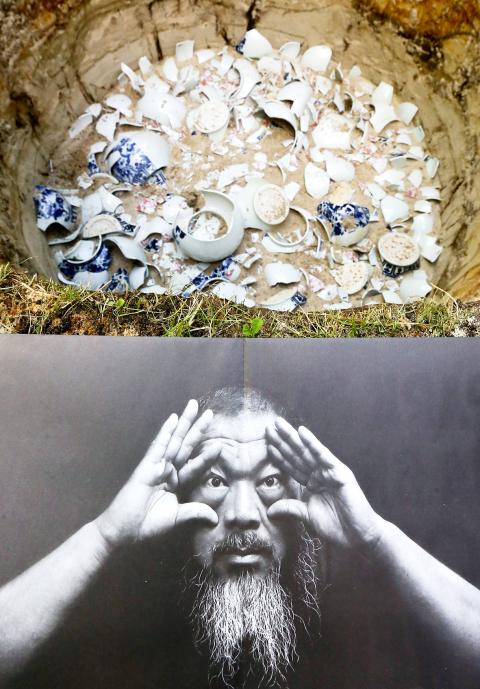
Photo: EPA
“Before, I was naive enough to think that a political regime, a strong society, would never use unsavory means in legal cases. If you bring a charge against someone, you do it in the normal way. You should not defame and frame someone and silence their voice,” Ai said.
The outspoken artist has been virtually silenced in China over the past couple of years, though he occasionally speaks to foreign journalists, and Ai said he was warned by police not to conduct this interview or he would face unspecified consequences.
“From what we see today, [the government] has completely lost its basic principles,” he said, referring to the frequent declarations of Chinese leaders that CCP members are honest and above-board people.
The 86-minute film, Ai Weiwei: The Fake Case, directed by Andreas Johnsen, opens with 2011 footage of Ai emerging from 81 days of detention amid a throng of journalists. Already a long-time government critic, he had been detained with other activists and dissidents amid calls for social and political reforms in China following the Arab Spring uprisings, but then was let go without charge.
After his release, authorities slapped his company with a US$2.4 million bill in back taxes and fines in a closed-door hearing. Ai unsuccessfully fought the tax assessment in court.
In recent years, Chinese authorities have increasingly targeted activists and dissidents, as well as their relatives, on non-political charges such as disturbing public order or business-related misdeeds, instead of free speech and political dissent charges that would draw international condemnation.
Last year, a Beijing court convicted the brother-in-law of the Nobel Peace laureate Liu Xiabo (劉曉波) of fraud charges and sentenced him to 11 years in jail.
The iconoclastic Ai has been outspoken in art and commentary since his youth. In one of his works, Ai was photographed giving the finger to Tiananmen, the symbolic heart of China’s political establishment.
Ai wrote scathing commentary via social media from 2005 to 2009, the year his microblogs in China were shut down. He especially angered authorities with his high-profile campaign to highlight the shoddily built classrooms that crumbled in a 2008 earthquake and killed thousands of students.
The 57-year-old said he did not seek to be an activist.
“All my feelings and viewpoints are genuine. They are all opinions that I, as an individual or as someone linked to artwork, would normally have,” he said. “But because of repeated crackdowns and bans, I have been turned into someone unusual, and I have become a kind of activist.”
The government has blacklisted him from any mention in state media, and the artist is not allowed to post anything on China’s social media. Authorities have confiscated his passport so that he cannot go abroad where he might speak freely.
His tribulations — reported in detail by foreign media — have raised his profile overseas, and Ai said he is thankful for support from foreign artists and organizations. However, he says he has been disheartened by the indifference of fellow Chinese artists.
“The biggest trauma is not how I was treated in jail but how I saw that the Chinese artists, as a group, pretended that nothing happened,” Ai said.
Ai said he believed people’s pursuit of freedom and happiness would eventually prevail.
“I may have underestimated myself. Given how seriously the government is treating me, it seems I do make a difference. Every day, there are young people who approach me to shake hands with me, to have photos taken with me or to seek autograph,” he said. “They all voice their support.”
When news got out about his hefty fine and tax bill, about 30,000 people expressed support online and offered donations and small loans totaling more than 9 million yuan (US$1.5 million). In the documentary, money folded into paper airplanes was flown over the wall into his studio.
His tax bill is now paid.

‘CROSSING THE LINE’: China’s embassy in Seoul criticized US Forces Korea Commander General Xavier Brunson, asking if his ‘hostile’ remarks were authorized by Washington South Korea and the US are in talks over recent public remarks by the commander of US Forces Korea, Seoul’s presidential office said yesterday, after the comments drew sharp criticism from China. In a recent podcast interview, US Forces Korea Commander General Xavier Brunson described South Korea as “the dagger in the heart of Asia” from China’s east coast, prompting the Chinese embassy in Seoul to say that he had “truly crossed the line.” The interview came amid growing speculation that Washington might seek to expand the role of US Forces Korea in countering the growing regional influence of China, a key

Through the noise of rushing papers and whirring belts at a print factory in Kyoto, two creators watch their photo essay come to life in broadsheet form — part of an effort to win new audiences in the age of artificial intelligence (AI). Despite the decline of the publishing industry, self-publication and handmade “zine” magazines are growing in popularity in Japan, reflecting the nation’s enduring love of paper in the digital era. While speaking to Agence France-Presse at the plant, his hands black with ink, one of the creators, Kazuma Obara, said: “I think [paper] is a medium that engages all five

Australian researchers have trained lab-grown brain cells on a silicon computer chip to play the 1990s shooter game Doom and said they are just scratching the surface of what the neurons could be capable of doing. It is the science-fiction work of biotech boffins at Cortical Labs, who researched and developed the technology that harnesses the workings of the brain’s networking system. Each so-called “biological computer” contains about 200,000 living human brain cells, grown from stem cells that were harvested from blood donations. Having mastered the simple computer game Pong, where a paddle is moved up and down to send a ball

A surprising gut feeling may help pigeons find their way home. Animals use various techniques to navigate, including following the stars and remembering key landmarks. Birds, fish and turtles orient themselves using Earth’s magnetic field as a compass, but it is not yet clear how exactly they do this. Pigeons are a well-known group of frequent flyers that can traverse hundreds of kilometers in a single day. For thousands of years, humans have used them to carry news, notes and military messages. Scientists have long tried to untangle how pigeons travel without getting lost. Some think the birds detect magnetic cues using light-sensitive


 RSS
RSS