


Andrew Kay, the designer of an early portable computer, the Kaypro II, that became a smash hit in the early 1980s before his company fell into bankruptcy in the 1990s as the computer industry leapfrogged ahead of him, died on Aug. 28 in Vista, California. He was 95.
His death was confirmed by his son, Allan.
For a time, Kay’s company, Kaypro, was the world’s largest portable-computer maker, ranked fourth in the PC industry overall behind IBM, Apple Computer and RadioShack.
Early on, the Kaypro II developed a loyal following. Arthur C. Clarke used a Kaypro to write his novel 2010: Odyssey Two; Stephen Case, who would become chief executive of America Online, bought one as his first computer, adding a 300-baud modem to explore the fledgling online world.
“The Kaypro computer was a necessary step in getting to the iPad,” Paul Freiberger, co-author of Fire in the Valley: The Making of the Personal Computer, said in an interview on Friday. “Back then few thought of making a computer you could carry around. It was loved because he got almost everything right.”
The Kaypro II burst onto the scene in 1982 at the West Coast Computer Faire in San Francisco. The hobbyist phase of the industry was just ending and although IBM had entered the personal computer market the previous year, portable computers were still a novelty.
The 1981 exposition was dominated by Adam Osborne’s trailblazing Osborne I computer, which weighed 10.9kg, had a 5-inch display and came with a handful of programs for what was then a breakthrough price: US$1,795.
The next year Kay’s boxy computer appeared at the same event, downstairs in a tiny booth in what was normally an underground parking garage. The Kaypro II generated a great deal of enthusiasm by surpassing many of the Osborne’s features.
Both machines were described as “luggables” and were the size of portable sewing machines. However, the Kaypro’s case was rugged metal, in contrast to the Osborne’s plastic shell, and it had a 9-inch cathode ray tube display. It weighed 13.15kg and, like the Osborne I, sold for US$1,795.
Later that year, Kay’s fledgling company benefited when Osborne announced plans for a new model, effectively killing sales of the firm’s existing machine. This failure of business strategy became famously known as the “Osborne effect.” By the end of 1983, Osborne’s company was bankrupt.
Neither the Osborne I nor the Kaypro II initially ran the MS-DOS operating system, which would ultimately be an Achilles heel as the software world catalyzed around the IBM PC and the software platform Microsoft had developed for it.
Kay came to the personal computer industry when he observed that his son-in-law was having trouble moving a bulky Apple II that came with a separate monitor. It occurred to him that an all-in-one machine would be more portable. At the time, Kay owned a small company that made electronics test equipment for the aerospace industry in Southern California.
The idea for a portable computer arrived just in the nick of time. His firm, Non-Linear Systems, had originally grown on the strength of the military and space industries. However, after the Apollo space program ended in the early 1970s, the company foundered and lost money for a number of years.
Kaypro’s revenue exceeded US$120 million in 1985. However, the company never successfully made the transition to the IBM-compatible world. It filed for Chapter 11 bankruptcy protection in 1990 and Kay, putting up US$250,000 of his family’s money, said: “We’ll build up our independent dealer base and do it again.”
However, Kaypro was not able to emerge from bankruptcy and its assets were liquidated in 1992.
Andrew Francis Kopischiansky was born on Jan. 22, 1919, in Akron, Ohio, and received an engineering degree from the Massachusetts Institute of Technology in 1940.
After moving to California in 1949, he went to work at the Jet Propulsion Laboratory, where he was involved in the Redstone rocket development program.

It began as a satirical online project. Now millions of young people in India are flocking to it as an outlet for their frustration. A parody political party called the Cockroach Janta Party, with the insect as its symbol, has exploded across India’s social media by turning absurdist humor into protest. Memes and short videos mocking corruption, joblessness and political dysfunction have flooded social media sites, where millions of users are embracing the cockroach — known for its ability to survive harsh conditions — as a tongue-in-cheek symbol of endurance. The online movement’s rise has been unusually rapid. The Cockroach Janta Party (CJP)

SPEAKING OUT: After Siranudh Scott’s allegations surfaced, celebrities and public figures took to social media to share their own experiences of sexual misconduct and abuse A high-profile alleged sexual abuse case within a wealthy Thai beer brewing family has prompted a wave of painful accounts from survivors of unconnected abuse in the conservative nation. Siranudh Scott, a member of the billionaire Thai family that founded the ubiquitous Singha beer brand, posted an emotional video this month accusing his elder brother Sunit of repeatedly abusing him when he was a teenager. Sunit, who is in his 30s, later denied the allegations in a video posted online, but Singha parent Boonrawd dismissed him from his executive role with the company on Tuesday last week. “I felt I needed to speak

A Hong Kong astronaut is to join a Chinese space mission for the first time as part of a three-person crew launching today, as Beijing edges closer to its goal of landing people on the moon. The Tiangong space station — crewed by teams of three astronauts that are typically rotated every six months — is the crown jewel of China’s space program, boosted by billions in state investment in a bid to catch up with the US and Russia. The Shenzhou-23 mission is to blast off at 11:08pm from the Jiuquan Satellite Launch Center in northwestern China, carrying three astronauts to
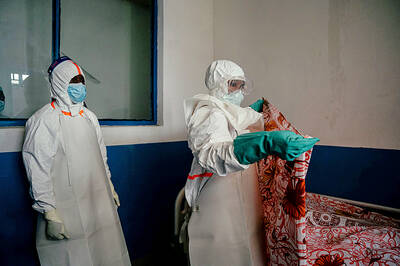
UPGRADED ALERT: The risk inside DR Congo is now considered ‘very high,’ while neighboring countries face a ‘high’ threat as the outbreak continues, the WHO said Ebola is spreading faster than responders can track it in eastern Congo, where health workers managed to follow up with barely one in five identified contacts in a single day. Authorities in the Democratic Republic of the Congo (DR Congo) reported 83 confirmed infections, 746 suspected cases and 1,603 identified contacts as of Thursday, but health workers were able to follow up on only 342 contacts that day — about 21 percent of the total under monitoring — data released by the DR Congo Ministry of Public Health on Friday showed. The figures suggest the response is falling behind the outbreak itself,


 RSS
RSS