


He might be more than a century old, but Hafeezullah still goes to work every day. With the aid of a cane, the wizened white-bearded centenarian tends to fields in Pakistan’s hauntingly beautiful Neelum Valley just as he did when Britain still ruled that part of the world.
Pakistan was recently named by the UN as one of the worst countries in the world to be for an old person in a report that cited insecurity and lack of freedom for those over 60.
However, a dozen or so centenarians like Hafeezulah living in a remote region of Kashmir are bucking that trend, putting their longevity down to their simple mountain lifestyle.
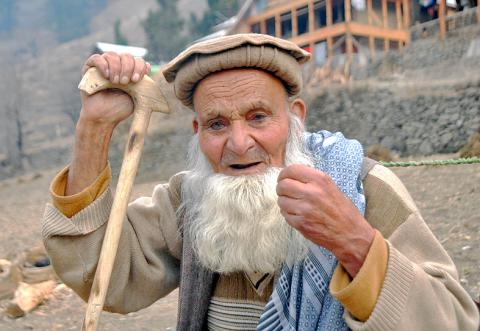
Photo: AFP
Situated in the Lower Himalayan Range, a 200km long river runs through the Neelum Valley, which is home to some of the most spectacular scenery on the planet.
Craggy, snow-peaked mountains, waterfalls and green pastures surround the village of Chattah where reporters met with about a dozen men and women claiming to be at least a century old.
Hafeezullah says he is 132, which would make him the oldest person in the world — although Pakistan’s National Database and Registration Authority (NADRA) says he is 107.
A slightly built man with a face as jagged as the mountains surrounding him, he said a healthy diet of mainly fresh produce and occasional meat was the reason behind his longevity.
He has lived through the days of British India and witnessed Partition, but says the thing he remembers most fondly is the low cost of living during his youth.
“We used to eat vegetables and pulses. We dumped the dried vegetables in land during the winter season and then dug them up and ate them in summer,” he said referring to the practice of freezing produce under snow-covered ground.
He has outlived three wives, and his fourth, Issem Jan, dedicates herself to helping him.
Chattah and nearby villages are 2,000m above sea level and cut off from the rest of the country by snow for almost six months a year.
The altitude also increases red blood cell production in the body, and the crisp air is free from the kind of choking pollution that blights Pakistan’s major cities.
Despite being a favored tourism spot, Neelum Valley is relatively untouched by time, and traditional farming methods, including the use of bullocks to plow fields, are still practiced.
There are no nearby markets, no fast food and villagers are for the most part self-sufficient.
“The farmers still use bulls to plow their fields. This an old system of agriculture,” village head Abdul Khaliq, 75, said.
He added that the village’s young people get up at about 4am and work till sunset, doing farm tasks like chopping wood, carpentry and tending to livestock — another factor contributing to their overall good health.
Mohammad Shapal Khan, an senior NADRA official said that only 60 percent of the region’s population had so far been added to federal data — but each village in the valley has a dozen or so people over 90.
In stark contrast, the average life expectancy in Pakistan is 64 for men and 66 for women, data from the WHO shows.
The UN-backed Global Age Watch Index named Pakistan as one of the three worst places in the world to grow old in and the worst in terms of so-called “enabling environment,” which includes security and freedom of movement.
Sabat Khan, another elderly local who claims he is 102, although official records place him at 92, said his idyllic homeland and lack of ill-health were responsible for his long life.
“It is thanks to God’s blessing that I’m healthy,” he said, surrounded by a multitude of grandchildren. “I’ve rarely been sick and now I’m an old man.”

An American scientist convicted of lying to US authorities about payments from China while he was at Harvard University has rebuilt his research lab in Shenzhen, China, to pursue technology the Chinese government has identified as a national priority: embedding electronics into the human brain. Charles Lieber, 67, is among the world’s leading researchers in brain-computer interfaces. The technology has shown promise in treating conditions such as amyotrophic lateral sclerosis and restoring movement in paralyzed people. It also has potential military applications: Scientists at the Chinese People’s Liberation Army have investigated brain interfaces as a way to engineer super soldiers by boosting

Jailed media entrepreneur Jimmy Lai (黎智英) has been awarded Deutsche Welle’s (DW) freedom of speech award for his contribution to Hong Kong’s pro-democracy movement. The German public broadcaster on Thursday said Lai would be presented in absentia with the 12th iteration of the award on June 23 at the DW Global Media Forum in Bonn. Deutsche Welle director-general Barbara Massing praised the 78-year-old founder of the now-shuttered news outlet Apple Daily for standing “unwaveringly for press freedom in Hong Kong at great personal risk.” “With Apple Daily, he gave journalists a platform for free reporting and a voice to the democracy movement in

PHILIPPINE COMMITTEE: The head of the committee that made the decision said: ‘If there is nothing to hide, there is no reason to hide, there is no reason to obstruct’ A Philippine congressional committee on Wednesday ruled that there was “probable cause” to impeach Philippine Vice President Sara Duterte after hearing allegations of unexplained wealth, misuse of state funds and threats to have the president assassinated. The unanimous decision of the 53-member committee in the Philippine House of Representatives sends the two impeachment complaints to deliberations and voting by the entire lower chamber, which has more than 300 lawmakers. The complaints centered on Duterte’s alleged illegal use and mishandling of intelligence funds from the vice president’s office, and from her time as education secretary under Philippine President Ferdinand Marcos Jr. Duterte and the

Burmese President Min Aung Hlaing yesterday cut all prisoners’ sentences by one-sixth, a blanket measure that a source close to deposed leader Aung San Suu Kyi said would further shorten her detention. Aung San Suu Kyi has been sequestered since a 2021 military coup, but the senior member of her dissolved National League for Democracy (NLD) party said that while her term had been reduced, her remaining sentence is still unclear. “We also don’t know exactly how many years she has left,” the source told reporters, speaking on condition of anonymity for security reasons. The military toppled Aung San Suu Kyi’s elected government


 RSS
RSS