


A Chinese shaman resplendent in a dark suit and green cloth hat thumbed yellowing pages said to predict the future — but mass migration to cities means the prospects for his own profession look bleak.
“To see a spirit, you have to practice the ancient rituals,” said Zhao Fucheng, 74.
He said he can communicate with the spirit world from his wooden hut in southwestern Guangxi Province.
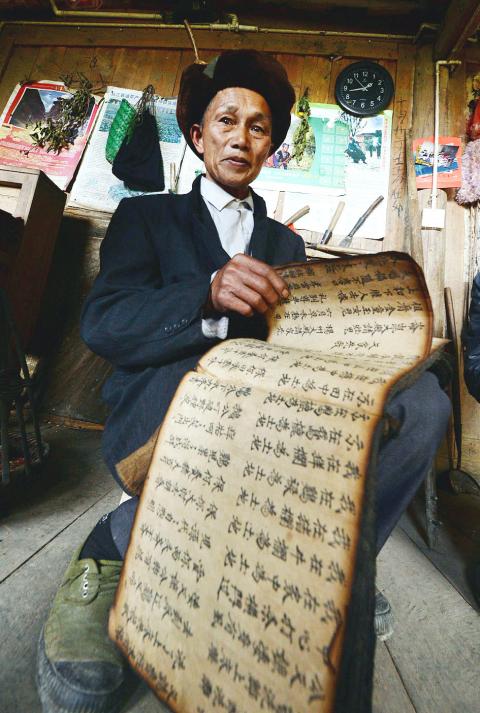
Photo: AFP
He is one of the estimated thousands of shamans — known locally as “spirit masters” — who are called on as healers in a centuries-old tradition among ethnic groups in the region.
“If something bad is going to happen to you soon, and your luck is running out, I can change your luck... If medicine doesn’t work, then you need to ask a spirit,” said Zhao, who belongs to the Yao ethnic minority.
He lives in the remote village of Qiuka, accessible by a dirt track which rises high over mountains patterned with rice fields and receives a steady stream of villagers who profess to believe in spirits.
“Sometimes if you go to the hospital and see a doctor and it doesn’t work, you need to look for a spirit master,” said 38-year-old farmer Zhao Jintai, who like many in the village is surnamed Zhao, but not related to the shaman.
“Spirits will make you ill, but they won’t eat you or anything like that,” Zhao Deqing said, 13.
He admires the motorbikes that older peers drive back from their jobs in nearby towns, and plans to leave the village as soon as school finishes.
When he does, Zhao will join the largest migration in human history — which has seen more than 300 million Chinese people move to cities over the past 15 years — and leave the elderly shaman behind.
The shaman Zhao said he specializes in healing and telling fortunes.
“I do some communicating with ghosts, beating drums and blowing cow horns — I can do the little things,” he said.
On a spring morning he agreed to make predictions for a visitor. Armed with the client’s date of birth and wearing reading glasses, he scrutinized a lunar calendar printed in red ink.
Mouthing a series of calculations, he reached for a book he says is hundreds of years old, its crumbling pages lined with Chinese characters.
“When you reach 39, things won’t go smoothly for you,” he declared, as his increasingly red-faced client nodded.
The Cultural Revolution, a decade of political upheaval launched in 1966 by China’s then-leader Mao Zedong (毛澤東), saw violent campaigns against “superstitious” practices in which spirit masters were beaten and abused.
Shamans in Qiuka hid their books during the turmoil, retrieving them only when campaigns relaxed in the 1980s.
Demand for their services surged in the following decades as market reforms undermined China’s public healthcare system and medical costs skyrocketed.
Even in a tiny village like Qiuka, with just a few hundred residents, several men identify themselves as spirit masters.
“People will look for me if they get sick... Ancient people left us this book... To attract spirits, you need to use blood. It can be a little scary,” said Zhao Fukai, a grey-haired man in his 60s, cradling a thick yellowed tome.
However, in the mountain villages of Guangxi one section of the population is visible by its absence — young people.
Nearly all of the remote village’s youth leave after graduating middle school, looking for work in cities which pay better than local jobs in farming or forestry.
China is set to add 300 million to its urban population over the next decade, a process bound to leave thousands of villages virtually empty.
Shamans in Qiuka fear that no one would learn the rites passed down to them.
Village traditions elsewhere, from theater to martial arts, face the same threat of extinction as China urbanizes.
“You can obviously make much more money working outside the village, you can’t earn much doing this,” shaman Zhao Jintai said.
He looked at his middle-aged son, who remains in the village due to an industrial accident but claims “not to believe” in the magic practiced by his father.
Yang Shengwen, a local researcher who has studied shamanic traditions in the region, said the practice would suffer as villages empty.
“Shamanism hasn’t vanished, but it’s a trend we are worried about, especially because of young people going to cities to work... In 30 years, they will be there, but after that, it’s hard to say,” he said.
From his mountaintop perch, Zhao admitted seeing fewer patients in recent years, giving a cryptic explanation.
“The spirits have left, so I communicate with them less,” he said.
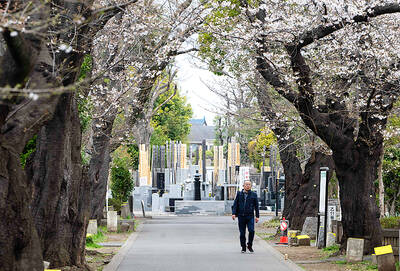
ROCKY RELATIONS: The figures on residents come as Chinese tourist numbers drop following Beijing’s warnings to avoid traveling to Japan The number of Chinese residents in Japan has continued to rise, even as ties between the two countries have become increasingly fractious, data released on Friday showed. As of the end of December last year, the number of Chinese residents had increased by 6.5 percent from the previous year to 930,428. Chinese people accounted for 22.6 percent of all foreign residents in Japan, making them by far the largest group, Japanese Ministry of Justice data showed. Beijing has criticized Tokyo in increasingly strident terms since Japanese Prime Minister Sanae Takaichi last year suggested that a military conflict around Taiwan could

A pro-Iran hacking group claimed to breach FBI Director Kash Patel’s personal e-mail inbox and posted some of the contents online. The e-mails provided by the hacking group include travel details, correspondence with leasing agents in Washington and global entry, and loyalty account numbers. The e-mail address the hackers claim to have compromised has been previously tied to Patel’s personal details, and the leaked e-mails contain photos of Patel and others, in addition to correspondence with family members and colleagues. “The FBI is aware of malicious actors targeting Director Patel’s personal email information,” the agency said in a statement on
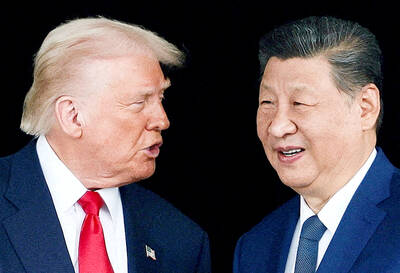
RIVALRY: ‘We know that these are merely symbolic investigations initiated by China, which is in fact the world’s most profligate disrupter of supply chains,’ a US official said China has started a pair of investigations into US trade practices, retaliating against similar probes by US President Donald Trump’s administration as the superpowers stake out positions before an expected presidential summit in May. The move, announced by the Chinese Ministry of Commerce on Friday, is a direct mirror of steps Trump took to revive his tariff agenda after the US Supreme Court last month struck down some of his duties. “China expresses its strong dissatisfaction and firm opposition to these actions,” a ministry spokesperson said in a statement, referring to the so-called Section 301 investigations initiated on March 11.

When a hiker fell from a 55m waterfall in wild New Zealand bush, rescuers were forced to evacuate the badly hurt woman without her dog, which could not be found. After strangers raised thousands of dollars for a search, border collie Molly was flown to safety by a helicopter pilot who was determined to reunite the pet and the owner. A week earlier, an emergency rescue helicopter found the woman with bruises and lacerations after a fall at a rocky spot at the waterfall on the South Island’s West Coast. She was airlifted on March 24, but they were forced to


 RSS
RSS