


Benjamin Carle is 96.9 percent made in France, right down to his underpants and socks. Unfortunately six Ikea forks, a Chinese guitar and unsourced wall paint stopped him being declared a 100 percent economic patriot, but nobody is perfect.
Carle, 26, set out last year to see if it was possible to live using only French-made products for 10 months as part of a television documentary.
The idea was triggered by French Minister for Economic Renewal Arnaud Montebourg’s call for the public to buy French to save the country’s industrial production sector.
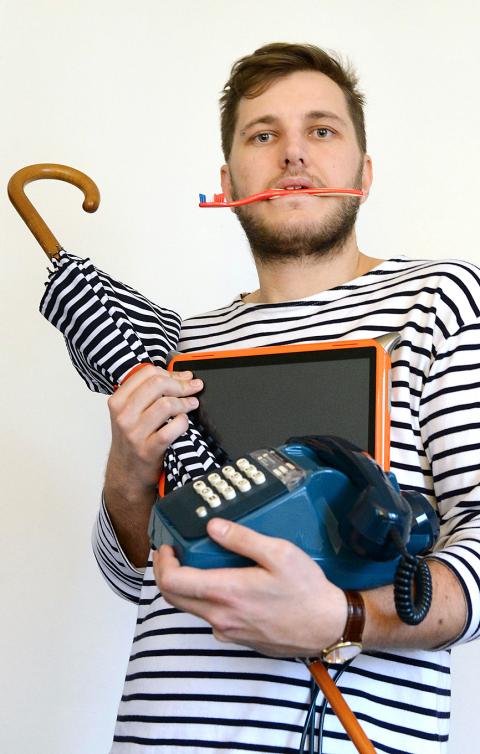
Photo: AFP
The experiment cost Carle his smartphone, television, refrigerator (all made in China), his spectacles (Italian), his underpants (Moroccan), morning coffee (Guatemalan) and his adored David Bowie music (British).
Fortunately his long-suffering girlfriend Anais and cat Loon (both French) stuck with him.
“Politicians say all sorts of things and expect us to go along with it. I wanted to see if it was possible and feasible to do what the minister was asking us to do. To hold him to account for his words,” Carle told the Guardian over a non-French coffee in a Parisian cafe this week after finishing his documentary.
He set just three rules: eat only foods produced in France, eliminate contact with foreign-made goods and do so on 1,800 euros (US$2,500) a month (above the minimum wage of 1,430 euros to cover the extra expense of living in Paris).
The journalist was shocked to find out at the start of the experiment that only 4.5 percent of the contents of his apartment were made nationally — and that the rest would have to go, including the lightbulbs (China) and green beans (Kenya).
Left without a refrigerator (none are made in France), or nail clippers, he was forced to chill his food on the window ledge and saw at his toenails with a penknife.
His foreign-made clothes, down to his underwear, were replaced by more expensive alternatives: French-produced underpants (26 euros), socks (9 euros), polo shirt (75 euros), espadrille sandals (26 euros), but no jeans, as none are produced in France.
In the film we see Carle scouring supermarket shelves for 100 percent French-made products, learning to cook seasonal fruit and vegetables grown in France, proudly brushing his teeth with the last toothbrush made in France by a company in Picardie employing 29 people, and hand-washing his smalls until he finds the last French-made washing machine (which being top-opening will not fit under the kitchen counter).
Going out with friends was problematic — no US films, no Belgian beer, no sushi or pizza.
Unable to use his British-made bicycle or even a French car after discovering the only affordable Peugeot, Renault and Citroen models are mostly made overseas, he invested in a fug-emitting orange Mobilette.
The last things to go, albeit reluctantly, were the computer, replaced by a Qooq, a recipe tablet that connects — slowly — to the Internet, and the iPhone, swapped for an old Sagem mobile.
Carle admits the experiment was part serious and part jest.
“It’s not entirely possible or even desirable to live 100% made in France, particularly in terms of new technology. But that wasn’t the point,” Carle said.
“This wasn’t about French nationalism or patriotism. It was trying to show that we should reflect about the way we consume and make different choices, and that applies in all countries. If we want to save jobs and industries wherever we are, we might think about supporting them,” he said.

An American scientist convicted of lying to US authorities about payments from China while he was at Harvard University has rebuilt his research lab in Shenzhen, China, to pursue technology the Chinese government has identified as a national priority: embedding electronics into the human brain. Charles Lieber, 67, is among the world’s leading researchers in brain-computer interfaces. The technology has shown promise in treating conditions such as amyotrophic lateral sclerosis and restoring movement in paralyzed people. It also has potential military applications: Scientists at the Chinese People’s Liberation Army have investigated brain interfaces as a way to engineer super soldiers by boosting
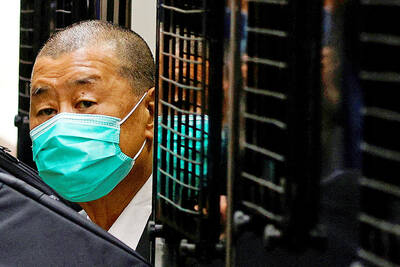
Jailed media entrepreneur Jimmy Lai (黎智英) has been awarded Deutsche Welle’s (DW) freedom of speech award for his contribution to Hong Kong’s pro-democracy movement. The German public broadcaster on Thursday said Lai would be presented in absentia with the 12th iteration of the award on June 23 at the DW Global Media Forum in Bonn. Deutsche Welle director-general Barbara Massing praised the 78-year-old founder of the now-shuttered news outlet Apple Daily for standing “unwaveringly for press freedom in Hong Kong at great personal risk.” “With Apple Daily, he gave journalists a platform for free reporting and a voice to the democracy movement in
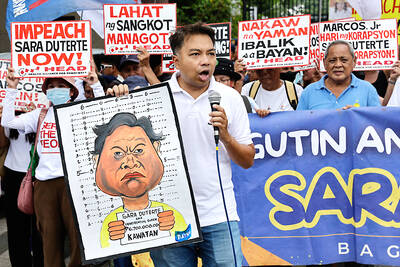
PHILIPPINE COMMITTEE: The head of the committee that made the decision said: ‘If there is nothing to hide, there is no reason to hide, there is no reason to obstruct’ A Philippine congressional committee on Wednesday ruled that there was “probable cause” to impeach Philippine Vice President Sara Duterte after hearing allegations of unexplained wealth, misuse of state funds and threats to have the president assassinated. The unanimous decision of the 53-member committee in the Philippine House of Representatives sends the two impeachment complaints to deliberations and voting by the entire lower chamber, which has more than 300 lawmakers. The complaints centered on Duterte’s alleged illegal use and mishandling of intelligence funds from the vice president’s office, and from her time as education secretary under Philippine President Ferdinand Marcos Jr. Duterte and the
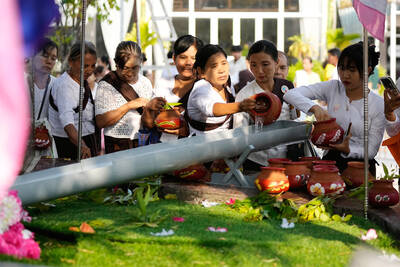
Burmese President Min Aung Hlaing yesterday cut all prisoners’ sentences by one-sixth, a blanket measure that a source close to deposed leader Aung San Suu Kyi said would further shorten her detention. Aung San Suu Kyi has been sequestered since a 2021 military coup, but the senior member of her dissolved National League for Democracy (NLD) party said that while her term had been reduced, her remaining sentence is still unclear. “We also don’t know exactly how many years she has left,” the source told reporters, speaking on condition of anonymity for security reasons. The military toppled Aung San Suu Kyi’s elected government


 RSS
RSS