


The race to become the next governor of Tokyo began yesterday in an election widely seen as a referendum on Japan’s energy policy, almost three years after the nuclear disaster at Fukushima.
Observers said the Feb. 9 election will be a two-way race between the anti-nuclear former prime minister Morihiro Hosokawa and Yoichi Masuzoe, an academic and former health minister, who served as a member of Japan’s Liberal Democratic Party (LDP) government.
“We have to stop [the policy of] restarting nuclear plants as soon as possible and adapt to a new era,” Hosokawa said on the campaign trail yesterday.
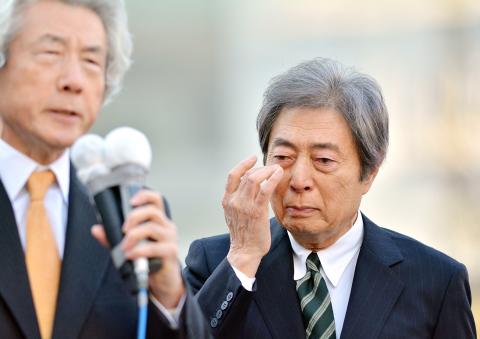
Photo: AFP
Japanese voters have become wary of nuclear power since the tsunami-sparked disaster at Fukushima began in March 2011, but the issue failed to materialize in the national polls that swept Japanese Prime Minister Shinzo Abe to power, with his opponents’ apparent haplessness neutralizing their anti-nuclear stance.
The governor of Tokyo has no actual power to change national energy policy, but the sheer size of the city, with 13 million inhabitants and a pivotal place in the economic, political and cultural life of Japan, means its verdict will be tough to ignore.
Hosokawa, whose 1993 to 1994 stint as prime minister is little more than a footnote to modern political history, has the backing of wildly popular one-time prime minister Junichiro Koizumi.
The abundantly coiffured Koizumi has shunned the limelight since his five-year term ended in 2006, but he emerged as an anti-nuclear convert midway through last year and began agitating for the permanent shuttering of Japan’s nuclear reactors.
That put him at odds with Abe, his one-time protege who has vowed to get the plants back on line when they have passed new, more stringent safety tests.
Popular memories of the 2001 to 2006 Koizumi administration remain overwhelmingly positive, and his backing is expected to give Hosokawa a significant boost, analysts said.
“At this point Mr Masuzoe seems to be the strongest candidate, as Mr Hosokawa has been largely mum about the details of his policy stances,” Tokyo University professor of politics Sadafumi Kawato said.
However, “Mr Koizumi is still popular and honestly I can’t predict the vote result,” he added.
“But if Mr Hosokawa wins the election, it could be an obstacle to Prime Minister Abe’s energy policy,” he said, adding that Tokyo is a major shareholder of Tokyo Electric Power Co, the operator of the Fukushima plant.
However, in a note to clients, research consultancy Capital Economics said Abe, whose drive to reinvigorate Japan’s sluggish economy is widely believed to be bearing fruit, may be able to ride out a negative result in the Tokyo poll.
“The influence of local politicians on energy policy is limited. The national government should therefore still be able to resume nuclear generation in coming months whichever way the Tokyo vote goes,” it said.
Masuzoe, who gained fame as a political scientist and TV pundit, said his priority was to make the 2020 Tokyo Olympics a success.
“I want to have the best Olympics and Paralympics ever in history,” he said, adding that public safety, disaster prevention and social welfare services are also among his priorities.
On energy policy, he said: “It is better to reduce the ratio” of nuclear power in energy consumption, in [the] short term, securing the safety of nuclear plants is important.”
At least 15 people filed their candidacy for the election, which is to be voted on by 10.82 million people, Tokyo’s election board said yesterday afternoon.
Other candidates include Kenji Utsunomiya, 67, an anti-nuclear liberal lawyer backed by Japan’s Communist Party, and Toshio Tamogami, 65, a former air defense force chief with outspoken nationalist views.
The post of Tokyo governor fell vacant last month when Naoki Inose stepped down in a money scandal after admitting he had been naive to accept an undeclared US$500,000 from a hospital tycoon.
Prosecutors have begun quizzing him over the cash, reports said yesterday.
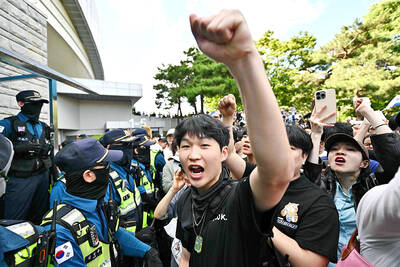
‘ABSURD MISTAKE’: The election commission said that there had been a failure to anticipate turnout after 14 polling stations ran short of ballot papers South Korean riot police yesterday cleared protesters from a Seoul polling station after a 35-hour blockade sparked by a shortage of ballot papers during local elections earlier this week. Wednesday’s election was the first nationwide vote since South Korean President Lee Jae-myung took office following the ouster of Yoon Suk-yeol over his short-lived martial law declaration. Lee’s ruling Democratic Party swept most races, but failed to flip the crucial Seoul mayoral seat. The South Korean National Election Commission apologized, blaming a failure to anticipate turnout after 14 polling stations in Seoul ran short of ballot papers. Some polling stations stayed open until 10pm to

France experienced its hottest spring on record, the French weather service said on Tuesday, after an exceptional early heat wave that also broke highs for the season in England and Wales. Meteo-France said the average nationwide temperature over March to May was 13.8°C — about 1.7°C above the norm, and surpassing records set in 2011 and 2020. “The warmest spring since records began in 1900,” it said in a bulletin. All three months were warmer than average, but the onset of an “unprecedented heatwave” late last month pushed the mercury to highs typically seen at the height of the summer. “Our country had never
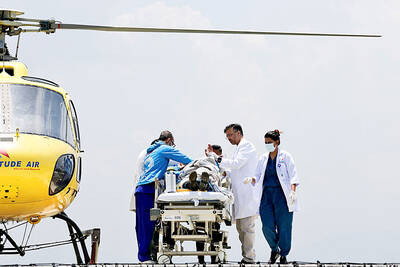
A Sherpa guide was found crawling to base camp on Mount Everest a week after he went missing and was reunited with his family, who had given up hope he would return. Dawa Sherpa was last seen on Friday last week descending the mountain, but he did not reach base camp even though his client did. The pair were among the last climbers on the mountain as the climbing season came to an end and the route was dismantled. Dawa was located by a cleaning crew on Thursday morning as he was crawling down the snowy slopes around the Khumbu Icefall, just above
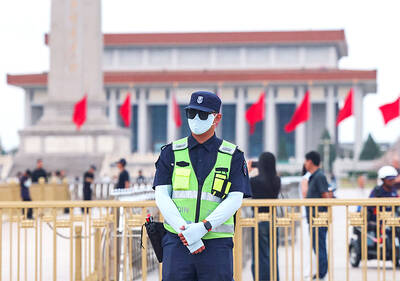
Chinese authorities are snuffing out any remembrance of the deadly 1989 military crackdown on student-led pro-democracy protests in Tiananmen Square, which happened 37 years ago yesterday, in a further tightening of a years-long campaign to erase what happened from public memory. Police told relatives of the victims they would not be allowed to visit a cemetery in Beijing on the anniversary of the crackdown, a person with knowledge of the matter said. Relatives of the victims visited the cemetery on the anniversary for more than 30 years to read memorial statements with police keeping watch, Amnesty International said. Hundreds of people,


 RSS
RSS