


Mikhail Kalashnikov, whose work as a weapons designer for the Soviet Union is immortalized in the name of the world’s most popular firearm, died on Monday at the age of 94.
Kalashnikov once aspired to design farm equipment, but even though his most famous invention — the AK-47 assault rifle — sowed havoc instead of crops, he often said he felt personally untroubled by his contribution to bloodshed.
“I sleep well. It’s the politicians who are to blame for failing to come to an agreement and resorting to violence,” he said in 2007.
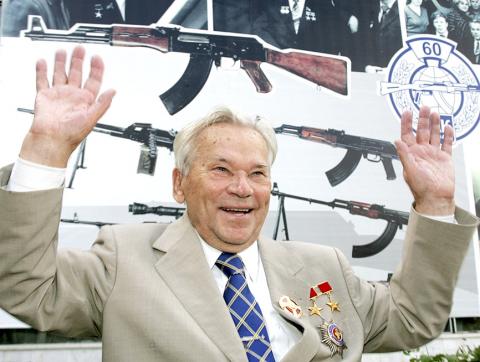
Photo: Reuters
Kalashnikov died in a hospital in Izhevsk, the capital of the Udmurtia Republic where he lived, said Viktor Chulkov, a spokesman for the republic’s president. He did not give a cause of death. Kalashnikov had been hospitalized for the past month with unspecified health problems.
The AK-47 — “Avtomat Kalashnikov” and the year it went into production — is the world’s most popular firearm, favored by guerrillas, terrorists and the soldiers of many armies.
An estimated 100 million guns are spread worldwide.
Though it is not especially accurate, its ruggedness and simplicity are exemplary: It performs in sandy or wet conditions that jam more sophisticated weapons such as the US M-16.
“During the Vietnam war, American soldiers would throw away their M-16s to grab AK-47s and bullets for it from dead Vietnamese soldiers,” Kalashnikov said in July 2007 at a ceremony marking the rifle’s 60th anniversary.
The weapon’s suitability for jungle and desert fighting made it nearly ideal for the Third World insurgents backed by the Soviet Union, and Moscow not only distributed the AK-47 widely, but also licensed its production in about 30 other countries.
The gun’s status among revolutionaries and national-liberation struggles is enshrined on the flag of Mozambique.
Kalashnikov, born into a peasant family in Siberia, began his working life as a railroad clerk. After he joined the Red Army in 1938, he began to show mechanical flair by inventing several modifications for Soviet tanks.
The moment that firmly set his course was in the 1941 Battle of Bryansk against Nazi forces, when a shell hit his tank. Recovering from wounds in the hospital, Kalashnikov brooded about the superior automatic rifles he had seen the Nazis deploy; His rough ideas and revisions bore fruit five years later.
“Blame the Nazi Germans for making me become a gun designer,” Kalashnikov said. “I always wanted to construct agricultural machinery.”
In 2007, Russian President Vladimir Putin praised him, saying: “The Kalashnikov rifle is a symbol of the creative genius of our people.”
Over his career, he was decorated with numerous honors, including the Hero of Socialist Labor and Order of Lenin and Stalin Prize. However, because his invention was never patented, he did not get rich off royalties.
“At that time in our country patenting inventions wasn’t an issue. We worked for Socialist society, for the good of the people, which I never regret,” he once said.
Kalashnikov continued working into his late 80s as chief designer of the Izhmash company that first built the AK-47. He also traveled the world helping Russia negotiate new arms deals, and he wrote books on his life, about arms and about youth education.
“After the collapse of the great and mighty Soviet Union so much crap has been imposed on us, especially on the younger generation,” he said. “I wrote six books to help them find their way in life.”
He said he was proud of his bronze bust installed in his native village of Kurya in the Siberian region of Altai. He said newlyweds bring flowers to the bust.
“They whisper ‘Uncle Misha, wish us happiness and healthy kids,”’ he said. “What other gun designer can boast of that?”

When a hiker fell from a 55m waterfall in wild New Zealand bush, rescuers were forced to evacuate the badly hurt woman without her dog, which could not be found. After strangers raised thousands of dollars for a search, border collie Molly was flown to safety by a helicopter pilot who was determined to reunite the pet and the owner. A week earlier, an emergency rescue helicopter found the woman with bruises and lacerations after a fall at a rocky spot at the waterfall on the South Island’s West Coast. She was airlifted on March 24, but they were forced to
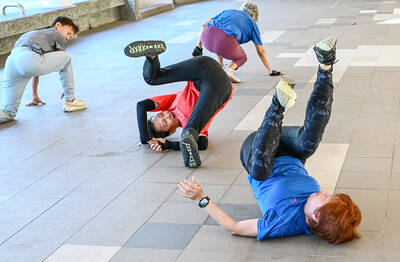
CONFIDENCE BOOSTER: ’After parkour ... you dare to do a lot of things that you think only young people can do,’ a 67-year-old parkour enthusiast said In a corner of suburban Singapore, Betty Boon vaults a guardrail, crawls underneath a slide, executes forward shoulder rolls and scales a steep slope, finishing the course to applause. “Good job,” the 69-year-old’s coach cheers. This is “geriatric parkour,” where about 20 retirees learned to tackle a series of relatively demanding exercises, building their agility and enjoying a sense of camaraderie. Boon, an upbeat grandmother, said learning parkour has aided her confidence and independence as she ages. “When you’re weak, you will be dependent on someone,” she said after sweating it out with her parkour classmates in suburban Toa Payoh,

HIGH HOPES: The power source is expected to have a future, as it is not dependent on the weather or light, and could be useful for places with large desalination facilities A Japanese water plant is harnessing the natural process of osmosis to generate renewable energy that could one day become a common power source. The possibility of generating power from osmosis — when water molecules pass from a less salty solution to a more salty one — has long been known. However, actually generating energy from that has proved more complicated, in part due the difficulty of designing the membrane through which the molecules pass. Engineers in Fukuoka, Japan, and their private partners think they might have cracked it, and have opened what is only the world’s second osmotic power plant. It generates
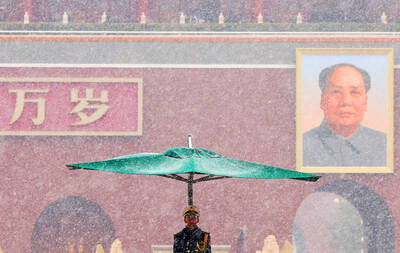
Chinese dissident artist Gao Zhen (高兟), famous for making provocative satirical sculptures of former Chinese leader Mao Zedong (毛澤東), was tried on Monday over accusations of “defaming national heroes and martyrs,” his wife and a rights group said. Gao, 69, who was detained in 2024 during a visit from the US, faces a maximum three-year prison sentence, said his wife, Zhao Yaliang (趙雅良), and Shane Yi, a researcher at the Chinese Human Rights Defenders group which operates outside the nation. The closed-door, one-day trial took place at Sanhe City People’s Court in Hebei Province neighboring the capital, Beijing, and ended without a


 RSS
RSS