


Nur Misuari, a charismatic Muslim leader who set the Philippines’ south ablaze with rebellion decades ago, is back doing what he does best after a less-than-successful fling with peace.
At the age of 71, the former academic is orchestrating a stand-off in the southern port city of Zamboanga which has claimed more than 100 lives and put him back in the national spotlight.
“We don’t want to be part of the Philippines anymore,” Misuari told supporters in his Jolo Island stronghold on Aug. 12 as he declared himself the president of the “Bangsamoro Republik” and railed against national government authorities.
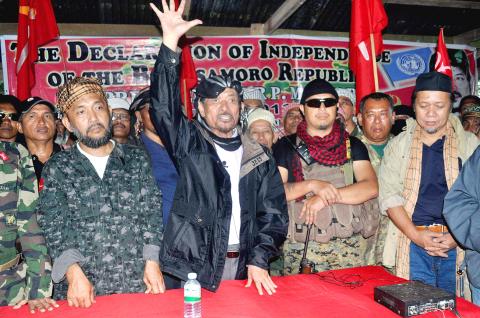
Photo: AFP
“Their presence in our homeland is illegal, unlawful, illicit. They should pack up and leave,” Misuari said.
A firebrand orator from an influential clan of the Tausug, a warrior-like seafaring tribe, Misuari rallied thousands of fellow Muslims in the early 1970s to take up arms for a separate state in the southern Philippines.
He was continuing a tradition for Muslims in the south of the mostly Catholic Philippines who had for centuries resisted outside Christian rule — whether that be Spanish, American or Filipino.
Misuari was a young political science professor at Manila’s prestigious University of the Philippines when he established the Moro National Liberation Front (MNLF) to launch a war for independence.
The conflict, which eventually took on other forms with the emergence of other rebel groups, has gone on to claim about 150,000 lives.
Misuari went into Middle East exile after a 1976 truce, then returned a decade later following the fall of former Philippine president Ferdinand Marcos to begin negotiations with democratic governments in Manila.
He eventually agreed to a peace pact in 1996, with the MNLF laying down its arms in return for self-rule in parts of the southern Philippines and Misuari as the autonomous region’s governor.
However, life for Misuari as a bureaucrat and politician would prove to be far less successful than as a revolutionary leader.
As head of the Autonomous Region in Muslim Mindanao (ARMM), he was finally in a position to help alleviate devastating poverty, corruption and violence in the south, and work to end the oppression that the millions of Muslims there feel.
Instead, he established a reputation among the political elite, the national media and some Muslims as an aloof administrator who was more concerned about his own interests.
They argue he wasted the hundreds of millions of dollars in development funds he controlled.
“Some say he blew his chance, that he did not perform well, that he did not deliver, that he failed his people,” said Jesus Dureza, who advised two past Philippine presidents on Muslim issues.
The governor was notorious for spending most of his time away, including weeks at a time with a large retinue at plush Manila hotels or on Middle East tours, said Ramon Casiple, executive director of the Manila-based Institute for Political and Electoral Reform.
Nevertheless, Misuari undoubtedly retains some support and influence.
“Nur is still an icon to some Muslims,” Dureza said.
He and Casiple said Misuari was still able to tap into powerful emotions among many Muslims in the south of feeling oppressed and their dreams of independence.
His status as the founder of the rebellion would also always ensure respect.
However, they said many also realize that Misuari’s motives for instigating the Zamboanga crisis may be driven more by personal interest and a fear of becoming politically irrelevant.
He sent an estimated 200 gunmen to Zamboanga in an effort to derail a planned peace deal with the region’s remaining major Muslim rebel group, the 12,000-strong Moro Islamic Liberation Front (MILF), which split from the MNLF in 1978.
Under the envisaged peace pact, a new autonomous region largely controlled by the MILF would replace the MNLF-brokered one.
“They fear that they might be outside the mosquito net,” Dureza said of the MNLF leadership, using a Filipino expression for total exclusion.
However, Misuari may have overplayed his hand, according to Casiple, citing his inability to draw much support beyond the Tausug heartlands of Jolo and Basilan Island.
“His problem now is that you have a president who is in no mood to negotiate,” Casiple said, citing Philippine President Benigno Aquino III’s rejection of a ceasefire offer by Misuari and plans to charge his men with rebellion.
“I think this is the endgame for him,” Casiple added.

An American scientist convicted of lying to US authorities about payments from China while he was at Harvard University has rebuilt his research lab in Shenzhen, China, to pursue technology the Chinese government has identified as a national priority: embedding electronics into the human brain. Charles Lieber, 67, is among the world’s leading researchers in brain-computer interfaces. The technology has shown promise in treating conditions such as amyotrophic lateral sclerosis and restoring movement in paralyzed people. It also has potential military applications: Scientists at the Chinese People’s Liberation Army have investigated brain interfaces as a way to engineer super soldiers by boosting
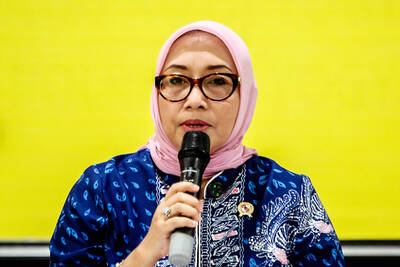
Indonesian police have arrested 13 people after shocking images of alleged abuse against small children at a daycare center went viral, sparking outrage across the nation, officials said on Monday. Police on Friday last week raided Little Aresha, a daycare center in Yogyakarta on Java island, following a report from a former employee. CCTV footage circulating on social media showed children, most younger than two, lying on the floor wearing only diapers, their hands and feet bound with rags. The police have confirmed that the footage is authentic. Police said they also found 20 children crammed into a room just 3m by 3m. “So
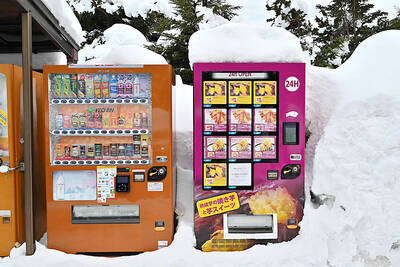
From post offices and parks to stations and even the summit of Mount Fuji, Japan’s vending machines are ubiquitous, but with the rapid pace of inflation cooling demand for their drinks, operators are being forced to rethink the business. Last month beverage giant DyDo Group Holdings announced it would remove about 20,000 vending machines — about 7 percent of their stock nationwide — by January next year, to “reconstruct a profitable network.” Pokka Sapporo Food & Beverage, based in Nagoya, also said last month it would sell its 40,000-machine operation to Osaka-based Lifedrink Co. “The strength of the vending machine
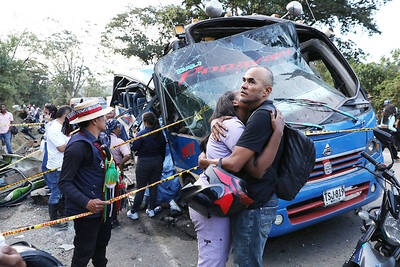
A highway bomb attack in a restive region of southwestern Colombia on Saturday killed 14 people and injured at least 38, the latest spate of violence ahead of next month’s presidential election. Authorities blamed the attack in the Cauca department — a conflict-ridden, coca-growing region — on dissidents of the now-disbanded FARC guerrilla army, who have been sowing violence across the country. “Those who carried out this attack ... are terrorists, fascists and drug traffickers,” Colombian President Gustavo Petro said on social media. “I want our very best soldiers to confront them,” he added. The leftist leader blamed the bombing


 RSS
RSS