


Indo-Canadian porn star Sunny Leone has happily reinvented herself as a Bollywood actress. While her past pursuits have been no barrier, being linked to India’s rape crisis represents a new challenge.
The 31-year-old became one of the most searched names on the Internet in India when she arrived in 2011 to appear in a reality TV series and has since taken several raunchy roles in mainstream movies.
As India casts around for reasons to explain a series of horrifying sex crimes, the latest being the kidnap and brutal rape of a five-year-old girl, pornography is under scrutiny and has led some to call for Leone to be jailed.

Photo: AFP
Recent events have galvanized anti-porn campaigners after it was revealed, via unnamed police officers quoted in local newspapers, that the suspects in the rape of the five-year-old had watched explicit material before the crime.
Aroused by video clips on their mobile phones, they allegedly abducted the girl in a working class area in eastern New Delhi and drunkenly raped her so violently she was left with life-threatening injuries.
The pornography claims coincide with a separate legal effort in the Supreme Court to introduce an outright ban on such material in India.
“Our children are accessing more and more graphic and brutal videos, and they are imitating them and we are suffering,” said Kamlesh Vaswani, a commercial lawyer who has petitioned the Supreme Court to demand a ban.
“Our laws are very vague in this area, so it can be corrected in the Supreme Court,” he said ahead of the next hearing in the case, set for Monday.
Two Indian laws already outlaw the distribution or creation of obscene material, with the Information Technology Act (2000) prescribing up to five years in jail for anyone caught publishing “lascivious” material.
However, because most of the pornography accessed in India is on sites outside the jurisdiction of prosecutors and viewed in the privacy of homes or on mobile phones, convictions are rare and the restrictions are largely meaningless.
“It is technically possible to ban it,” said 41-year-old Vaswani, who has a 10-year-old son at home in the central city of Indore. “They need to have some expert help from the IT sector.”
He blames Leone, star of X-rated hits including Sunny’s Slumber Party, for bringing adult material in India to a wider audience.
“She deserves to go to jail if she continues to promote pornography,” he added.
Appearing in a debate on Monday night on the Headlines Today news channel, Leone defended her dual career as porn star and actress, and dismissed fears that adult material was linked to sex crime.
“Pornography is not for people who think it’s for real. It’s fantasy and it’s entertainment,” she said, dressed in a full-length yellow outfit revealing only her lower arms. “It’s complete nonsense to blame rape on adult material out there. Education starts at home. It’s mums and dads sitting with their children, and teaching them what is right and wrong.”
Fellow star John Abraham also defended her, saying those seeking to blame pornography for rapes were missing the root cause of the problem in India — social attitudes to women and a lack of education.
“By banning something, you’re not going to solve the problem. The world over, people have access to porn. Are there rape cases like this [of the five-year-old] that exist the world over? No. Did rape cases exist before porn came into being? Yes,” he said.
The debate about links between pornography and sex crime mirrors other largely unresolved controversies globally about whether violent video games cause gun crime or if gangster rap encourages anti-social behavior.
Some experts deny any link, pointing to stable or declining incidences of rape in some countries where pornography has gone from scarcity to ubiquity in the past 15 years, thanks to its availability on the Internet.
Others say the Internet provides a forum for criminally minded perverts to meet and vocalize their darkest desires. It also creates an industry that produces ever more depraved and damaging material.
The Supreme Court ruling in India will set a new legally binding precedent and could force the government to find a way to ban one of the most searched for subjects on Google.
“In terms of the larger debate, whether porn leads to violence, I don’t think anyone should have a knee-jerk reaction and say it does,” Indian Deputy IT Minister Milind Deora said on Tuesday. “We are a liberal society and we don’t want to get into the space of censoring content.”

Kouri Richins, a Utah mother who published a children’s book about grief after the death of her husband is to serve a life sentence for his murder without the possibility of parole, a judge ruled on Wednesday. Richins was convicted in March of aggravated murder for lacing a cocktail given to her husband, Eric Richins, with five times the lethal dose of fentanyl at their home near Park City in 2022. A jury also found her guilty of four other felonies, including insurance fraud, forgery and attempted murder for trying to poison her husband weeks earlier on Feb. 14, 2022, with a

DELA ROSA CASE: The whereabouts of the senator, who is wanted by the ICC, was unclear, while President Marcos faces a political test over the senate situation Philippine authorities yesterday were seeking confirmation of reports that a top politician wanted by the International Criminal Court (ICC) had fled, a day after gunfire rang out at the Philippine Senate where he had taken refuge fearing his arrest. Senator Ronald “Bato” dela Rosa, the former national police chief and top enforcer of former Philippine president Rodrigo Duterte’s “war on drugs,” has been under Senate protection and is wanted for crimes against humanity, the same charges Duterte is accused of. “Several sources confirmed that the senator, Senator Bato, is no longer in the Senate premises, but we are still getting confirmation,” Presidential

HELP DENIED? The US Department of State said that the Cuban leadership refuses to allow the US to provide aid to Cubans, ‘who are in desperate need of assistance’ US Secretary of State Marco Rubio on Wednesday said that Cuba’s leadership must change, as Washington renewed an offer of US$100 million in aid if the communist nation agrees to cooperate. Cuba has been suffering severe economic tumult led by an energy shortage that plunged 65 percent of the country into darkness on Tuesday. Cuba’s leaders have blamed US sanctions, but Rubio, a Cuban American and critic of the government established by Fidel Castro, said the system was to blame, including corruption by the military. “It’s a broken, nonfunctional economy, and it’s impossible to change it. I wish it were different,” he told
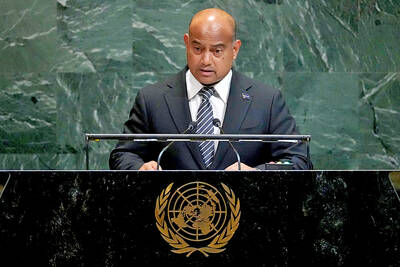
Nauru said it would hold a referendum to change its official name, described as a colonial relic from a time when “foreign tongues” mangled the native language. Nauru would change its name to Naoero to “more faithfully honor our nation’s heritage, our language and our identity,” Nauruan President David Adeang said in a statement on Tuesday. The Pacific island nation’s native language is Dorerin Naoero, which is spoken by the vast majority of its approximately 10,000 inhabitants. “Nauru emerged because Naoero could not be properly pronounced by foreign tongues, and was changed not by our choice, but for convenience,” the government said in


 RSS
RSS