


The tiny Himalayan country of Bhutan began electing a new parliament yesterday for only the second time in its history, five years after the Buddhist monarchy gave up its absolute power.
Voters were to first choose members of the upper house National Council yesterday, a non-party body, then in the following weeks will decide which of five parties will form the next government in the Bhutanese National Assembly.
Since the beginning of this month, the 67 candidates for the 20 elected National Council seats — five more members will be appointed by King Jigme Khesar Wangchuck — have been holding debates and public meetings in their respective districts after a local selection process.
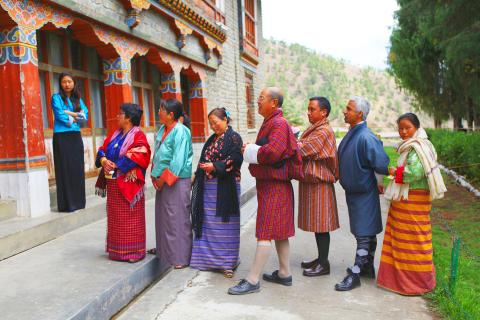
Photo: AFP
In the more remote areas, villagers have walked for hours, or even days, to attend the forums and question the candidates at first hand, and election staff have made similar long treks to set up and staff polling stations in hamlets inaccessible by road.
Election officials made a fourth attempt on Monday to reach Lunana in the far north by means of Indian military helicopters after bad weather frustrated the first three tries.
Yesterday was declared a public holiday and Bhutan’s land borders will be closed for 24 hours over the election period.
While interest is reported to be high, confusion persists about parliament’s role in a hierarchical country with an illiteracy rate of about 50 percent, where for decades, the monarchy’s word has been law and is still deeply revered.
There have also been grumblings about the obligation for the candidates to make their pitches in the national language, Dzhonka, which is one of half a dozen tongues spoken in Bhutan and not well understood in many rural areas.
The Bhutanese National Council, whose members have no party affiliation, monitors the actions of the government, reviews legislation and advises the king. It can also propose laws itself, provided they are not financial.
With an electorate of less than 400,000 and the use of electronic voting machines, results will be declared soon after the polls close, but will be no pointer to the National Assembly elections, whose dates have not yet been announced.
The center-right Druk Phuensum Tshogpa (DPT) party of Bhutanese Prime Minister Jigmi Thinley has governed Bhutan since winning a massive landslide victory in 2008. It took 45 of the 47 seats in the house against the People’s Democratic Party (PDP).
This time round, three new parties are in the fray, two of them led by women, but there is little between them in their center-left stance and the requirement that all candidates must be graduates has caused them problems in their hunt for recruits.
Opinion polls are banned in Bhutan and analysts are thin on the ground, but the DPT is not expected to repeat its massive triumph of 2008. The country known abroad for its high-end tourism and unique yardstick of Gross National Happiness has seen huge development under the DPT government, but a wide income gap, youth unemployment and delinquency and urban migration are among the main issues expected to figure in the campaign.
The DPT also faces seeing key figures barred from standing, with Bhutanese Home Affairs Minister Minjur Dorji and Bhutanese National Assembly Speaker Jigme Tshultim appealing against recent convictions for corruption in a land allocation case dating back to before the last elections.
If their appeals are not heard, or not upheld, before the elections, the party will have to find new candidates. Bhutanese Information and Communications Minister Nandalal Rai could also be excluded for the alleged mishandling of large contracts for domestic airports.

‘CROSSING THE LINE’: China’s embassy in Seoul criticized US Forces Korea Commander General Xavier Brunson, asking if his ‘hostile’ remarks were authorized by Washington South Korea and the US are in talks over recent public remarks by the commander of US Forces Korea, Seoul’s presidential office said yesterday, after the comments drew sharp criticism from China. In a recent podcast interview, US Forces Korea Commander General Xavier Brunson described South Korea as “the dagger in the heart of Asia” from China’s east coast, prompting the Chinese embassy in Seoul to say that he had “truly crossed the line.” The interview came amid growing speculation that Washington might seek to expand the role of US Forces Korea in countering the growing regional influence of China, a key

Through the noise of rushing papers and whirring belts at a print factory in Kyoto, two creators watch their photo essay come to life in broadsheet form — part of an effort to win new audiences in the age of artificial intelligence (AI). Despite the decline of the publishing industry, self-publication and handmade “zine” magazines are growing in popularity in Japan, reflecting the nation’s enduring love of paper in the digital era. While speaking to Agence France-Presse at the plant, his hands black with ink, one of the creators, Kazuma Obara, said: “I think [paper] is a medium that engages all five

Australian researchers have trained lab-grown brain cells on a silicon computer chip to play the 1990s shooter game Doom and said they are just scratching the surface of what the neurons could be capable of doing. It is the science-fiction work of biotech boffins at Cortical Labs, who researched and developed the technology that harnesses the workings of the brain’s networking system. Each so-called “biological computer” contains about 200,000 living human brain cells, grown from stem cells that were harvested from blood donations. Having mastered the simple computer game Pong, where a paddle is moved up and down to send a ball

A surprising gut feeling may help pigeons find their way home. Animals use various techniques to navigate, including following the stars and remembering key landmarks. Birds, fish and turtles orient themselves using Earth’s magnetic field as a compass, but it is not yet clear how exactly they do this. Pigeons are a well-known group of frequent flyers that can traverse hundreds of kilometers in a single day. For thousands of years, humans have used them to carry news, notes and military messages. Scientists have long tried to untangle how pigeons travel without getting lost. Some think the birds detect magnetic cues using light-sensitive


 RSS
RSS