


A southern Philippine town plans to hold funeral rites for the world’s largest saltwater crocodile and then preserve its remains in a museum to keep tourists coming and prevent their community from slipping back into obscurity, the town’s mayor said yesterday.
The 1-tonne crocodile was declared dead on Sunday a few hours after flipping over with a bloated stomach in a pond in an ecotourism park in the town of Bunawan, which had started to draw tourists, revenue and development because of the immense reptile, Mayor Edwin Cox Elorde said.
“The whole town, in fact the whole province, is mourning,” Elorde said from Bunawan in Agusan del Sur province. “My phones kept ringing because people wanted to say how affected they are.”
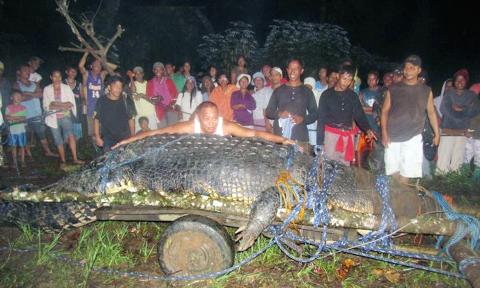
Photo: AFP
Guinness World Records had proclaimed it the largest saltwater crocodile in captivity last year, measuring the giant at 6.17m. The reptile took the top spot from an Australian crocodile that measured more than 5m and weighed nearly a tonne.
The crocodile was named Lolong, after a government environmental officer who died from a heart attack after traveling to Bunawan to help capture the beast. The crocodile, estimated to be more than 50 years old, was blamed for a few brutal deaths of villagers before Bunawan folk came to love it.
The giant reptile has come to symbolize the rich biodiversity of Agusan marsh, where it was captured. The vast complex of swamp forests, shallow lakes, lily-covered ponds and wetlands is home to wild ducks, herons and threatened species like the Philippine hawk eagle.
Wildlife experts were to perform an autopsy yesterday to determine the cause of its death, Elorde said.
Bunawan villagers planned to perform a tribal ritual, which involves butchering chicken and pigs as funeral offerings to thank forest spirits for the fame and other blessings the crocodile has brought, Elorde said. A group of Christians would separately offer prayers before the autopsy.
The rites would be held at the ecotourism park, where the reptile had emerged as a star attraction, drawing foreign tourists, scientists and wildlife reporting outfits like the National Geographic to Bunawan, a far-flung town of 37,000 people.
The crocodile’s capture in September 2011 sparked celebrations in Bunawan, but it also raised concerns that more giant crocodiles might lurk in a marshland and creek where villagers fish. The crocodile was captured with steel cable traps during a hunt prompted by the death of a child in 2009 and the later disappearance of a fisherman. Water buffalos have also been attacked by crocodiles in the area.
About 100 people led by Elorde pulled the crocodile from a creek using a rope and then hoisted it by crane onto a truck.
Philippine officials had planned to construct a road to the park to accommodate the growing number of tourists, Elorde said, adding that he planned to have the crocodile preserved and placed in a museum so Bunawan villagers and tourists could still marvel at it.

An American scientist convicted of lying to US authorities about payments from China while he was at Harvard University has rebuilt his research lab in Shenzhen, China, to pursue technology the Chinese government has identified as a national priority: embedding electronics into the human brain. Charles Lieber, 67, is among the world’s leading researchers in brain-computer interfaces. The technology has shown promise in treating conditions such as amyotrophic lateral sclerosis and restoring movement in paralyzed people. It also has potential military applications: Scientists at the Chinese People’s Liberation Army have investigated brain interfaces as a way to engineer super soldiers by boosting
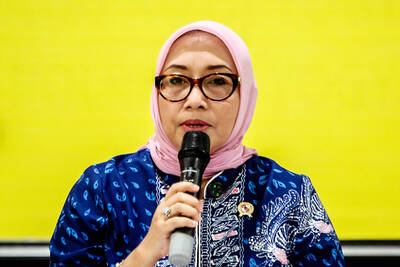
Indonesian police have arrested 13 people after shocking images of alleged abuse against small children at a daycare center went viral, sparking outrage across the nation, officials said on Monday. Police on Friday last week raided Little Aresha, a daycare center in Yogyakarta on Java island, following a report from a former employee. CCTV footage circulating on social media showed children, most younger than two, lying on the floor wearing only diapers, their hands and feet bound with rags. The police have confirmed that the footage is authentic. Police said they also found 20 children crammed into a room just 3m by 3m. “So
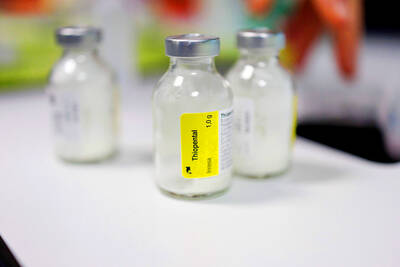
A grieving mother has ended her life at a clinic in Switzerland four years after the death of her only child. Wendy Duffy, 56, a physically healthy woman, died at the Pegasos clinic in Basel after struggling to cope with the death of her 23-year-old son, Marcus. The former care worker, from the West Midlands, England, had previously attempted to take her own life. The case comes as assisted dying would not become law in England and Wales after proposed legislation, branded “hopelessly flawed” by opponents, ran out of time. Ruedi Habegger, the founder of Pegasos, described Duffy’s death as
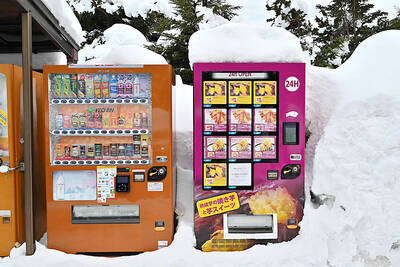
From post offices and parks to stations and even the summit of Mount Fuji, Japan’s vending machines are ubiquitous, but with the rapid pace of inflation cooling demand for their drinks, operators are being forced to rethink the business. Last month beverage giant DyDo Group Holdings announced it would remove about 20,000 vending machines — about 7 percent of their stock nationwide — by January next year, to “reconstruct a profitable network.” Pokka Sapporo Food & Beverage, based in Nagoya, also said last month it would sell its 40,000-machine operation to Osaka-based Lifedrink Co. “The strength of the vending machine


 RSS
RSS